
How much does it cost to build an AI agent in 2026?
If you are asking what an AI agent costs, you are probably about to get the wrong answer. Not because the price ranges online are wrong, but because the build price is the least useful number in the whole decision.
Here is the number that actually matters: what your manual process is costing you right now, every week, in people's time, slow turnaround, and work that never gets done. An AI agent is not an expense to minimize. It is a trade. You spend a one-time build and a running cost, and in return you take a repetitive process off your team for good. Whether that trade is worth it depends entirely on what you are trading it for.
This guide is for founders and operations leaders seriously weighing that trade, not collecting quotes to file away. You will get the real build ranges, the pricing models, the ongoing costs most quotes hide, and a simple way to estimate your own number. But we start where the decision actually starts, with the transformation, not the price tag.
The number most cost guides ignore
Every AI agent cost article hands you a price menu. Almost none give you the one comparison that decides everything: the cost of the agent against the cost of staying manual.
Picture the process today. Someone on your team copies data between systems, answers the same questions, or chases updates for hours every week. Now picture it after. The agent does that quietly in the background, and your people spend those hours on work only they can do. The distance between those two pictures is the real return, and it is almost always bigger than the build price.
A 60,000 dollar agent that removes 30 hours of manual work a week pays for itself in a single quarter. That same 60,000 dollars spent automating something nobody really does is a waste at any price. So before you compare a single quote, put a rough number on what the current way is costing you. That one figure reframes every number in this article, and it is the difference between an investment and an expense.
If you want a structured way to map where AI fits in your product and what it is worth before you spend anything, our free SaaS AI Blueprint walks founders through exactly that. It is a short download, no sales call required.
The AI agent market in 2026, and why cost is on every roadmap
AI agents have moved from experiment to line item. The global AI agent market was worth about 7.6 billion dollars in 2025, grew to roughly 10.9 billion dollars in 2026, and is projected to reach 182.9 billion dollars by 2033, according to Grand View Research. That is compound growth near 45 percent a year, one of the fastest of any software category.
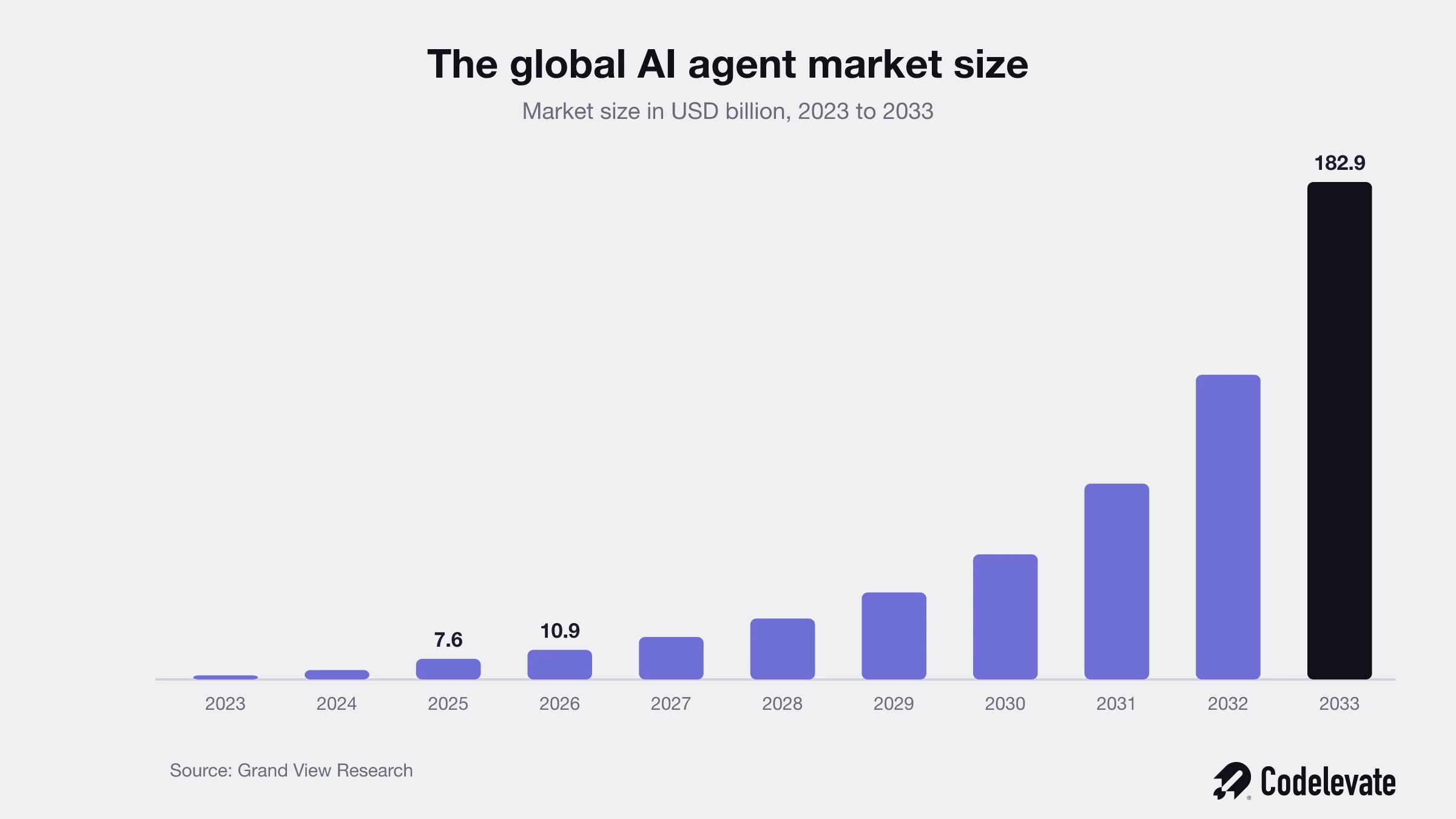
Two things follow from a market growing that fast. First, the tools, models, and talent are maturing quickly, which steadily lowers the cost of building a capable agent. What cost 200,000 dollars to build two years ago can cost a fraction of that today, because the hard parts are increasingly handled by mature frameworks and cheaper models. Second, your competitors are already moving, so the question is less whether to invest and more how to invest without overspending.
Adoption is broad but still early, which is exactly why budgets are under pressure now. McKinsey's State of AI research shows organizations experimenting with or piloting AI agents across knowledge management, marketing and sales, IT, service operations, and software engineering, while most functions still have only a small share running them at scale.
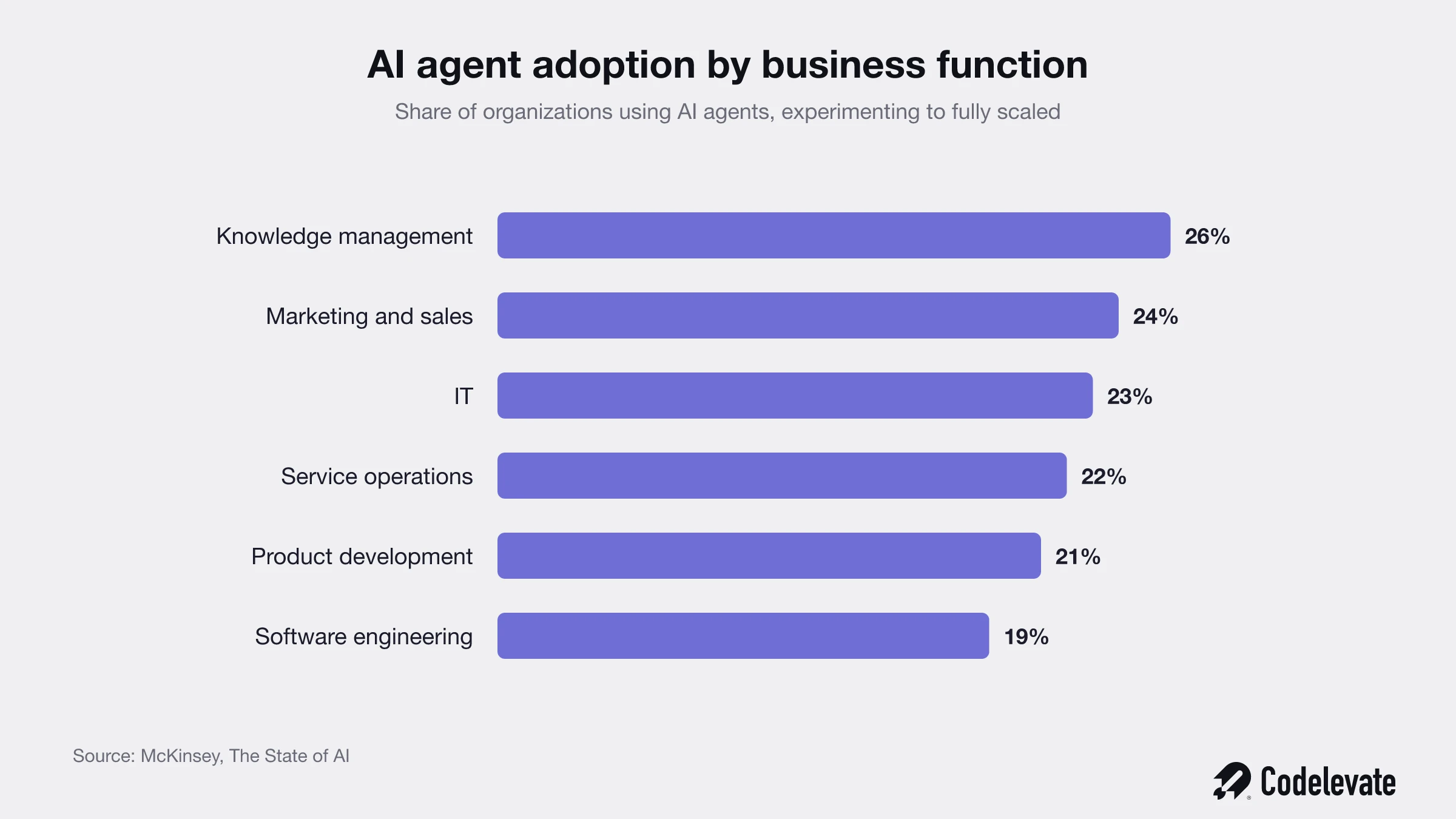
The pattern is consistent. Plenty of teams are trying agents, far fewer have them in production, and the gap between the two is almost always cost and complexity. The companies that close that gap are the ones that treated cost as a plan, not a surprise. That is the gap this guide is here to close.
How much does it cost to build an AI agent?
The honest answer is that it depends on complexity, but the ranges are clearer than most vendors admit. Here is how AI agent build costs break down in 2026.
- Simple, single-task agent: 15,000 to 50,000 dollars. One job, predictable inputs, light integration. Think an FAQ assistant, a meeting scheduler, or a basic lead qualifier.
- Mid-tier workflow agent: 50,000 to 150,000 dollars. Real reasoning, custom logic, and integration with your live systems. Most business-critical agents land here.
- Complex multi-agent system: 150,000 to 400,000 dollars and up. Several agents working together with orchestration, compliance, and many integrations.
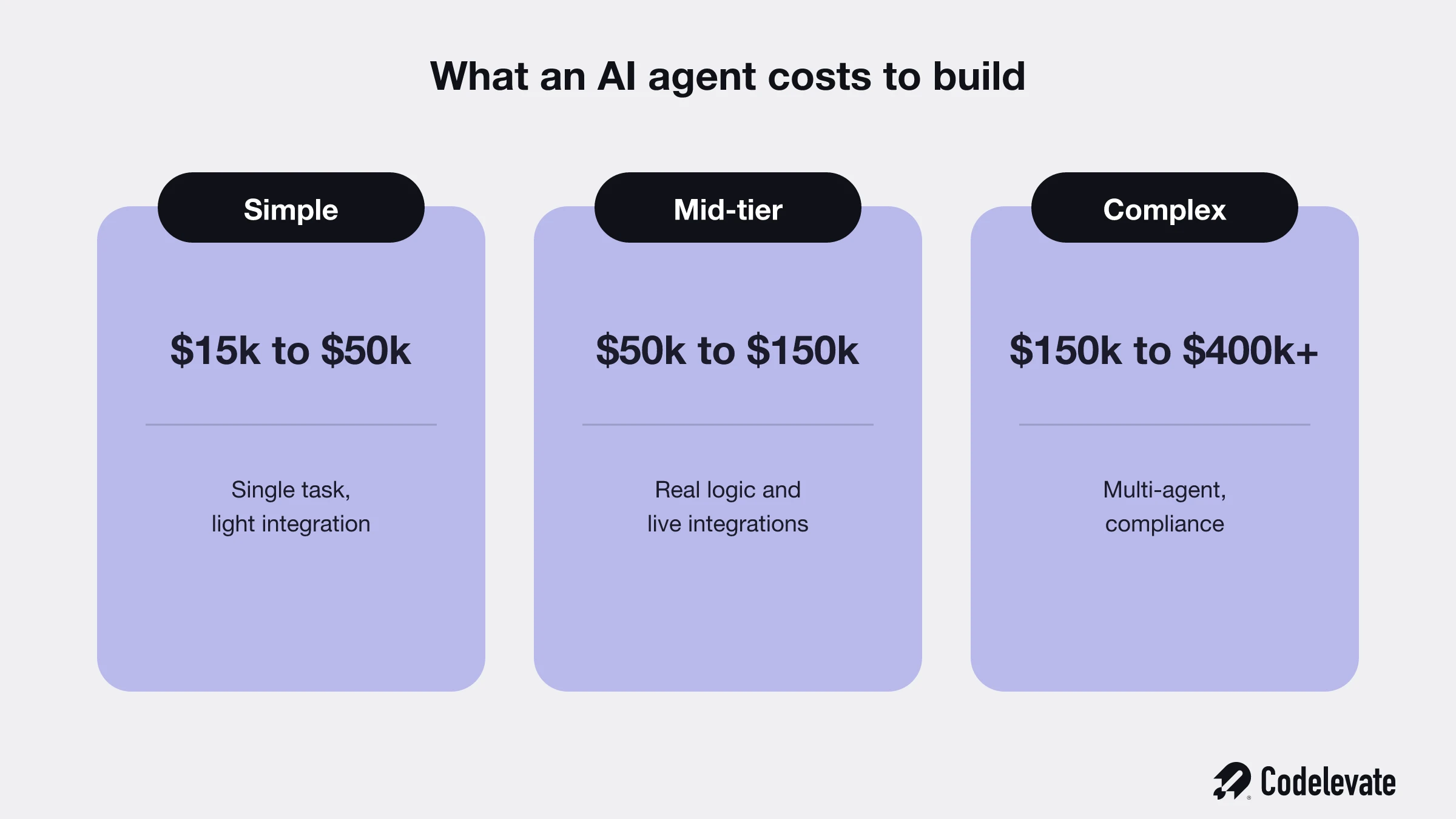
Most mid-market builds settle between 40,000 and 150,000 dollars. The range is wide because two agents with the same one-line description can need very different amounts of engineering underneath. An FAQ bot that reads a help center is cheap. An FAQ bot that has to pull a customer's live order status from three systems and stay compliant is not.
A useful way to read these numbers: the more the agent has to touch your real systems and the higher the cost of a mistake, the further up the range you land. A draft-only assistant is cheap. An agent that takes actions in systems where errors cost money is not, because the testing and guardrails around it are where much of the work goes.
AI agent pricing models in 2026
The same agent can be quoted in very different ways, and the pricing model affects your total cost as much as the build itself. These are the models you will most often see.
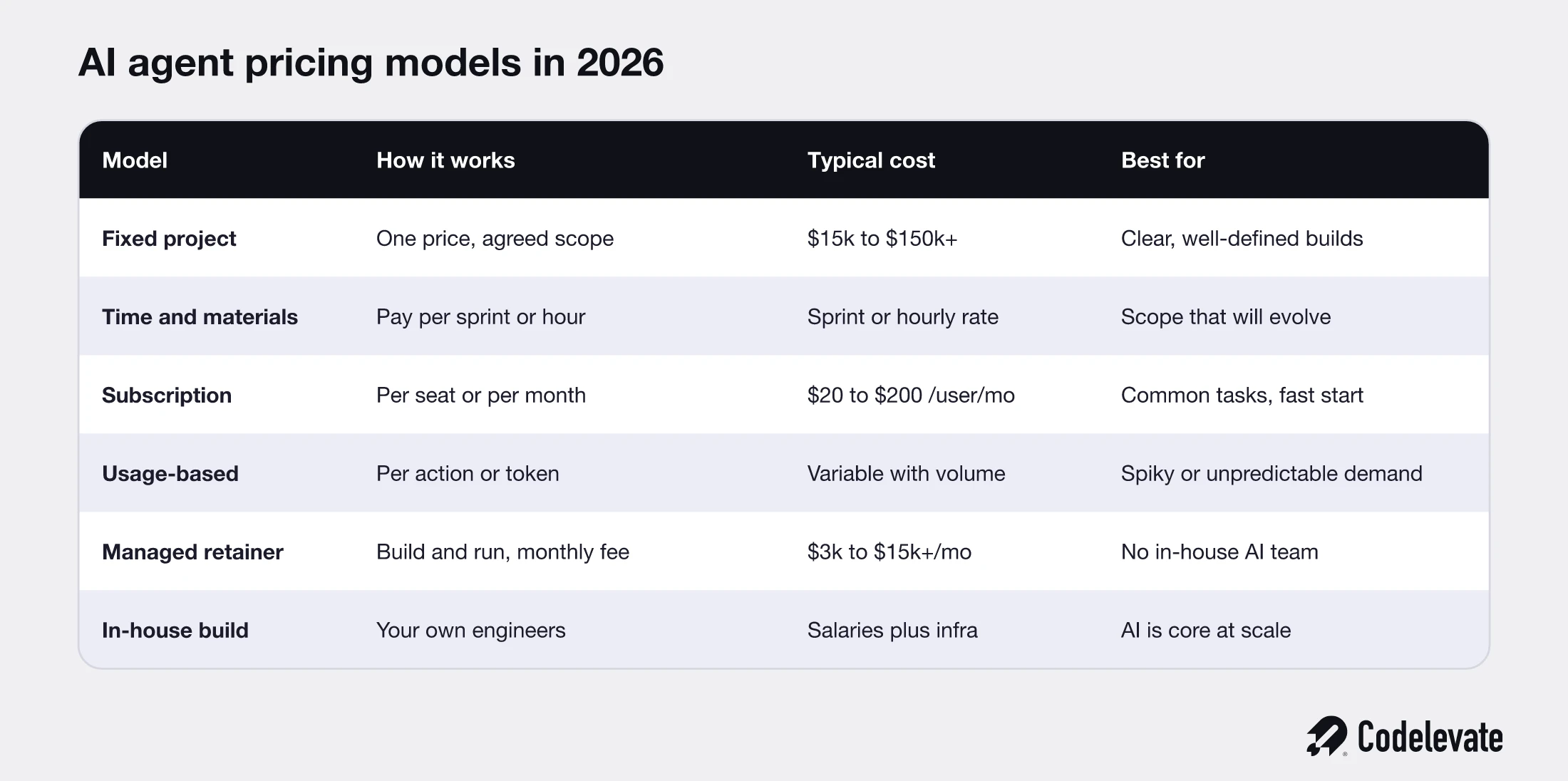
No single model is cheapest. A fixed price protects you from overruns but assumes you know the scope. Usage-based looks cheap until volume climbs. A subscription is the fastest start but can cost more than a custom build once you have many users. The right model depends on how clear your scope is and how predictable your volume will be, so decide those two things before you compare quotes.
What you are actually paying for
The model is rarely the expensive part. Most of the budget goes into making the agent work safely inside your business.
- Integration engineering. Connecting the agent to your CRM, database, and internal tools is usually the single biggest line item.
- QA and safety testing. Making sure the agent behaves on the messy real cases, not just the demo path.
- Data preparation. Getting your data clean, accessible, and structured enough for the agent to use.
- The agent logic itself. Prompts, tools, reasoning steps, and guardrails.
- Infrastructure and monitoring. The plumbing that keeps it running and observable.
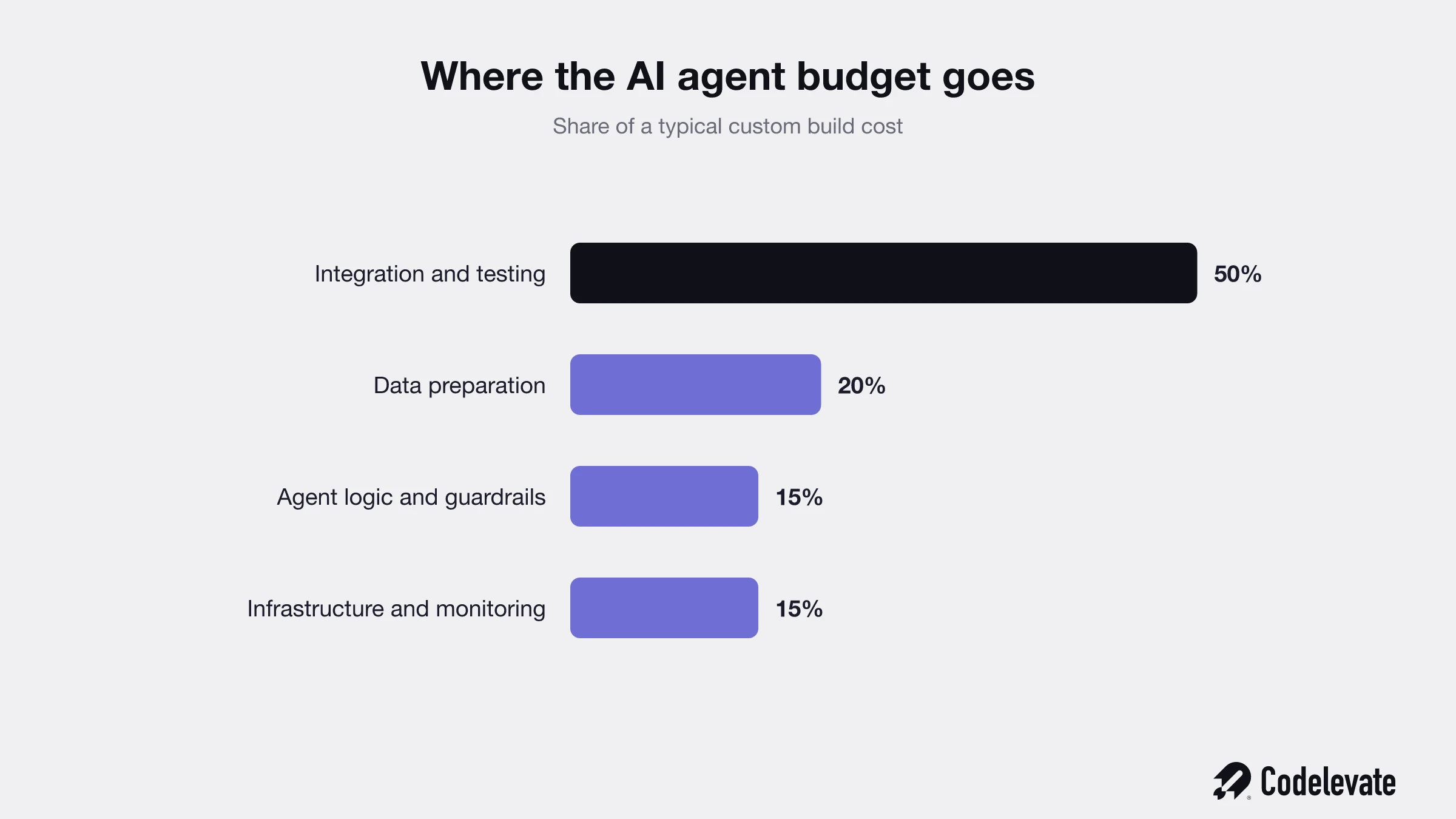
For most enterprise builds, integration and testing alone account for 40 to 60 percent of the total. That is why a simple agent on top of a complicated system can still be expensive, and why the cleanest way to lower cost is to narrow what the agent has to touch. The model that powers the reasoning is often the smallest line on the invoice. If a quote is mostly about the model and barely mentions integration and testing, it is probably underestimating the real work.
The ongoing costs most quotes leave out
A build price is only half the story. Running an AI agent in production is a recurring cost, and it is the line item teams underestimate most.
- Monthly run cost. Budget roughly 3,200 to 13,000 dollars a month for a production agent serving real users, covering model usage, infrastructure, and monitoring.
- Maintenance. Expect 15 to 30 percent of the build cost every year to keep the agent accurate and up to date as your data, tools, and the underlying models change.
- Total cost of ownership. First-year costs often run 40 to 80 percent higher than the build price once running and upkeep are included.
Model choice drives a lot of this. LLM API prices vary enormously between models, and smart model routing and caching can cut running costs sharply, in some cases removing the model cost entirely for a large share of repetitive traffic. Sending every request to the most powerful and most expensive model is the most common way teams overspend after launch. Picking the right-sized model for each task is one of the highest-leverage cost decisions you will make.
The takeaway is simple. Ask any vendor for the monthly running cost, not just the build price, and treat a quote that ignores it as incomplete.
Red flags in an AI agent quote
Because the market is young, quotes vary wildly in quality. A few warning signs that a number is not to be trusted:
- No running cost. A build price with no monthly estimate is half a quote. The running cost is where the long-term spend lives.
- Vague scope. If the quote does not say which systems the agent integrates with, it cannot be accurate, because integration is the biggest driver.
- Model-first thinking. A proposal that leads with the model and barely mentions testing and guardrails has the cost backwards.
- No success metric. If nobody can say how you will measure whether the agent worked, you cannot tell whether any price was worth paying.
- Agent washing. Some vendors rebrand a basic chatbot as an agent and price it like one. Ask exactly what it can do on its own before you pay agent prices.
Build vs buy: which approach fits your budget?
This is the decision that moves your budget the most, so it is worth slowing down on. The cost answer is rarely the same as the gut answer.
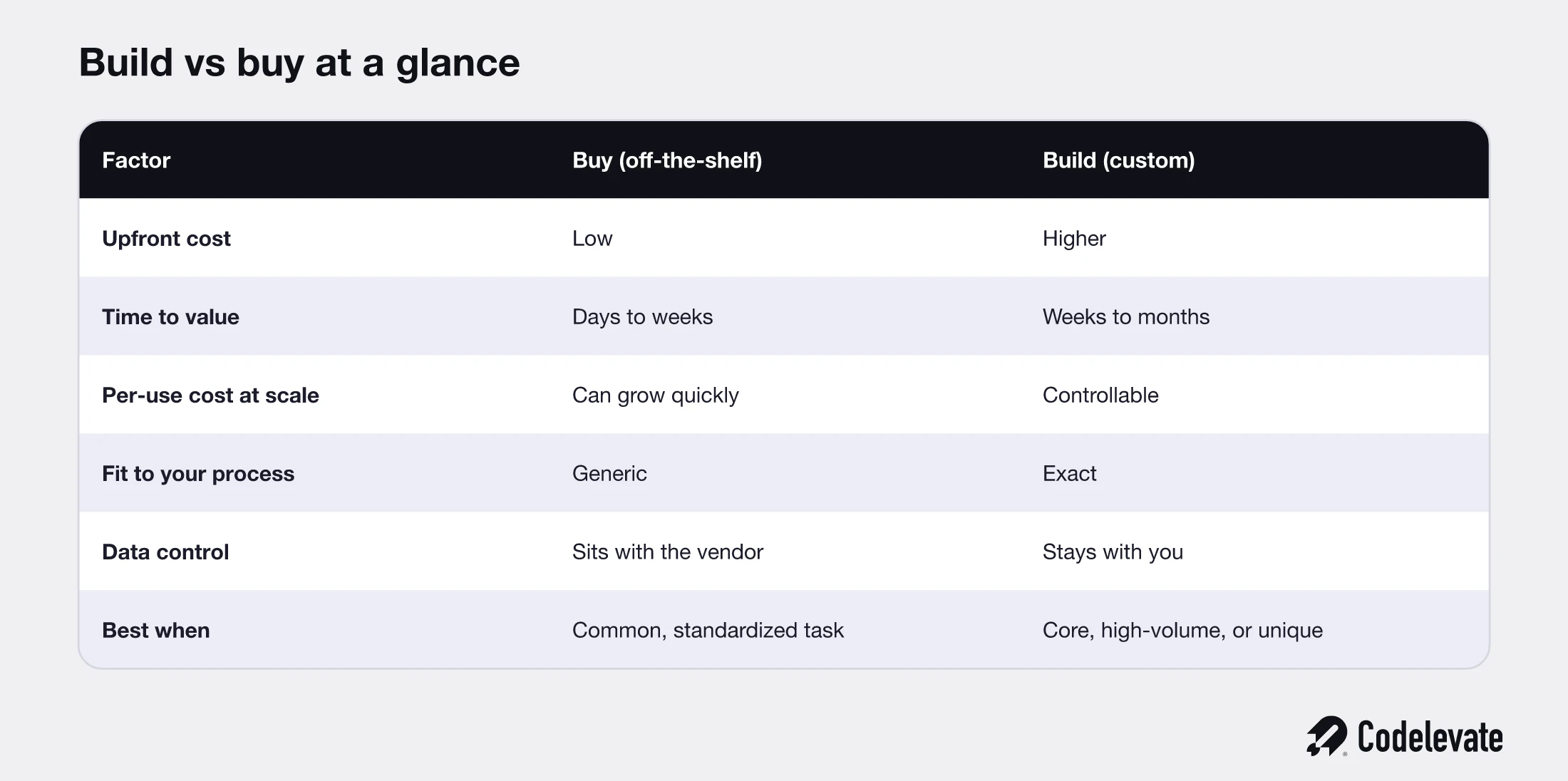
Buying is usually cheaper to start. You pay a subscription, you skip the engineering, and you get value quickly for common tasks like scheduling, support deflection, or note taking. For many teams that is the right first move.
Building usually wins on cost over the long run when the process is core to how you compete, high in volume, or unique enough that no generic tool fits. You trade a higher upfront cost for control over behavior, data, and per-use cost as you scale. Consider a support agent quoted at 40 dollars per seat per month for 80 agents. That is 38,400 dollars a year, every year, and it climbs as you grow. A custom build at 90,000 dollars looks expensive next to one year of that subscription, but cheaper across three, and you own it. The crossover point is where the build vs buy decision really lives.
A simple rule helps. If the task is common and your volume is modest, buy. If the task is central to your business and your volume is large or growing, build. If you are somewhere in between, buy first to learn, then build once you know exactly what you need. The deeper version of this decision, beyond just cost, is in our guide on how to choose the right AI agent for your process automation.
A simple way to estimate your AI agent cost
You can get to a realistic number before you ever talk to a vendor. Work through these five questions.
- What is the one job? A single, well-defined task sits at the low end of the range. A broad assistant that does many things sits at the high end.
- How many systems does it touch? Count every tool the agent must read from or write to. Each integration adds cost, and this is usually the biggest driver.
- How risky is a mistake? An agent that drafts internal notes needs light testing. One that touches payments, health, or legal needs far more, which raises the price.
- What volume will it handle? Volume drives the running cost more than the build. Estimate conversations or actions per month so you can size the monthly bill, not just the build.
- Build, buy, or managed? Your answer here sets the pricing model and the shape of the cost over time.
As a worked example, a mid-market support agent that answers questions, reads order status from two systems, and escalates the hard cases is a mid-tier build, so 50,000 to 150,000 dollars to build and a few thousand a month to run. Knowing that band before any sales call changes the entire conversation. If you want to skip the manual math, our pricing calculator gives you a fast, transparent estimate based on scope, so you walk in already knowing the right ballpark.
How to keep AI agent costs down
- Start with a narrow pilot on one process, prove the value, then expand. Scope creep is the most expensive habit in AI projects.
- Right-size the model for each task and route smartly instead of sending everything to the most expensive one.
- Cache repetitive answers so you are not paying the model for the same question twice.
- Reuse your existing infrastructure and data pipelines where you can.
- Phase the rollout so spend follows proven results, not optimism.
- Track one clear success metric from day one, so you can tell whether the agent is earning its keep.
None of these are exotic. They are the difference between an agent that pays for itself and one that becomes a line item nobody can justify.
How Codelevate approaches AI agent cost
We start with your process and give you an honest estimate that includes the running costs, not just the build. Our AI development team scopes the work in stages, so you can prove value on a small budget before committing to the full build. That keeps the early risk low and the eventual decision based on real numbers rather than a hopeful slide.
If you would rather see a number first, our pricing calculator gives you a transparent starting estimate in a couple of minutes. From there, a short conversation is usually enough to turn that into a firm, staged plan.
The takeaway
The teams that win with AI agents are not the ones who found the cheapest build. They are the ones who knew what the transformation was worth before they spent a euro, then scoped narrowly and proved it on a small budget. Cost is only ever half of the equation. The other half is what staying manual is quietly costing you.
Three ways to take the next step: grab the free SaaS AI Blueprint to plan where AI fits, run your numbers through our pricing calculator, or book a free call and we will help you size it against the transformation you are actually after.

.svg)
.svg)


