
How much autonomy should your AI agent have? A practical framework for 2026
Most AI agent projects do not stall because the model is wrong. They stall because a person still has to check everything the agent does, and nobody put a price on that review time before the project was approved.
The pattern is familiar. The pilot works. The agent drafts the reply, matches the invoice, triages the ticket, and everyone agrees it is impressive. Then it meets the business, and a human sits in front of an approval queue all day clicking accept. The 60 percent time saving that justified the budget quietly becomes 15 percent. The agent is not the problem. The missing piece is an autonomy design: a deliberate decision about what this agent is allowed to do without asking.
This article is written for founders, CTOs, and operations leaders who are past the demo and now have to make that call in production. It is not a governance essay. It is the practical decision: which actions the agent takes alone, which ones it proposes for approval, which ones it must never touch, and how it earns more room over time. You will get a 5 level autonomy model, the 2 questions that set the level for any given action, a worked example with real numbers, the promotion gates an agent has to pass before you widen its permissions, and what the EU AI Act actually requires as of August 2026.
If you are still deciding whether to try AI at all, this will be too early to be useful. This is for teams that already have an agent working and now have to make it pay.
Key takeaways
• Autonomy is set per action, not per agent. One agent can be fully autonomous on 3 of its actions and blocked on a fourth.
• The 2 questions that decide the level: how expensive is it to reverse this action, and how long before someone notices it went wrong.
• Human review is not free. Price it at the loaded hourly cost of the person doing it, and put it in the business case before you approve the build.
• Approving everything is not safety. It creates rubber-stamping, where reviewers accept at 98 percent and stop reading, which is worse than no gate at all.
• Agents should earn autonomy through measured evidence, not through a manager's confidence. Set promotion gates and hold to them.
• Sampled review, where a person checks 5 percent of completed actions properly, usually catches more real errors than 100 percent review done at speed.
• Under the EU AI Act, high-risk systems must be designed so a person can understand, monitor, and stop them. The human oversight obligations become enforceable on 2 August 2026.
• Design the escalation path before you design the agent. It is the part that determines whether the project returns money.
Why the review queue is where AI agent ROI disappears
Every agent business case has an obvious line and a hidden one. The obvious line is the time the agent saves. The hidden one is the time a human spends supervising it, and in most projects that second line is never written down.
Work an example. A support agent handles 400 tickets a week and drafts a reply for each one. Writing a reply by hand took 6 minutes, so the raw saving looks like 40 hours a week. Then the deployment adds a rule: every draft is reviewed before it goes out. Review takes 90 seconds per ticket, because the person has to read the customer message to judge whether the reply is right. That is 10 hours a week of new work. The net saving drops to 30 hours, which is still good.
Now change one variable. The team decides that review means reading the full ticket history, not just the draft, because a wrong answer to an angry enterprise customer is expensive. Review becomes 4 minutes. That is 26.7 hours a week of review against 40 hours saved. The project now returns a third of what the slide said, and everyone is confused about why the numbers feel wrong.
Nothing about the agent changed. What changed was the oversight design, and oversight design is usually decided late, by whoever is most nervous, in a meeting with no cost model in the room.
This is the reframe worth holding onto: human review is a budget you spend, not a safety property you switch on. You have a finite number of review minutes per week. Spend them on the actions where a mistake actually costs something, and stop spending them where it does not.
Autonomy is a per-action decision, not a per-agent one
The most common design mistake is treating autonomy as a single dial on the whole agent. Teams ask whether they trust this agent and answer yes or no for everything it does. That is the wrong unit.
An agent is a bundle of actions with wildly different risk. Take a finance agent that processes supplier invoices. It reads the PDF, extracts line items, matches the invoice to a purchase order, flags mismatches, posts the entry to the ledger, and schedules the payment. Reading and extracting are free to get wrong, because the next step catches it. Posting to the ledger is annoying to reverse but recoverable. Scheduling a payment moves money out of the company.
Set one autonomy level for that agent and you either block the whole thing behind human approval, which wastes most of the value, or you let it run and you have handed payment authority to a language model. Split it by action and the answer becomes obvious: extract and match run alone, ledger posting runs alone with a daily sample check, payment above a threshold needs a person.
This is also how you avoid the trap where a single scary action holds the entire project hostage. In our experience the scary action is usually 2 to 5 percent of the volume. Isolate it, gate it properly, and let the other 95 percent run.
The 5 autonomy levels
Use a shared vocabulary so the conversation stops being about feelings. These 5 levels cover almost every production agent we have built or reviewed.
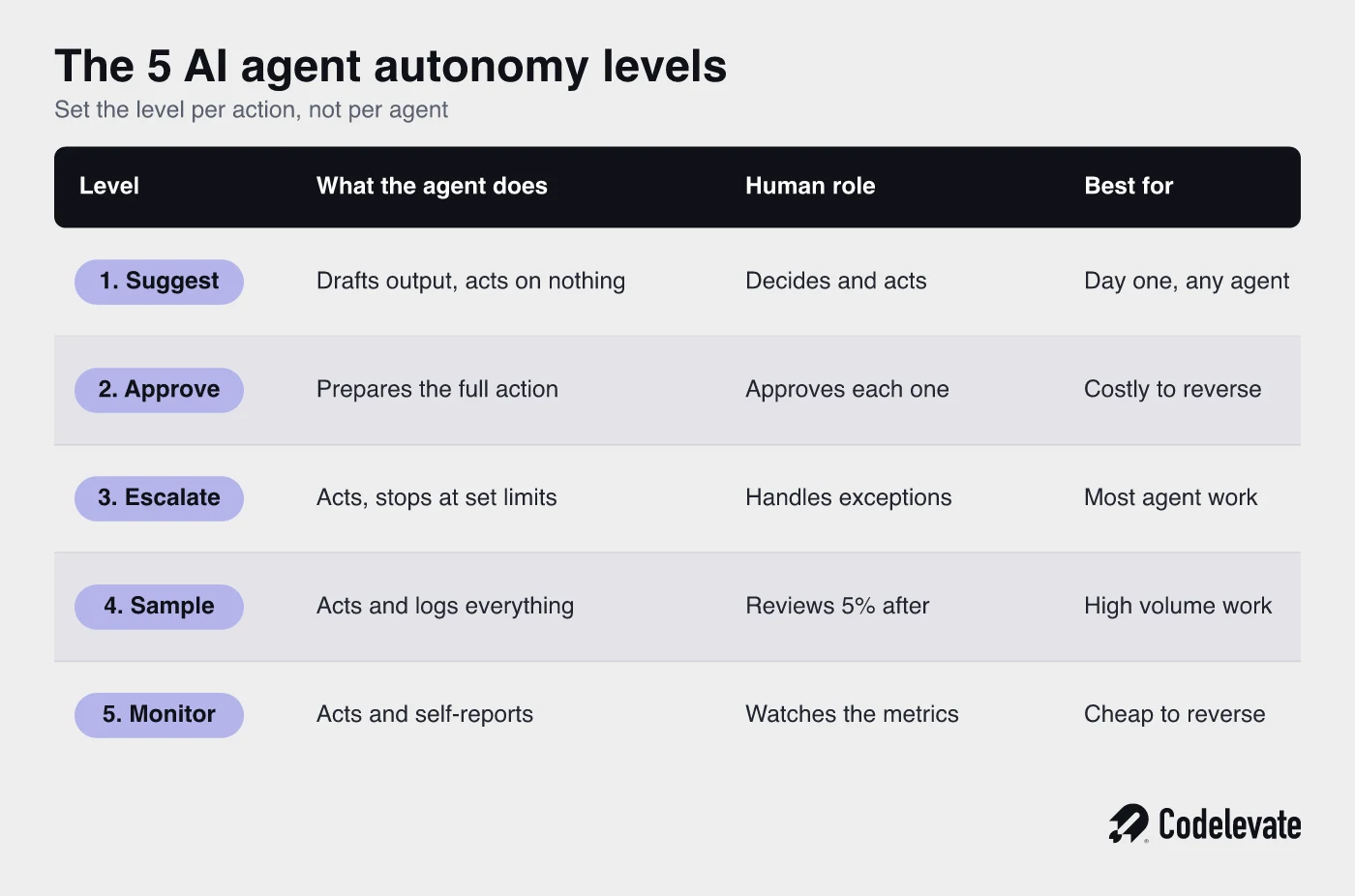
Level 1 is suggestion. The agent produces output and a human decides whether to use any of it. Nothing happens automatically. This is where every agent should start on day one, because it is how you gather evidence cheaply.
Level 2 is approval. The agent prepares the complete action, the human approves or rejects, and the system executes on approval. The important detail is that the human is approving a finished action, not editing a draft. If reviewers are rewriting output rather than approving it, the agent is not ready for level 2 and you are paying twice.
Level 3 is exception handling. The agent acts on its own and escalates only when a defined condition is hit: low confidence, an amount above a threshold, a customer tier, a missing field, a policy keyword. This is the level where most of the value sits, and it is the level most teams skip because it requires actually defining the exceptions.
Level 4 is sampled oversight. The agent acts and a human reviews a percentage of completed actions after the fact, plus everything the monitoring flags. Nobody is in the critical path. This suits high volume, low individual value actions where the cost of one error is small but a systematic error would hurt.
Level 5 is monitored autonomy. The agent runs and humans watch aggregate behaviour, error rates, and drift, intervening only when the numbers move. Reserve this for actions that are cheap to reverse and instantly visible when wrong.
Notice that the levels are not a maturity ladder you climb to reach the good one. Level 2 is the correct permanent answer for some actions and always will be. The goal is the right level per action, not the highest level everywhere.
The 2 questions that set the level
Skip the risk workshop. For any single action, 2 questions get you to the right level in about a minute.
1. What does it cost to reverse this action?
Not what does it cost if it is wrong. What does it cost to undo. A wrong internal summary costs nothing to reverse, you write a better one. A wrong ledger entry costs a correcting entry and an explanation to the accountant. A wrong email to 4,000 customers cannot be reversed at all, only apologised for. A wrong payment can sometimes be recalled and sometimes cannot.
Reversal cost is the better question because it maps to a real number and it separates actions that feel scary from actions that are actually expensive. Sending an internal Slack message feels risky the first time an agent does it. It costs nothing to reverse.
2. How long before someone notices?
Call this detection lag. An error a customer sees within 10 seconds has a lag of 10 seconds and a natural correction loop. An error that quietly misclassifies 200 records a day and surfaces at the quarterly close has a lag of 3 months, and by then you are not fixing one mistake, you are fixing 18,000.
Detection lag is the variable teams underestimate most, and it is the one that turns a small error rate into a real incident. A 2 percent error rate is fine when errors are caught the same day. The same 2 percent compounding silently for a quarter is a data cleanup project.
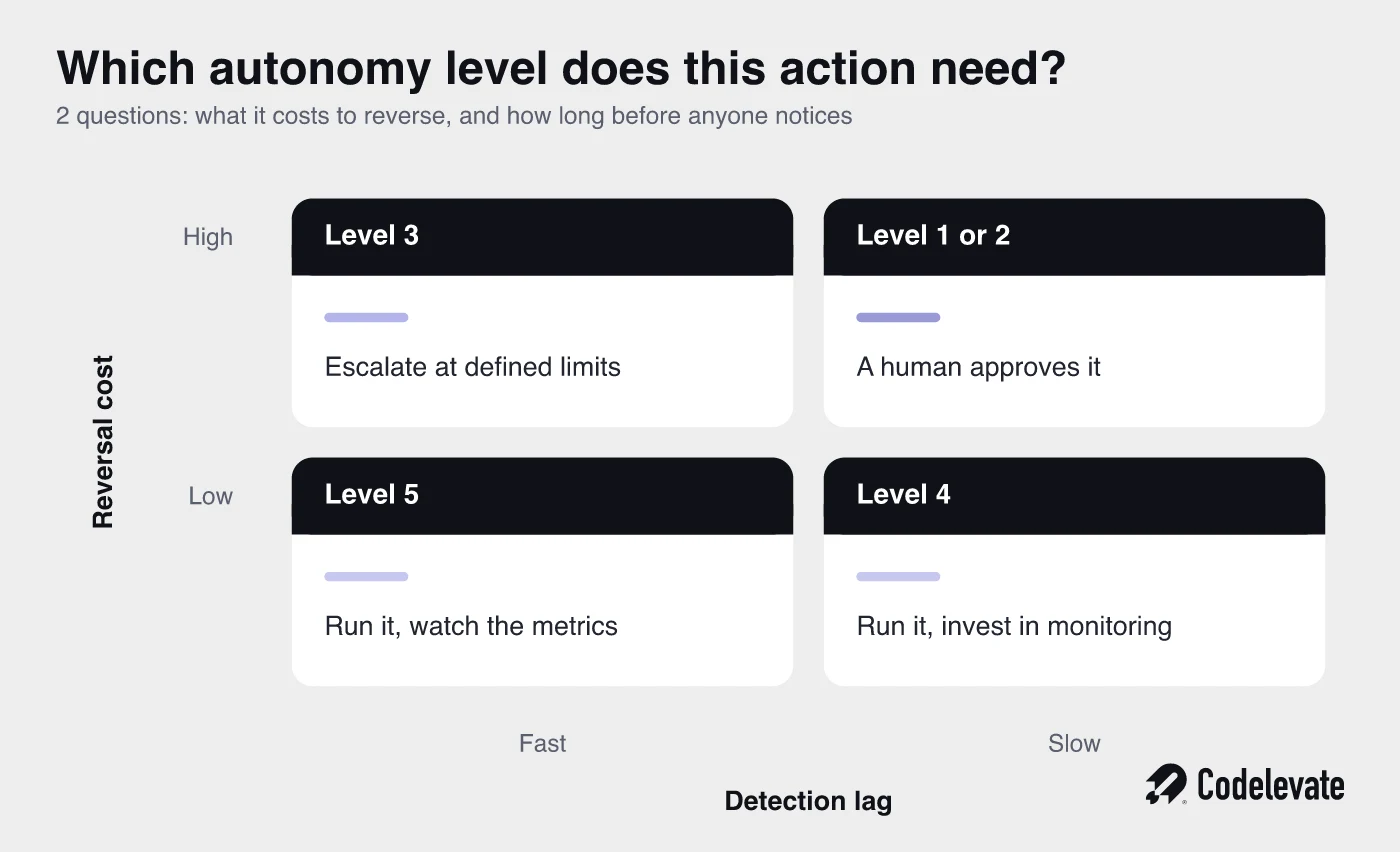
Putting the 2 together
Cheap to reverse and fast to detect means run it autonomously, level 4 or 5. Cheap to reverse but slow to detect means run it autonomously and invest in monitoring rather than approval, because a human clicking accept will not catch a slow drift either. Expensive to reverse but fast to detect means level 3 with tight exception rules, since you can afford some autonomy when mistakes surface immediately. Expensive to reverse and slow to detect is the only quadrant that genuinely needs level 1 or 2, and it is a much smaller share of the work than most teams assume.
That last point is the practical payoff. Once you place actions on this grid, the number of things that truly need a human in the critical path usually collapses to a short list, and your review budget goes where it earns its keep.
A worked example: claims triage at an insurer
Take a claims intake agent handling 1,200 claims a month. It does 5 things: read the submission, classify the claim type, check the policy is active, decide fast-track or manual assessment, and send the acknowledgement to the claimant.
Classification is cheap to reverse, an assessor changes the label in seconds, and errors surface within a day when the file lands on the wrong desk. Level 5, monitored.
The policy validity check reads from the policy system and produces a yes or no. Wrong answers are caught at the next step and cost nothing to reverse. Level 5.
Fast-track routing decides whether a claim skips human assessment and pays out. Expensive to reverse once money leaves, and a systematic error in the routing rule could take weeks to notice. Level 3 with hard boundaries: fast-track allowed under 500 euro, on claim types with a clean 12 month history, never on a policy flagged for fraud review. Everything outside that escalates.
The acknowledgement email is cheap to reverse in theory, since you can send a correction, but a wrong one goes to a person on a bad day and there is no unsend. Level 4: send automatically, sample 5 percent, and hold a manual gate for the 3 sensitive claim types.
The result is that roughly 88 percent of the workflow runs without a person in the critical path, the review effort concentrates on the 500 euro plus fast-track decisions, and the business case survives contact with production. Compare that to the default design, where the whole agent sat behind one approval queue and the team wondered why the savings never materialised.
If you are mapping your own workflow to this kind of split, our SaaS AI Blueprint walks through how to scope an AI build so the economics hold up before you commit engineering time. It is free and it covers the parts most vendor decks skip.
The failure nobody budgets for: rubber-stamping
Here is the uncomfortable part. A human approval gate only works if the human is actually reading. Put a person in front of 300 agent outputs a day and they will not be, by week 3.
The tell is an approval rate that climbs toward 99 percent and review time per item that drops below the time it physically takes to read the content. At that point the gate is theatre. It produces an audit trail that says a human checked, when what happened is a human clicked. The EU AI Act names this directly in its human oversight requirements: systems must help people stay aware of the tendency to over-rely on automated output, which is exactly the behaviour a high-volume approval queue creates.
This is why 100 percent review is often worse than sampled review. Reviewing 5 percent of items with 3 minutes each and a checklist catches real defects. Reviewing 100 percent at 8 seconds each catches almost nothing and costs 5 times more. If you are going to keep a human gate, measure it: track approval rate, time per review, and the rate at which reviewers actually change something. If reviewers reject less than 2 percent and spend under 15 seconds per item, you do not have oversight, you have a cost centre.
The honest fix is usually to move that action to level 3 or 4, define the exception rules that would have caught the real problems, and spend the recovered time on the exceptions properly.
How an agent earns more autonomy
Autonomy should be granted on evidence, not on how the last demo went. Set the promotion criteria before launch and write them down, because after launch the conversation gets political.
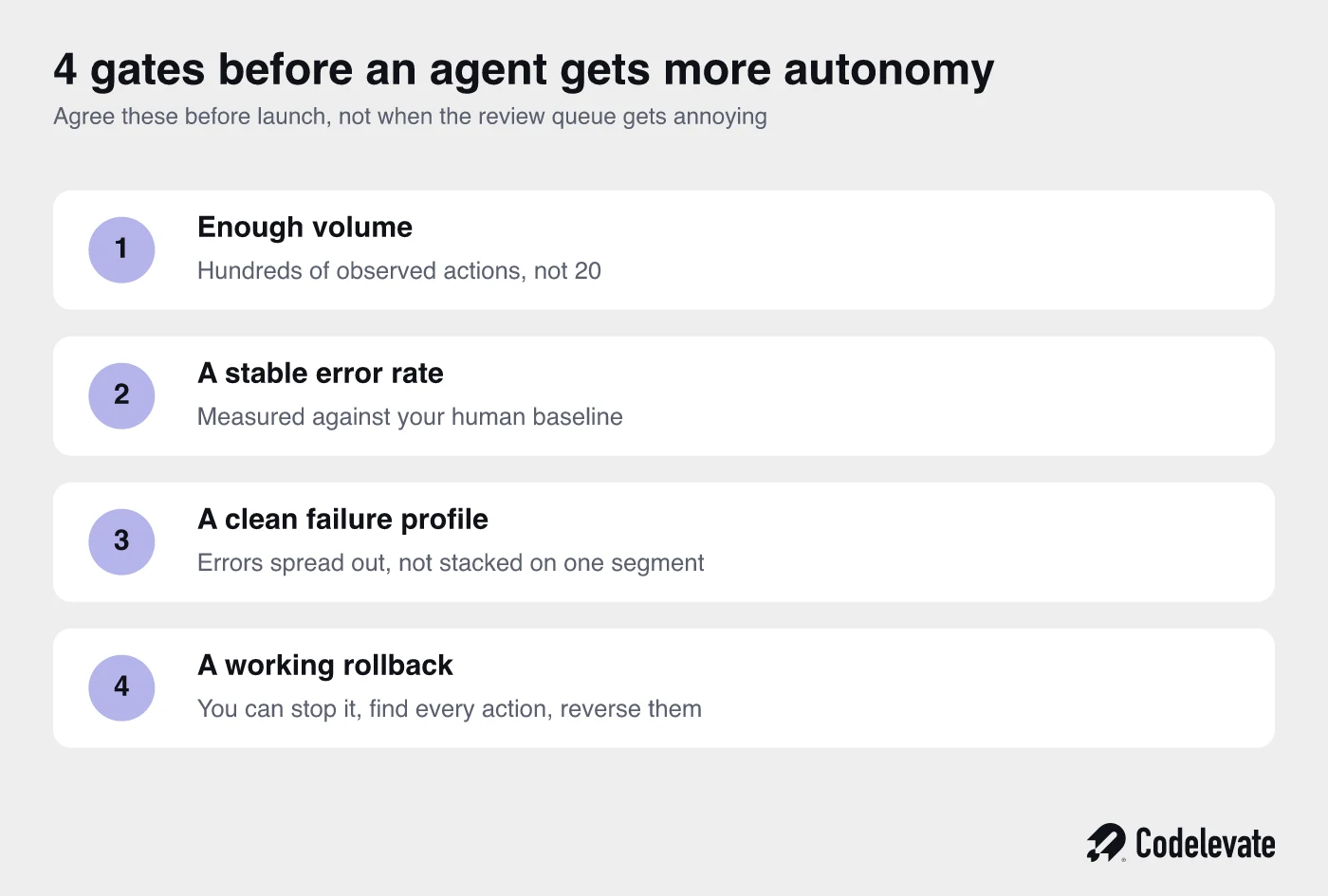
Gate 1 is volume. You need enough observed actions for the error rate to mean something. A few hundred is usually the minimum for a routine action. Judging an agent on 20 examples is guessing with extra steps.
Gate 2 is a stable error rate below the agreed threshold, and the threshold should be set against the human baseline, not against perfection. If your team's manual classification accuracy is 94 percent, holding the agent to 99.5 percent is not a safety standard, it is a way of never shipping. Measure your humans first. Most teams have never done this and are shocked by the number.
Gate 3 is a clean failure profile. Not just how often it is wrong but how it is wrong. An agent that fails randomly at 3 percent is much safer than one that fails at 1 percent but always on the same customer segment. Look at the distribution, not just the average.
Gate 4 is a working rollback. Before you widen permissions, prove you can stop the agent, find every action it took in a window, and reverse them. If the answer to how you undo yesterday's 400 actions is a support ticket and a prayer, the agent does not get more autonomy regardless of its accuracy. This is also what regulators mean by effective oversight: the ability to intervene and interrupt, not just to watch.
Run the promotion in one direction at a time. Move one action up one level, watch it for a defined period, then move the next. Teams that promote 5 actions at once cannot tell which change caused the incident. For the evidence side of this, we wrote a longer piece on how to know an AI agent is ready for production.
What the EU AI Act actually requires
Plenty of vendors are using the AI Act as a reason to sell oversight tooling, so it is worth being precise about what it says.
Article 14 applies to high-risk AI systems and requires that they are designed so natural persons can effectively oversee them. In practice that means the people responsible must be able to understand the system's capabilities and limitations, monitor its operation and spot anomalies, stay aware of automation bias, decide not to use the output, and intervene or interrupt the system through a stop mechanism. The measures have to be proportionate to the risk, the level of autonomy, and the context of use. The human oversight obligations for high-risk systems become enforceable on 2 August 2026. You can read the text of Article 14 of the EU AI Act in full.
Two things follow. First, the Act does not require a human to approve every action. It requires that oversight is effective and proportionate, which is an argument for the design in this article rather than against it. A well-defined level 3 setup with real exception rules, monitoring, and a working stop button meets the spirit of Article 14 far better than an approval queue nobody reads.
Second, most agents in most companies are not high-risk under the Act. Drafting marketing copy or triaging internal tickets does not fall in the same category as recruitment screening, credit scoring, or safety components. Classify honestly before you design for the strictest possible reading. If you need the full picture, our guide to the EU AI Act for businesses in 2026 covers the classification and the timelines.
How we build autonomy into agent projects
When we scope an agent build, the autonomy map is part of the specification, not an afterthought for the deployment week. Concretely, that means 4 things happen before code is written.
We list every action the agent can take, individually, including the boring ones. We assign a reversal cost and a detection lag to each, with the client's operations people in the room, since they are the ones who know what a wrong entry actually costs to fix. We set the launch level per action, which is almost always lower than the target level. And we write the promotion gates into the project plan with a review date, so widening autonomy is a scheduled decision with evidence rather than a request someone makes when the review queue gets annoying.
The technical side follows from that map. Exception rules become code with tests. Every action gets logged with enough context to reconstruct why it happened. The stop mechanism gets built and tested in week one, not promised for later. Sampling is automated so the 5 percent review actually happens instead of depending on someone remembering.
This is unglamorous work and it is the difference between an agent that quietly runs 90 percent of a workflow after 6 months and one that is still sitting behind an approval queue because nobody ever agreed what it was allowed to do. If you want that mapped for your own workflow, this is a core part of how our AI development team scopes projects.
3 patterns that cost real money
The first is the permanent pilot. The agent has been at level 1 for 8 months because nobody owns the decision to promote it. The team is paying for the model, the maintenance, and the human doing the work anyway. If no one is accountable for the promotion decision with a date attached, the default outcome is paying twice forever.
The second is autonomy by exhaustion. The review queue becomes unbearable, someone turns approval off for everything at once, and the first bad week produces an incident that sets the whole programme back a year. This is what happens when the only 2 options on the table are all or nothing.
The third is the invisible dependency. An agent runs at level 5 on an action everyone forgot about, an upstream system changes its data format, and the agent keeps producing confidently wrong output for weeks. High autonomy is not the mistake here. Missing monitoring is. Any action at level 4 or 5 needs an automated check on its output distribution, not just on whether the job ran.
Where to start this week
If you already have an agent in production or close to it, the useful first move takes about 2 hours. List every action it can take. Put a reversal cost and a detection lag against each one. Mark the current level and the level the grid says it should be. In most workflows that exercise finds 2 or 3 actions sitting behind human approval for no defensible reason, and one action running autonomously that quietly should not be.
That list is a better artefact than any AI strategy document, because it turns an argument about trust into a set of specific, decidable questions. It also gives you the numbers to put in a business case that survives the first quarter.
The transformation worth aiming for is not an agent that does everything. It is a workflow where your people spend their attention on the 10 percent of decisions that genuinely need judgement, and the other 90 percent runs without them. That only happens if you design the escalation as carefully as you design the agent.
If you want the framework in a fuller form alongside the rest of the build decisions, download the free SaaS AI Bslueprint. It covers scoping, cost, and the architecture choices that decide whether an AI build pays back.
And if you would rather work through your own autonomy map with someone who has done it before, book a free call with our team. Bring the list of actions and we will tell you honestly which ones we would let run alone.

.svg)
.svg)


