
How to Choose the Right AI Agent for Your Process Automation
The right AI agent for process automation is the one that fits your specific process, not the one with the most impressive demo. The agent that handles invoices well is rarely the one that triages support tickets or qualifies leads. Match it correctly and you take real work off your team. Match it poorly and the project stalls before it ever reaches production.
This article walks you through how to make that choice with confidence. You will learn what an AI agent for process automation is, how to assess your own process before you shop, the 7 criteria that separate a good fit from an expensive mistake, and a step by step way to test options before you commit.
The decision carries weight. Gartner expects over 40 percent of agentic AI projects to be canceled by the end of 2027, usually because of unclear value, rising cost, or weak controls. The teams that succeed are not the ones with the smartest model. They are the ones that choose deliberately.
What is an AI agent for process automation?
An AI agent for process automation is software that can read context, decide what to do, and take action to finish a task with little human input. Unlike a fixed script, it can handle variation, work with messy information, and keep going when a process does not follow a perfect path.
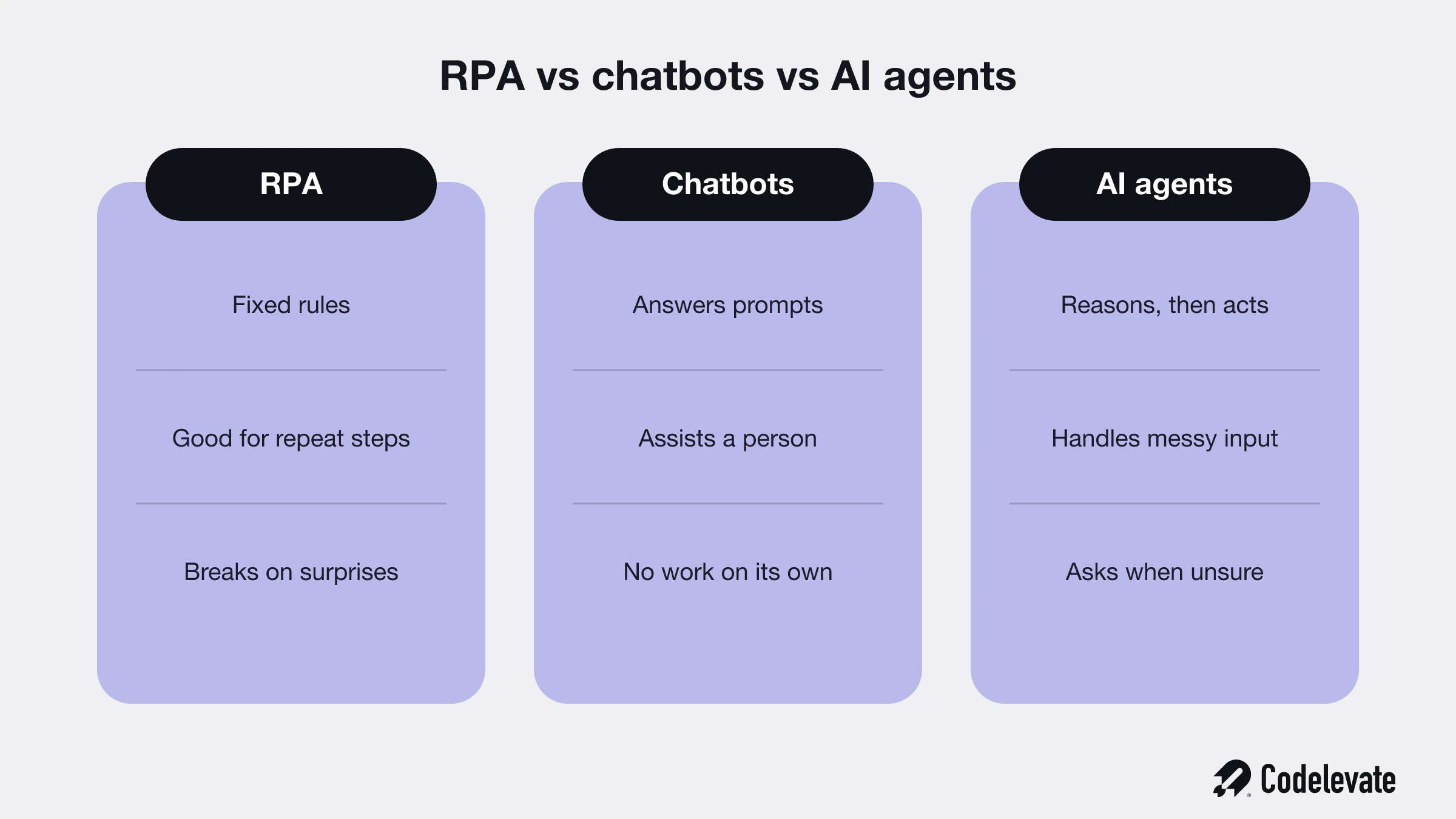
It helps to see agents next to the tools they get confused with:
- Traditional automation and RPA follow fixed rules. They are fast and dependable for structured, repetitive steps, and they break the moment something unexpected shows up.
- Chatbots respond to prompts. They answer questions and assist a person, but they do not carry out multi step work on their own.
- AI agents combine reasoning with action. An agent can read an email, work out what it needs, pull data from another system, complete the task, and escalate to a person only when it is unsure.
If you want the fundamentals first, our primer on what AI agents are and why your business needs them is a good starting point.
Why the right choice matters so much
The cost of the wrong agent is higher than the license fee. You lose months of team time, you spend trust that is hard to rebuild, and you often have to start the process over.
Part of the difficulty is noise. Gartner describes a wave of agent washing, where vendors rebrand basic chatbots or rule based tools as agents with no real agentic ability. A clear evaluation process is your defense against paying agent prices for a chatbot.
The reward for choosing well is just as concrete. McKinsey estimates that generative AI, including agent driven work, could add between 2.6 and 4.4 trillion dollars in value a year across the economy, with the biggest gains in customer operations, marketing and sales, software engineering, and research. The opportunity is real. So is the downside of picking blindly.
Start with the process, not the agent
Before you compare a single tool, map the process you want to automate. The process decides which agent fits, not the other way around. Score yours against these factors:
- Volume and frequency. High volume, repetitive work pays back fastest.
- Rules versus judgment. Pure rules may only need traditional automation. Work that needs interpretation is where agents earn their place.
- Structured versus unstructured inputs. Agents are strongest when the input is messy, like emails, documents, or chat.
- Risk and error tolerance. A process that approves payments needs far tighter control than one that drafts internal notes.
- Systems involved. List every tool the process touches. Integration is usually the hardest part.
- Success metric. Decide upfront how you will measure success, whether that is hours saved, faster turnaround, or fewer errors.
If you cannot name a clear success metric, the process is not ready to automate yet. That single honest check saves more failed projects than any tool comparison.
7 criteria for choosing the right AI agent
Once you understand the process, score each agent against these 7 criteria. Together they tell you what a polished demo will not.
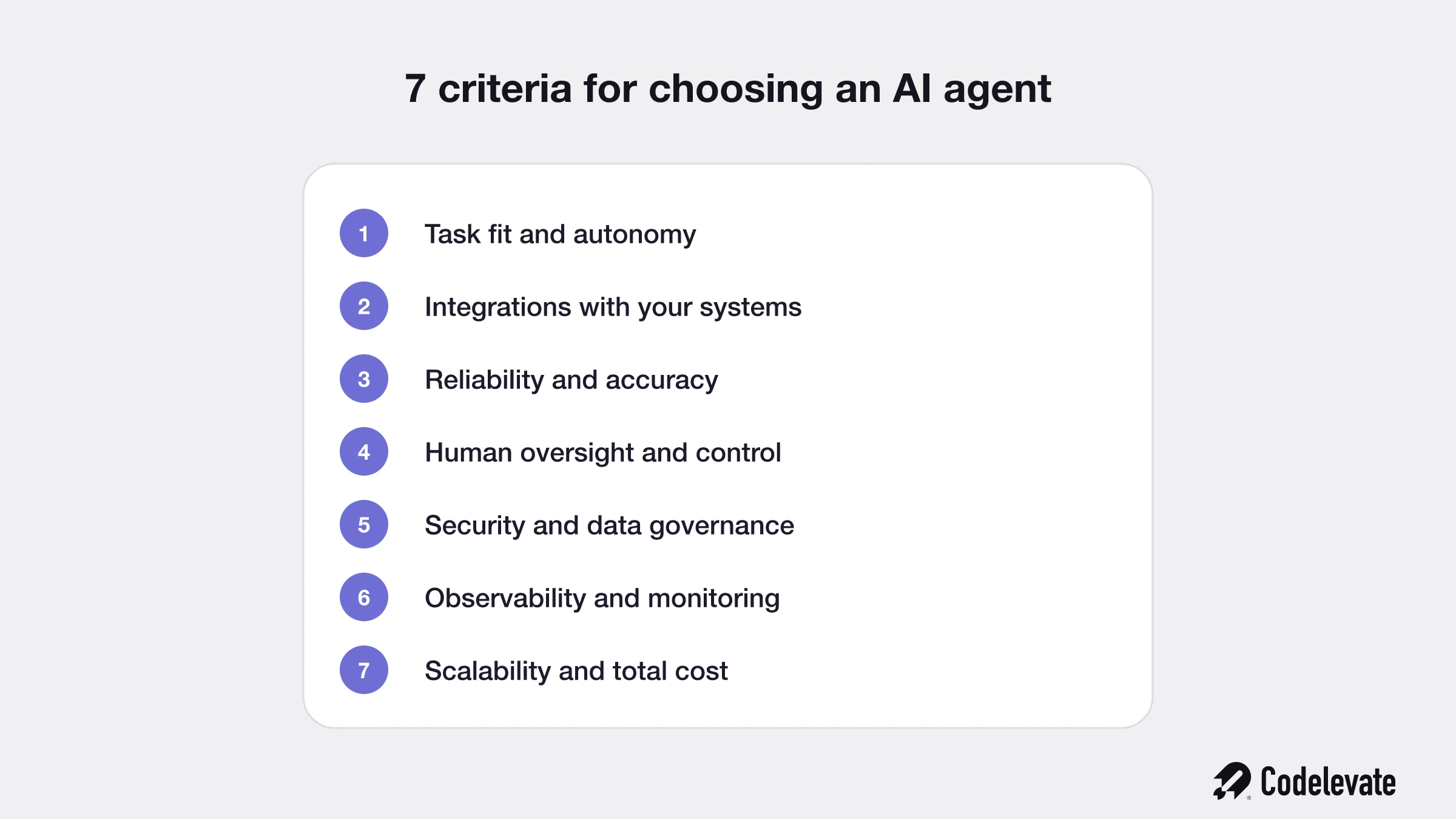
1. Task fit and autonomy
Match the agent's independence to the risk of the task. Assistive agents suggest and a person approves. Supervised agents act but escalate edge cases. Autonomous agents run end to end. Start with less autonomy on higher risk work, then widen it as the agent earns trust.
2. Integrations with your systems
An agent is only as useful as the systems it can reach. Check that it connects to your core tools, your data, and your internal APIs. Shallow integration is the quiet reason many automation projects fail.
3. Reliability and accuracy
Ask how the agent handles uncertainty and errors. A good one knows when it does not know and hands off rather than guesses. Look for answers grounded in your own data and consistent results across repeated runs.
4. Human oversight and control
You need a clear way for people to review, correct, and override the agent. Checkpoints on important actions keep automation safe while it builds a track record, and they give you an audit trail when something goes wrong.
5. Security, compliance, and data governance
Confirm how the agent stores and processes your data, where that data goes, and whether the vendor meets your compliance needs. For regulated work, decide your controls before you deploy, not after an incident.
6. Observability and monitoring
You cannot manage what you cannot see. The agent should log its decisions and actions so you can monitor performance, debug failures, and prove value with real numbers. Without that, you are trusting a black box.
7. Scalability and total cost
Look past the sticker price. Add usage based model costs, integration and maintenance, and the cost of human review. An agent that is cheap for one process can get expensive across fifty, so model the full cost before you scale.
Build or buy: which path fits
One of the bigger decisions is whether to buy a ready made agent or build your own.
Buy when the process is common and standardized, the tool already fits your stack, and your data and compliance needs are simple. You get value quickly with little engineering.
Build when the process is core to how you compete, needs deep integration with your own systems, or handles sensitive data and logic no generic tool covers. Building gives you control over behavior, data, and cost as you scale.
Many teams do both. They buy for common processes and build for the few that give them an edge.
How to evaluate and choose, step by step
- Define the process and its success metric. Write down what good looks like in numbers.
- Shortlist two or three agents that fit the task and your stack.
- Run a pilot on real data, not a polished demo. Demos hide the messy cases that matter.
- Score the results against your metric and the 7 criteria above.
- Check governance, security, and full cost before you commit.
- Roll out gradually, keep people in the loop on important actions, and widen autonomy as results hold.
Mistakes worth avoiding
- Giving an agent full autonomy on a high risk process before it has earned it.
- Treating governance as an afterthought. Weak controls sit behind many canceled projects.
- Trusting the label. Test real agentic ability on your own process, not in a demo.
- Automating judgment that should stay with a person, with the agent preparing the work around it.
How Codelevate approaches AI agent automation
We start with your process and your numbers, not with a tool. Our AI automation agency maps where agents create real value, then builds, integrates, and governs them so they hold up in production rather than in a demo.
If you would rather pressure test your plan before spending budget, that is a conversation worth having early, while the choice is still cheap to change.
The takeaway
Choosing the right AI agent is less about finding the smartest model and more about disciplined matching. Understand your process, score agents on task fit, integrations, reliability, oversight, security, observability, and cost, then prove value with a pilot before you scale. That is the difference between the projects that ship and the 40 percent that get canceled.
If you want a second set of eyes on which agent fits your process, book a free call with our team and we will help you find the fastest safe path to value.


.svg)
.svg)


