ChatGPT or custom AI: which one, and when
"Can't we just do this with ChatGPT?" It is the question we hear most, usually in the first 5 minutes of a call. The honest answer is often yes. Start with ChatGPT, Copilot, Claude or Gemini, and mean it.
The real question in ChatGPT vs custom AI is not which model is smarter. It is where the work leaves the chat window. As long as a person reads the output, edits it and sends it, a business plan is almost always enough. Once the AI needs data from your own systems, does the same task hundreds of times a month, and its output reaches a customer without anyone rewriting it, you are building something else. That is where custom AI starts, or at least a step towards it.
This article is for the owner, managing partner or operations lead of a Dutch B2B service company with 10 to 200 people. Think of an accountancy or administration office, a subsidy advisor, a customs or vehicle tax specialist, a training provider that manages certificates. Your core work is an expert process your team does by hand, with volume, and you have no technical team. It is not for you if you are at the idea stage, building a consumer app, comparing hourly rates, looking for 1 Zapier flow, or running an enterprise tender.
In this article you will learn where ChatGPT for business is enough, the 6 signals that tell you a process has outgrown it, the steps in between with honest prices for each, what OpenAI's business terms actually say about your data, and how an administration office does the sum in euro.
Key takeaways
• Start with a business plan for ChatGPT or a similar tool. For letters, summaries and first drafts it is the cheapest and fastest option you have.
• A custom GPT or project with a good context pack gets far more out of the same licence. It mostly costs a few days of your own time.
• The line to custom AI sits at 6 signals: your own systems, volume, output that nobody rewrites, consistency, data rules, and who answers when it goes wrong.
• 1 signal is rarely enough. When 2 or 3 show up on the same process, it pays to look past the chat window.
• OpenAI's business accounts do not train on your data by default. Personal accounts can, unless someone switches it off. That difference belongs in your AI policy.
• According to OpenAI, data residency in Europe is offered for Enterprise, Edu and the API, not for the Business plan. For client files that matters.
• Custom AI does not replace ChatGPT. It takes over 1 process that runs at volume, and your team keeps using ChatGPT for everything else.
Start with ChatGPT, and mean it
A ChatGPT Business seat currently costs 21 euro per user per month billed annually, or 26 euro billed monthly, according to OpenAI's pricing page. Copilot, Claude and Gemini sit in the same range. For that money every employee gets an assistant that rewrites a letter, summarises a long document and drafts the first version of a quote.
For knowledge work that differs every time, that is hard to beat. An advisor answering a difficult client email gets nothing from a custom system. They need a good model, a few lines of context and their own judgment. The chat is exactly the right tool there.
The business plan also adds things a personal account lacks. There is an admin console, you can add and remove people, and there are connectors to Google Workspace and Microsoft 365. More important, the terms are different. We come back to that below.
What you mostly need to sort out at this stage is usage. Which tasks do we do with AI, which not, and which data may go in. A team that has used ChatGPT for real work for 3 months knows exactly where it rubs. That knowledge is the best brief you can later hand to anyone.
A custom GPT or project gets more out of the same licence
The second step needs no new licence. Inside ChatGPT you can build a custom GPT or a project: a fixed space with instructions, examples and files that come along with every conversation. Claude has projects, Copilot has agents, Gemini has gems. The idea is the same.
The difference is what you put in. We call it a context pack. It is a short set of documents that tells the model how your firm works:
• Your tone, plus 5 to 10 examples of good output, such as letters a client actually received.
• Your templates and the fixed sentences that must always be in them.
• The rules an experienced employee carries in their head: when to escalate, which exceptions exist, what is never allowed.
• A list of common mistakes, so the model learns to avoid them.
With a pack like that, 1 repeated task already gets far more consistent output. Everyone uses the same instructions instead of their own prompt. Count on 2 to 5 days of work from someone who knows the process, plus upkeep when your rules change.
This is also where the first limit shows. A custom GPT reads what you upload or what a connector can fetch. A person starts the conversation, checks the output and moves it into the right system. It is still work a human does piece by piece. For tens of items a week, that is fine. For hundreds a month, it is not.
Want to write down what your process needs before you choose anything? Use the free AI product requirements template. You describe the task, the data, the volumes and the risks, and you have a brief you can hand to a colleague, a freelancer or us.
6 signals that your work has outgrown the chat
These are the signals we see again and again in conversations with owners. Walk through them for 1 specific process, not for your whole company. Most firms have 1 or 2 processes that are over the line, and a long list of tasks where the chat keeps doing fine.
1. The AI needs data from your own systems and has to write back
As long as an employee copies the input and pastes the output, the employee is the integration. That works until the volume grows. It changes when the AI has to open a file in your practice software, read client data from Exact or AFAS, and then write back a status, a note or a draft.
Reading through a connector is sometimes possible inside ChatGPT already. Writing back to your own system reliably, with a check on what changes and a log of who did what, is a different job. That is software you build and maintain.
2. The same task, hundreds of times a month
A task that comes up 40 times a year is rarely worth automating. A task that comes up 400 times a month almost always is. At volume, minutes per item, errors per hundred items and cost per item start to count. You can only measure those when the work runs through a fixed flow instead of loose chats.
3. The output reaches a customer or a system of record without a rewrite
A first draft that someone always rewrites may be off now and then. The person catches it. An email that goes to a client automatically, or an amount that lands in your books, may not be off. The less a person rewrites, the more checks have to live inside the software itself.
4. Consistency matters more than brilliance
ChatGPT is good at a surprisingly good answer. A process often needs something else: the same answer for the same input, every time. Two colleagues who put the same file into a chat do not get the same result, because they use different words and the model does not always answer the same way.
In custom AI you fix what is fixed. Rules that are certain live in ordinary code. The model only does the part that needs language, with fixed instructions and a fixed output format. And you test it against a set of real cases before anything changes. It is less exciting, which is exactly the point.
5. Data rules apply
If you handle personal data, the GDPR (AVG in Dutch) applies. If you work for clients, you often have a confidentiality agreement. Sometimes a client explicitly asks that data stays in the EU. A business plan covers part of that, not all of it. The more of these rules apply to 1 process, the more you want to decide where the data lives, who can reach it and what gets logged.
6. Someone has to answer when it is wrong
When an employee copies a mistake out of ChatGPT, that employee is responsible. That is how an assistant should work. But when a process runs on its own and something goes wrong in 60 files on a Friday afternoon, who looks at it? Who knows what changed, and who rolls it back? With a chat the answer is "whoever pasted it". With a process that touches your clients, you want a name.
When do you need custom AI instead of ChatGPT
You need custom AI when 1 process shows 2 or more of the 6 signals at once, usually volume plus your own systems. If a process only has the consistency signal, try a custom GPT with a good context pack first. If it has volume, systems and a client at the end, the chat will not get you further than a first draft.
The table below puts the 3 main options side by side on the 7 questions that decide it.
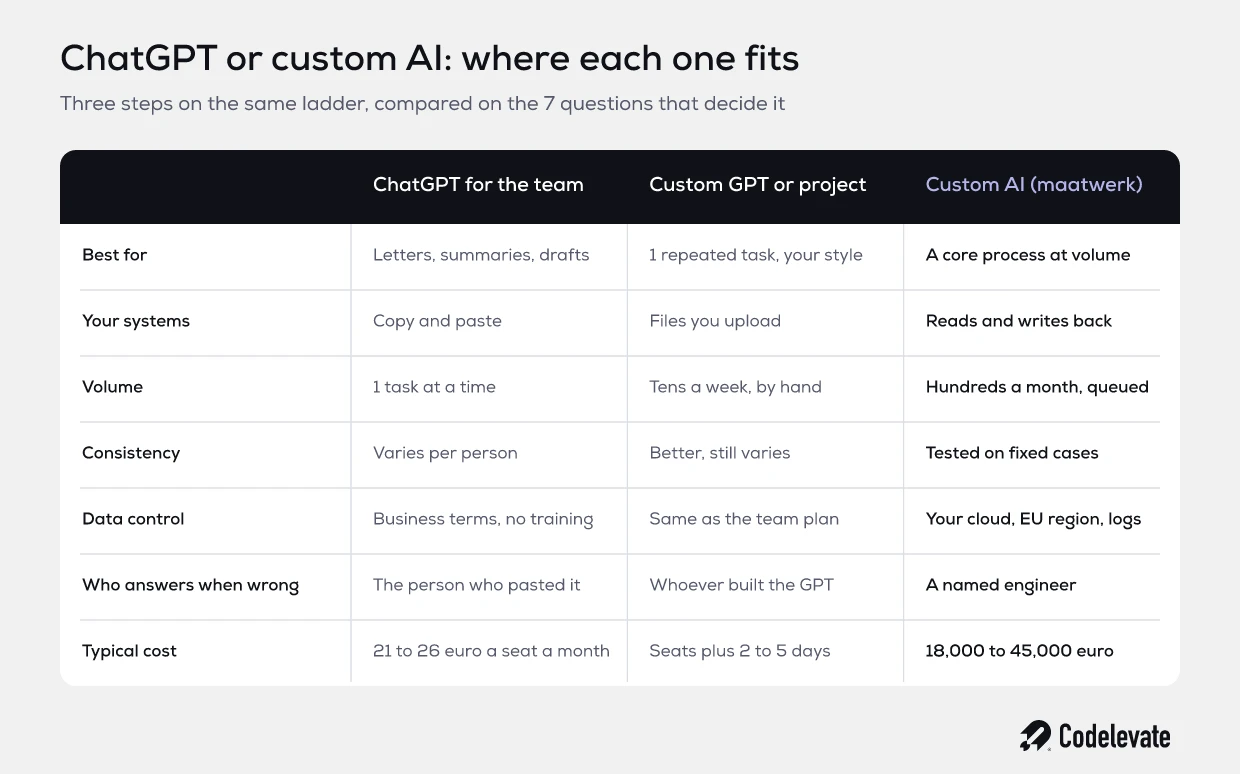
Read the table from left to right as a ladder, not as a choice between good and bad. Most firms use all 3 at once: ChatGPT for everyone, a few custom GPTs for recurring tasks, and custom AI for the 1 process where the volume sits.
The ladder from chat to custom AI, with a price per step
Between a loose chat and a fully custom system there are 4 steps. You do not have to climb all of them. You stop at the step where the process has enough. Below is what each step is, what it costs and where it stops.
Step 1: ChatGPT for the team
A business plan for everyone who does knowledge work. Cost: 21 to 26 euro per user per month, so for 15 people about 315 to 390 euro a month. It stops where the work needs data from your systems or leaves the building without a person.
Step 2: a custom GPT or project with a context pack
The same licence, plus 2 to 5 days of your own time to write and test the context pack. It stops where an employee still has to start, check and move every item by hand.
Step 3: an integration through the API
Here a simple flow, for example in n8n or Make, sends documents to a model through the API and puts the result somewhere. Automation shops that sell to small firms ask entry prices of 1,500 to 5,000 euro for this, plus the cost per call. It is a good step for 1 well defined task. It stops where you need tests, logging, an approval step and an owner. A flow nobody watches tends to stop on the day you need it most.
Step 4: custom AI for 1 process
Software that runs the process in your own environment. It reads from your systems, does the work, lets a person approve where a mistake is expensive, and writes back. With tests, a staging copy, logging, and the AI cost per item measured and capped. With us that costs 18,000 to 45,000 euro per major process, fixed per automation. After that comes operations, at 1,250 euro per month per automation. More on that below.
The data question: business account or personal account
This is the question that goes wrong most in practice. Not because firms are careless, but because employees have used ChatGPT on their own accounts for a long time. The gap between those 2 kinds of account is bigger than most people think.
For business products OpenAI is clear. On its business data privacy page, OpenAI states that by default it does not train on data from ChatGPT Enterprise, ChatGPT Business, ChatGPT Edu or the API platform, inputs and outputs included. Data is encrypted at rest and in transit. A data processing addendum is available, and OpenAI lists SOC 2 Type 2 and ISO 27001 among its standards.
Note 1 detail on the same page. According to OpenAI, data residency in Europe is available to eligible customers of Enterprise, Edu, Healthcare and the API platform. The Business plan is not in that list. If you need client files to provably stay in the EU, the Business plan is not automatically enough.
For personal accounts the picture is different. OpenAI's help article on model improvement says content from its services for individuals may be used to train models unless you turn that off in settings. And anyone who clicks thumbs up or down shares the whole conversation, even after opting out.
What does that mean for you?
• Client data does not belong in personal accounts. Pasting an annual income statement with a citizen service number into a free account is hard to square with the GDPR and with your agreements with that client.
• A business plan solves the training point, not the question of where data is processed or how long it is kept.
• Check the same 3 points in the business terms of Copilot, Claude and Gemini: training, processing location and retention.
• With custom AI you choose: your own cloud account, an EU region, a model that does not train on your data, and a log of every call.
If you want to know exactly which data an AI feature sends outside Europe and how to check it, read our article on EU data residency for AI features.
Worked example
An example, not a client. Take an administration office with 22 people and 1,200 private clients whose income tax return it files every spring.
The office uses ChatGPT Business for everyone. That costs about 460 euro a month. People use it to write letters, summarise new regulations and draft difficult emails. It works well, and that does not change.
The bottleneck is tax season. Clients upload their documents to a portal. For each file, an employee checks that everything is there: annual statements, mortgage, property valuation, medical costs, donations. They compare it with last year, summarise what is missing and send the client a request. That takes about 40 minutes per file.
• 1,200 files at 40 minutes is 800 hours per season.
• At an internal cost of 60 euro an hour, that is 48,000 euro.
A few employees try it with ChatGPT. They paste documents into a project and let it list what is missing. That saves a few minutes, but it creates new problems. Personal data goes into chats. Every employee does it differently. The output still has to be moved into the file, and nobody can see which files have been checked. This process shows 4 of the 6 signals: own systems, volume, client contact and regulated data.
Now suppose a custom automation reads the documents from the portal, compares them with last year's file in the practice software, drafts the request and queues it. An employee approves or edits it, and the status goes back into the file. Assume that brings the time per file down to 10 minutes.
• 1,200 files at 10 minutes is 200 hours. That is 600 hours less, or 36,000 euro per season.
• Cost in year 1: a Blueprint at 5,000 euro, an automation at 30,000 euro and 12 months of operations at 1,250 euro, 50,000 euro in total.
• Cost in year 2: 15,000 euro of operations.
After 2 seasons, 65,000 euro of cost sits against 72,000 euro of hours. That is no miracle in year 1, and we say so. The real argument is elsewhere. The office can take on 400 more clients without looking for another hire in a tight market. And for the first time, the work is written down 1 way.
Had the office filed 300 returns a year, our advice would have been different. A good custom GPT, a clear work instruction and a rule that client data only goes into the business account. The arithmetic picks the step, not the wish to build something new.
What custom AI costs and what you get back
With us, custom AI does not start with building. It starts with the question of whether building is worth it. That is what the Blueprint is for: 2,500 to 10,000 euro depending on the number of processes, in 10 to 20 working days. You get the process mapped as it really runs, the bottlenecks priced in hours and euro, the AI opportunities ranked, a roadmap with fixed prices per milestone and a first rough prototype in your own repository. It is yours to keep. You can also have it built in house. If you want to know what that kind of analysis delivers, read what an AI audit delivers.
Then come the automations, 1 bottleneck per milestone, fixed at 18,000 to 45,000 euro per major process. A person approves where a mistake is expensive. The software connects to what you already run, such as Exact, AFAS or your sector tool.
Then the 3 questions every owner rightly asks.
Who works on it? 2 engineers by name, from the Blueprint to year 2. You know who they are before you sign, and they are the same people who mapped your process.
What happens after launch? Operations start the day the first automation runs. Monitoring, a named engineer on the alert, the AI cost per item capped, a 1 page report every month, and model and rule updates. Plan on 1,250 euro per month per automation. The response time is set in the Blueprint.
What if month 1 disappoints? Exit after month 1: pay for what is delivered, keep everything. The code lives in your own repository, in your own accounts, from day 1.
How to decide this week
You do not need a 40 page strategy to make this call. Pick 1 process and answer 5 questions:
• How often does it happen per month, and how many minutes does it take each time?
• Which systems does the input come from, and where does the result have to go?
• Does a person always read the output before a client sees it?
• Does it contain personal data or confidential client data?
• Who calls you when it goes wrong, and who fixes it?
If the answers are "rarely", "copy and paste", "yes", "no" and "the employee", stay with ChatGPT and build a good context pack. That is not second best. It is the right choice for that work. If the answers lean the other way, you are ready for the next step.
Put your answers on paper with the free AI product requirements template. In an hour you have a brief you can compare across anyone you give it to.
Codelevate turns Dutch B2B service companies into software companies: we map the expert process you run by hand, automate it so the same team handles the volume, and build the platform your customers pay for, with 2 engineers by name from the blueprint to year 2.
Not sure which step your process is on? Send us what you have. 1 of the 2 engineers reads it with you in 20 minutes, and you get 1 of 3 answers in writing the same day: do it in house, hire, or the Blueprint.