What does AI automation cost? Build, running cost and payback in real numbers
Ask 3 builders what AI automation costs and you get 3 build prices. The build price is the smallest part of the bill. If you searched for "AI automation cost", you are probably comparing quotes that each show only 1 of the 3 cost layers.
An AI automation costs money to build, money to run and money to keep up to date. The number that decides is on none of those quotes: what 1 file, 1 application or 1 certificate will cost you, against what it costs you by hand today. You can work that number out yourself, and after this article you will know how.
This article is for the owner, managing partner or operations lead of a Dutch B2B service company with 10 to 200 people. You run a repeatable expert process by hand, you charge per unit or per hour, there is volume, and growth currently means hiring. Think subsidy advisors, vehicle tax (BPM) and customs specialists, certification bodies, administration offices and inspection firms.
It is not for you if you are at the idea stage, building a consumer app, comparing hourly rates, looking for 1 Zapier flow or preparing a public tender. The numbers below will not be your numbers.
In this article you will learn which 3 layers make up the cost of AI automation, what realistic amounts look like per layer, how to calculate the cost per unit, how a worked example with 400 vehicle tax calculations a month plays out, and when automation simply does not pay back.
Key takeaways
• AI automation has 3 cost layers: build (once per process), run (every month) and change (every year). A quote that only names the first is a third of a quote.
• Rented flows from an automation shop start around 1,500 to 5,000 euro, with fees per operation that grow with your volume. An owned automation of 1 major process sits around 18,000 to 45,000 euro.
• The model cost itself is small: at current Anthropic prices, 1 file costs roughly 2 to 60 dollar cents in tokens, depending on the model and the size of the file.
• The number that decides is the cost per unit: units per month times minutes per unit times your hourly cost, against the build plus the monthly running cost.
• In our worked example the cost of a vehicle tax calculation drops from 55 euro to about 18 euro, and an investment of 35,000 euro is paid back in month 3.
• An AI cost cap per unit belongs on the quote. Without a cap, you carry the risk when a model gets more expensive or an error repeats itself.
• At low volume, or with a process that runs differently every month, automation does not pay back. A better work instruction or 1 extra colleague is then the cheaper choice.
What does AI automation cost?
Most articles about AI automation cost give 1 number: the build. That makes sense, because it is the number on the quote. But an automation is not a renovation that is finished when the builder leaves. It is closer to a machine in your workshop: it uses power, needs maintenance and now and then a new part.
That is why we count in 3 layers. Each layer has its own price form and its own question you can put to every supplier.
• Build: once, fixed per process. Question: what is in it, and what is not?
• Run: every month. Question: what does 1 unit cost, and who looks when it stops?
• Change: every year. Question: who updates the rules when the law, the model or your accounting package changes?
Below we work out each layer with amounts. Then we put them into 1 calculation you can run on your own process.
Layer 1: the build
The build is the work of turning your manual process into an automated one. Reading documents, pulling out the data, applying the rules, preparing the result for a person who approves it, and connecting it to the systems you already run, such as Exact, AFAS or your sector tool.
There are roughly 2 ways to have that built, and they differ more in what you pay afterwards than in what you pay up front.
Rented flows:
Many automation shops that serve small firms build flows in n8n or Make and charge an entry price of about 1,500 to 5,000 euro. That is quick and low effort, and for 1 simple connection it can be exactly right. A form that adds a line to your CRM does not need custom software.
The catch is in the months after. You pay per operation or per execution, so your bill grows with your volume. The flow runs on someone else's platform, and when that platform changes its prices or terms, your cost per unit changes with it. And when something breaks, it is often unclear who fixes it, apart from you.
Owned automation:
An owned automation is built in your own environment: your repository, your cloud account, your data. For 1 major process we plan with 18,000 to 45,000 euro, fixed per automation, 1 bottleneck per milestone. Where you land in that band depends mostly on 3 things.
• The number of systems it has to talk to. A connection with Exact is different from one with a sector tool that has no documentation.
• How messy your input is. Clean PDFs are cheaper than photos of paper registration documents from 4 countries.
• How many exceptions your process has, and where a person must approve because a mistake is expensive.
If you want an AI agent built rather than an existing process automated, the build prices for that are in our article on what it costs to build an AI agent. This article is about something else: a process you already run by hand today and pay for per unit.
Layer 2: running, the cost that comes back every month
Once the automation runs, the second layer starts. It has 3 items: the model cost per unit, the hosting, and the people who keep an eye on it. The first 2 are smaller than most owners expect. The third is the one most often forgotten.
Model cost per unit: cents, if someone watches them
A language model charges per token, a piece of text of roughly 3 to 4 characters. On Anthropic's pricing page (September 2026), Claude Haiku 4.5 costs 1 dollar per million input tokens and 5 dollars per million output tokens. Claude Sonnet 5 costs 2 and 10 dollars, Claude Opus 5.5 4 and 20 dollars. Batch processing takes 50% off.
What does that mean per file? A worked example with rounded numbers.
• Light: a form of a few pages, 10,000 tokens in and 1,000 out, on Haiku 4.5. That is 0.01 plus 0.005 dollars: about 1.5 dollar cents.
• Typical: a file of 15 pages, 30,000 tokens in and 3,000 out, on Sonnet 5. That is 0.06 plus 0.03 dollars: 9 dollar cents per pass. With a second checking pass and the occasional retry you land at 20 to 30 dollar cents.
• Heavy: a large file with many attachments, 100,000 tokens in and 10,000 out, on Opus 5.5. That is 0.40 plus 0.20 dollars: 60 dollar cents.
For most processes in a service company you are somewhere between 2 and 60 dollar cents per unit. That is little next to an hourly rate. It only becomes a lot when nobody is looking: a loop that reads the same file 200 times, or a model that runs on the most expensive tier for no reason.
Hosting, monitoring and a named engineer
Hosting in your own cloud account is usually a small item at these volumes. In the worked example below we use 50 euro a month; your real number depends on your cloud and your volume.
The bigger item is operations: monitoring, a named engineer who gets the alert when something stops, the cap on the AI cost per unit, a 1 page monthly report, and updates to models and rules. We use a planning value of 1,250 euro a month per automation for this. The response time is set in the Blueprint, so it matches how expensive downtime is for you.
That item feels like overhead until the first Monday morning with 400 files in the queue. Then the question is no longer what monitoring costs, but who you call.
Layer 3: change, because rules do not stand still
An automation of an expert process is built on rules. And rules change. Vehicle tax rates change on 1 January, subsidy schemes open and close, a certification standard gets a new version. The technology changes too: models are replaced, an accounting package updates its connection, a customer suddenly sends a different file format.
There are 2 kinds of change, and they belong in 2 places in your budget.
• Maintenance: a new rate, a new model version, a connection that renames a field. That belongs in the monthly operations fee, or you pay for it separately every time.
• Extension: a new process step, a new product, an extra system. That is a new milestone with its own fixed price, agreed before anyone starts on it.
Ask every supplier where each kind of change falls. Whoever does not put the answer in writing will bill it by the hour later. The only thing certain in this line of work every year is that 1 January will be different from 31 December.
The number that decides: cost per unit
Now that the layers are clear, you can merge them into 1 number you can compare with today. That number is the cost per unit: per file, per application, per calculation, per certificate. You calculate it like this.
• Today: minutes per unit divided by 60, times your hourly cost including employer costs and overhead.
• After: the minutes a person still spends on checking and exceptions, times the same hourly cost, plus the model cost per unit, plus the monthly running cost divided by your units per month.
• Saving per month: the difference per unit times the number of units per month.
• Payback: the one off investment divided by the saving per month.
2 remarks make the difference between an honest calculation and a flattering one. First, count the exceptions. No automation handles 100% of your files without a person, and you do not want it to where a mistake is expensive. Second, saved hours only become money when you use them. That happens when you take on more volume with the same team, or when you do not fill a vacancy.
Want to run this calculation on your own process before you talk to a supplier? Our free AI product requirements template puts the process, the volumes, the costs and the choice of builder in 1 place, so every quote has to answer the same questions.
Worked example
An example, not a client. An office prepares vehicle tax (BPM) calculations for car dealers who import vehicles. It charges about 100 euro per calculation and does 400 a month. Revenue from this process is 400 times 100 euro: 40,000 euro a month.
Today: all by hand
An employee gathers the documents, looks up the data, determines the depreciation and calculates the tax. That takes 60 minutes per calculation on average.
The hourly cost: an employee with a gross salary of around 48,000 euro costs roughly 70,000 euro a year with employer costs and overhead. At about 1,300 productive hours a year, that is 70,000 divided by 1,300, roughly 54 euro an hour. We round up to 55 euro.
• Cost per calculation: 60 minutes is 1 hour, times 55 euro, is 55 euro.
• Cost per month: 400 times 55 euro is 22,000 euro.
• That is 55% of the revenue of this process, and 400 hours of work a month: about 3 people.
After automation: a person approves
The automation reads the documents, pulls out the data, applies the rules and prepares a proposal. An employee checks it and approves. We assume 85% of files are checked in 8 minutes, and 15% are exceptions that still take 60 minutes of manual work.
• Average human time: 0.85 times 8 minutes is 6.8 minutes. 0.15 times 60 minutes is 9 minutes. Together 15.8 minutes.
• Labour per calculation: 15.8 divided by 60, times 55 euro, is 14.48 euro.
• Model cost per calculation: we use 0.30 euro, the top of the typical example above, rounded up.
• Running cost per calculation: 1,250 euro operations plus 50 euro hosting is 1,300 euro a month. Divided by 400, that is 3.25 euro.
• New cost per calculation: 14.48 plus 0.30 plus 3.25 is 18.03 euro.
The cost per calculation drops from 55 euro to 18.03 euro. The difference is 36.97 euro per calculation. Times 400, that is 14,788 euro a month in capacity that comes free.
The payback
The investment: a Blueprint of 5,000 euro and a build of 30,000 euro, together 35,000 euro. We assume the first month after go live delivers only half, because the team is still getting used to it.
• Month 1: half of 14,788 is 7,394 euro. Total 7,394 euro.
• Month 2: 14,788 euro more. Total 22,182 euro.
• Month 3: 14,788 euro more. Total 36,970 euro.
In month 3 after go live the 35,000 euro is paid back. After that, 14,788 euro of capacity is left over every month. It becomes money as soon as the office takes on more calculations with the same 3 people, or does not hire the 4th employee it was planning to.
Change 1 assumption and the outcome changes with it. If a calculation takes 30 minutes today instead of 60, the saving drops to about 5,400 euro a month and payback moves to month 7. That is why a good calculation starts with your own minutes, measured, not guessed.
Rented, owned or hired: the layers side by side
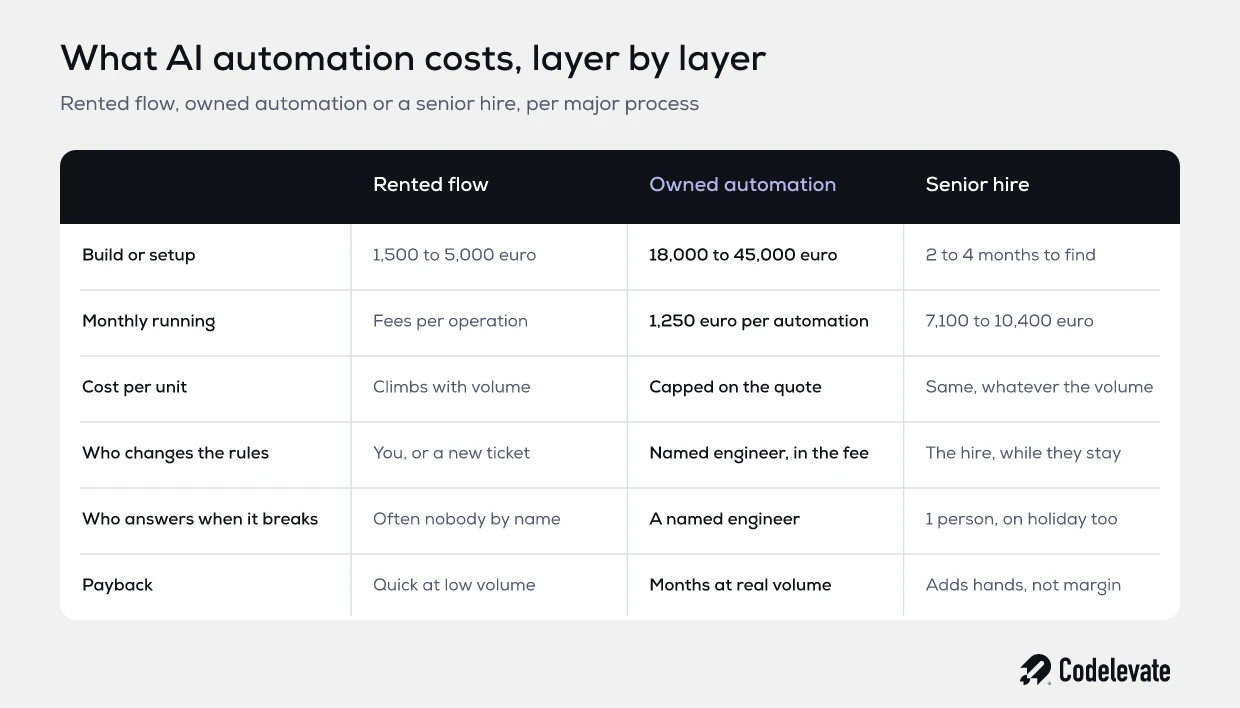
The table puts the 3 routes side by side. The difference is rarely in the first row. It is in the rows below: what 1 unit costs as your volume grows, who changes the rules, and who answers when it stops.
A rented flow wins at low volume with a simple process. At 400 files a month with exceptions and connections, the bill per operation grows, and the knowledge of how it works sits with whoever built the flow.
The third route is hiring. If you want to build it yourself, you need a senior developer. A Dutch recruiter puts the 2026 gross salary at 65,000 to 95,000 euro a year, depending on the region (Search Company). With employer costs that comes to roughly 85,000 to 125,000 euro a year, 7,100 to 10,400 euro a month, and it takes 2 to 4 months to find someone. That can be the right choice if you have several processes and the role is permanent. It is 1 person, with holidays and a notice period.
The other hire is an extra employee for the manual work itself. In the worked example that person costs 70,000 euro a year and adds 1,300 hours of capacity. Not a bad choice, but the cost per unit stays at 55 euro. You buy hands, not margin.
The AI cost cap per unit belongs on the quote
The model cost per unit is small, but it is not fixed. Models change price, a new type of document is 3 times as long, or an error makes the automation process the same file again and again. Without an agreement you carry that risk, and you only notice it on the invoice.
A cost cap per unit puts that risk with the builder. The quote says, for example: the AI cost per calculation is measured and capped at 1 euro. The system measures every unit, stops or raises an alert when something is off, and the monthly report shows what it really was.
3 questions to ask every supplier:
• What does 1 unit cost in model and hosting, measured in the pilot and not estimated?
• What is the cap per unit, and what happens when it is hit?
• Where do I see every month what it really cost?
If these questions get no number, a later invoice will.
When AI automation does not pay back
Not every process should be automated. There are 3 situations where we advise against it, even if you want it built.
Low volume. Take the same office with 40 calculations a month instead of 400. The running cost of 1,300 euro a month becomes 32.50 euro per calculation. The new cost per calculation is 14.48 plus 0.30 plus 32.50: 47.28 euro. The saving is 7.72 euro per calculation, times 40 is 308.80 euro a month. The 35,000 euro then only comes back after about 113 months, more than 9 years. You do not do that.
An unstable process. If 5 advisors do the same work 5 different ways, you automate 5 processes, or you automate the wrong one. First the process needs 1 shape, with 1 source of truth for rules, templates and data. That is work, but it is not AI work.
No clear unit. If you cannot say what 1 file costs today, you cannot say what the automation will return. Measure a month first: how many units, how many minutes, how many exceptions. That measurement is free and saves you a wrong investment.
In each of these cases a better work instruction, a shared folder or 1 extra colleague is cheaper. An honest supplier says so before sending a quote.
Who works on it, what happens after launch and what if month 1 disappoints
Cost is not only about amounts. 3 questions decide whether the amounts above hold in practice, and they should be answered before you sign.
Who works on it? With us, 2 engineers, by name, from the Blueprint to year 2. The same 2 people who map your process build it, review it and get the alert when it stops. You know who they are and where they sit before the start.
What happens after launch? Operations start on the day the first automation runs: monitoring, a named engineer on the alert, the cost cap per unit, a 1 page monthly report and updates to models and rules. The response time is set in the Blueprint. The code and the data live in your repository and your cloud account.
What if month 1 disappoints? Then you stop. Exit after month 1: pay for what is delivered, keep everything.
How we work out the numbers before anything is built
Codelevate turns Dutch B2B service companies into software companies: we map the expert process you run by hand, automate it so the same team handles the volume, and build the platform your customers pay for, with 2 engineers by name from the blueprint to year 2.
The calculation in this article is where the Blueprint starts. In 10 to 20 working days we map the process as it really runs, price the bottlenecks in hours and euro, rank the AI opportunities, and write a roadmap with fixed prices per milestone, plus a first rough prototype in your own repository. The Blueprint costs 2,500 to 10,000 euro, depending on the number of processes. It is yours, also if you then decide to build it in house.
2 examples of where such a calculation led: a processor of vehicle tax files went from 4 to 8 hours per file to under 5 minutes, and a subsidy matching engine went from hours of expert searching to seconds. If you would rather measure afterwards what an automation returned, our article on measuring the return of an AI agent helps.
In short
AI automation costs money in 3 layers: build, run and change. The build of 1 major process sits around 18,000 to 45,000 euro, operations around 1,250 euro a month, and the model cost is cents per unit when someone caps it. Whether it pays off shows in 1 number: the cost per unit, today against after.
With volume and a stable process it pays back within months. At 40 files a month, or with a process that changes every week, it does not. Work it out with your own minutes first.
Put your process, volumes and costs in 1 place with the free AI product requirements template, so you hold every quote against the same yardstick.
Send us what you have
A process description, a price list, a spreadsheet with your volumes: send us what you have. 1 of the 2 engineers reads it with you in 20 minutes, and you get 1 of 3 answers in writing the same day: do it in house, hire, or the Blueprint.