
What does an AI audit really deliver for your company?
A good AI audit delivers one thing above all: a prioritised, costed list of exactly where AI and automation will pay off in your business, backed by an honest read on whether your data and operations are ready to build it. Not a trend report, not a readiness score you file and forget, but a roadmap you could hand to a team on Monday and start executing. That is the difference between an audit that earns its fee and a slide deck that does not.
This guide is written by a team that runs these audits as the first step of real automation projects, so what follows is what a serious audit actually produces, not what a brochure promises. We will cover what an AI audit is, the concrete deliverables you should expect, what it assesses, how long it takes, what it costs, and how to tell a genuinely useful audit from an expensive box-ticking exercise.
It is written for founders, operations leaders, and CTOs who suspect AI could help but want a clear, unbiased answer on where, before they spend on a build.
Key takeaways
The short version, before we earn it:
• A good AI audit delivers a prioritised roadmap of where AI pays off, not a vague readiness score. The output is a plan you can act on.
• The core deliverable is a ranked list of 5 to 10 concrete use cases, scored by impact, effort, and business value.
• It also delivers an honest data and readiness assessment, a business case with rough ROI, and a risk and governance review.
• Term clarity matters: an opportunity audit finds where to use AI, a governance audit checks the AI you already run for risk and compliance. They are different jobs.
• Typical timelines are 2 to 4 weeks for a small or mid-sized company, longer for a full enterprise review.
• The audit is the cheapest, highest-leverage step in any AI project, because the most expensive mistake is building the wrong thing well.
• A useful audit ends with a decision, not a document. If it does not tell you what to build first and what to skip, it failed.
What is an AI audit?
An AI audit is a structured assessment of your business that answers a specific question: where can AI and automation create real value, and are you ready to capture it? A good auditor maps your workflows, data, and goals, then hands back a ranked set of opportunities with the effort and payoff attached to each. The point is to replace a vague sense that "we should be doing something with AI" with a concrete, evidence-based plan.
One source of confusion is worth clearing up immediately, because the phrase covers two different jobs. An AI opportunity audit, sometimes called an AI readiness audit, looks forward: it finds where AI could help and whether you are set up to build it. An AI governance audit looks at what you already run: it checks existing AI systems for bias, security, and compliance with rules like the EU AI Act and GDPR. Both are valuable, but they answer opposite questions, and most companies asking "should we get an AI audit" mean the first one. This guide focuses there, and covers governance as one part of a good opportunity audit rather than a separate exercise.
The reason the audit exists is simple economics. AI projects fail far more often from aiming at the wrong problem than from bad engineering. An audit is a small, fixed cost that stops you from spending a large, variable one on something that was never going to move the business. It is the map you buy before the road trip.
What an AI audit actually delivers
This is the part that separates a real audit from a repackaged sales call, so here is exactly what should land on your desk at the end of one. A serious engagement produces a set of concrete deliverables, not a single vague summary.

The centrepiece is a prioritised opportunity list. This is a ranked set of 5 to 10 specific AI and automation use cases, each scored on business impact, build effort, and value, so you can see at a glance what to do first and what to leave for later. A good list names real processes in your business, not generic ideas, and it is honest about which opportunities are small wins and which are big bets.
Alongside it comes a data and readiness assessment. AI runs on data, so the audit takes an honest snapshot of what you have, what is missing, what needs cleaning, and what infrastructure would need to change before anything can be built. This is where a good auditor earns trust by telling you the unglamorous truth, that half your top idea depends on data you do not yet capture, before you spend on it rather than after.
Third is a business case with rough ROI. For the top opportunities, the audit estimates what each would cost to build and run, and what it would save or earn, so the roadmap is a financial decision and not a wish list. The numbers are estimates at this stage, and any honest auditor will say so, but a rough, defensible figure is worth far more than a confident, invented one.
Fourth is a risk and governance review. The audit flags where a use case touches sensitive data, where a human must stay in the loop, and what the EU AI Act and GDPR require for the ideas on your list. For a European company this is not a footnote, it is part of whether an opportunity is viable at all.
Finally, and most importantly, it delivers a decision. The whole thing rolls up into a clear recommendation: here is what to build first, here is what to skip, here is roughly what it costs, and here is what it returns. If your audit ends with a readiness score and no direction, you paid for homework instead of an answer.
What an audit surfaces, in practice
The deliverables sound abstract until you see them land on a real business, so here is the shape of a typical finding. A mid-sized company comes in convinced its big AI opportunity is a customer-facing chatbot, because that is the visible, exciting idea. The audit interviews the operations team and finds something duller and far more valuable: three people spend a combined two days a week copying order details between a webshop, a spreadsheet, and an accounting tool, and the same data gets re-keyed and mis-keyed at each step.
That boring process scores higher than the chatbot on every axis. It is high-volume, rule-heavy, and the data already exists, so the effort is low and the payoff is immediate. The chatbot, by contrast, depends on a knowledge base the company has not written and touches customer data that raises compliance questions, so it drops down the list to a later phase. The audit hands back exactly that: automate the order flow first for a fast, certain win, revisit the chatbot once the groundwork exists. Nobody would have guessed that ranking from the outside, and that reordering is the entire value of the exercise.
The pattern repeats across almost every audit. The opportunity people are excited about is rarely the one that pays off first, and the one that pays off first is usually a process nobody thought was interesting. Finding it, and proving it with data and rough numbers, is what you are buying.
What a good AI audit assesses
To produce those deliverables, an audit has to look at more than your software. The best ones assess a handful of dimensions together, because an opportunity is only real if all of them line up.
• Processes. Which workflows are repetitive, high-volume, or rule-heavy enough that automating them frees real time or money.
• Data. What data exists, how clean and accessible it is, and what is missing before a use case can work.
• Technology. Whether your current systems and integrations can support the ideas, or what would need to change first.
• People and process maturity. Whether the team and the workflow are stable enough that automation sticks rather than breaking on the first exception.
• Governance and risk. Where sensitive data, compliance, or the need for human oversight shapes what you can and should build.
The reason all five matter is that a brilliant use case with no data behind it is a fantasy, and a great idea in a process that changes every week is a waste. A good audit scores the opportunity and the readiness together, so the roadmap only contains things you can actually build now.
How long an AI audit takes, and what it costs
An AI audit is deliberately short and fixed, because its whole value is being a cheap step before an expensive one. For a small or mid-sized company, a focused audit typically takes 2 to 4 weeks, which is enough time to interview the people who run the work, look at the data, and produce a real roadmap. A full enterprise-wide review with deep data audits and many stakeholders runs longer, often 6 to 10 weeks, because the surface area is larger.
On cost, a discovery or AI audit usually lands between 5,000 and 15,000 euros for that two-to-four-week engagement, in line with what serious agencies charge across the market. That can feel like a lot to spend on a document, until you compare it to the alternative. A mid-sized AI build runs from 20,000 into six figures, so an audit that stops you from building the wrong one, or that finds a better opportunity than the one you walked in with, pays for itself many times over. The audit is the cheapest insurance you can buy against the most expensive mistake in this field.
If you want to prepare before you commission anything, our free SaaS founder's AI blueprint walks through where AI tends to pay off and how to think about prioritising it, so you arrive at an audit already knowing what good looks like.
A useful audit vs an expensive box-tick
The title of this guide asks what an AI audit really delivers, and the honest answer is that it depends entirely on who runs it. The market is full of audits that produce a glossy readiness score and nothing you can act on. Here is how to tell the two apart before you pay.
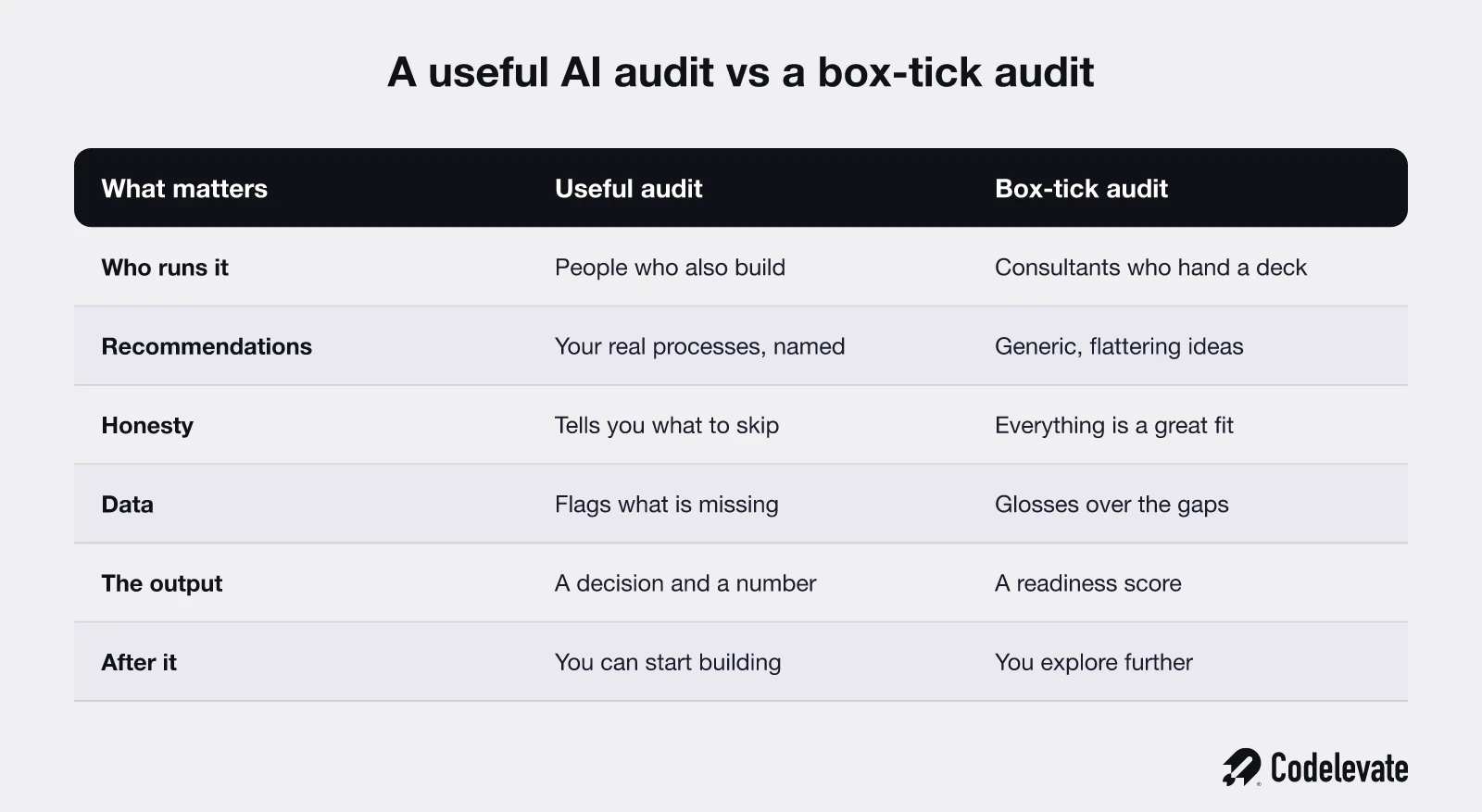
A useful audit is run by people who build, not just assess. When the auditor will also, if you choose, build the thing they recommend, their incentives point at a roadmap that actually works, because they will have to deliver it. An audit from a pure consultancy that hands you a deck and walks away has no such skin in the game, and it shows in how buildable the recommendations are.
A useful audit is specific and honest. It names your real processes, it tells you which of your ideas are bad, and it is candid about the data you are missing. A weak audit is generic, flattering, and vague, because generic is cheaper to produce and flattery sells the next phase. If everything you suggested came back as a great fit, be suspicious.
A useful audit ends in a decision and a number. You should finish it knowing what to build first, what it will roughly cost, and what it should return. If you finish it with a maturity score and a recommendation to "explore further," you have bought a reason to hire the same firm again, not an answer.
When you need an AI audit, and when you can skip it
An audit is worth it when you have a real business and a genuine sense that manual work or missed data is costing you, but you are not sure where AI would help most or whether you are ready. That describes most companies at the start of their AI journey, and for them a small audit is the single best first spend, because it turns a big, risky decision into a clear one.
You can skip the formal audit when the opportunity is already obvious and contained. If you know exactly which one workflow you want to automate and it is simple and self-contained, you do not need a three-week assessment to tell you, you need someone to build it. You should also hold off if your processes are still changing weekly, because an audit of a moving target ages badly. And if you have strong in-house data and product leadership who can already see and rank the opportunities, an external audit may only confirm what you know. The rule is the same one that governs the whole field: buy the audit when it will change a decision, not when it will decorate one.
How Codelevate runs an AI audit
Because we run audits as the opening step of real automation projects, ours is built to produce a roadmap we could build from, not a report to file. We start by sitting with the people who actually do the work, because the best opportunities live in the friction they feel daily and rarely on an org chart. We look honestly at the data behind each idea, we score the opportunities on impact and effort together, and we attach rough costs and returns so the roadmap is a business decision.
The thing that makes our audit useful is that we have to stand behind it. As an AI automation agency that also builds what it recommends, we cannot afford a roadmap that looks good and does not work, which keeps us honest about what is worth building and what is not. If you want the fuller picture of how the audit fits into a build, our guide to what an AI automation agency does covers the stages that follow discovery. And where an opportunity turns out to need custom software rather than connected tools, our AI development team builds that too.
The promise is the one this guide argues for throughout: you will leave the audit knowing what to build first, what it costs, what it returns, and what to leave alone, with no obligation to build it with us.
The bottom line
What does an AI audit really deliver? Done well, it delivers clarity you can act on: a ranked, costed roadmap of where AI pays off in your business, an honest read on whether your data and processes are ready, a rough business case, a risk and governance check, and a clear decision on what to build first. Done badly, it delivers a readiness score and a reason to keep paying. The difference is whether the people running it build what they recommend and are willing to tell you the truth. Buy the audit when you have real work worth removing and want an unbiased answer on where to start, and judge it on one test: did it end in a decision, or just a document?
Free download: our SaaS founder's AI blueprint helps you spot where AI and automation pay off before you commission anything. And if you want a straight, buildable answer on where AI fits in your business, you can book a free call with our team and we will walk you through what an audit would surface, with no obligation.

.svg)
.svg)


