
From service to SaaS platform: selling your expertise as software
A client pays you 100 euro today for a calculation your specialist does by hand. In a few years that same client will try it first with their own AI assistant. The question then is not whether your knowledge still has value. The question is whether that knowledge lives in your product, or in somebody else's prompt.
This article is about how to build a SaaS platform from a service that already runs, and how to turn your service into software. You sell your expertise as a product: to the clients you already have, and to the clients who are too small for your current rate. For a service firm, a SaaS platform is not a new company. It is the same knowledge, packaged so that revenue no longer grows only with the people you hire.
This piece is for the owner, managing partner or operations lead of a Dutch B2B service company with 10 to 200 people. Think subsidy advisors, BPM, customs and tax specialists, certification and training providers, compliance consultancies, administration offices, inspection firms and brokers. Your core service is a repeatable expert process, done by hand, priced per file or per hour, with volume. You have no technical team, and your growth depends on who you can hire.
It is not for you if you are looking for a startup idea, want to build a consumer app, only compare hourly rates, need a single Zapier flow, or run a 6 month tender.
In this article you will learn which services can become a platform, the order to do it in, which pricing models work, what changes inside your company, how to answer "our customers pay for our service, not software", and when you should not start at all.
Key takeaways
• Your clients will try the work you sell per file with their own AI. The firm that puts its expertise into a product first keeps the client. The firm that waits becomes a price.
• Not every service becomes a platform. It works when the process runs on rules, is repeatable, has volume, and has clients who would rather self serve.
• The platform is year 2, not month 1. First you map the process and automate it internally, so the same team handles more volume.
• The order is fixed: Blueprint, Foundation, Automations, Platform, with Operations underneath from the first automation.
• A platform sells your service at a price point the manual version can never reach. That opens a market you currently leave alone.
• 3 pricing models fit: per unit, subscription, or service plus software. Most service firms end up with a mix.
• Your service does not disappear. Complex files, accountability and advice stay human, and they get more valuable, not less.
• Do not start if your process is not stable, your volume is low, or nobody inside wants to own the product.
Why your service becomes a price if you wait
Service firms sell time and judgment. As long as the work can only be done by hand, that is a sound model. The problem starts when part of the work can be done by software, and the client notices.
In August 2026, ING Research reported that AI is putting the traditional revenue model of Dutch accountants under pressure. Standard work gets faster, so the hours per client go down. According to ING, the value moves to specialist knowledge and advice. What holds for accountants holds for every firm that bills per file or per hour.
For you, that means something concrete. The client who pays 100 euro for a standard calculation will soon ask why. They paste their data into a chatbot, get an answer that looks right, and only call you when it goes wrong. That answer is often roughly correct. In your field, roughly correct is not good enough, but the client only sees the difference later.
You then have 2 options. You wait, and your price per file drops step by step, because the client can see the alternative. Or you put your rules, your exceptions and your checks into a product yourself. Then the client uses your knowledge instead of a generic AI, and pays you for it. The first firm in a niche to do that keeps the client. The one that waits becomes a line on a comparison site.
What a SaaS platform means for a service firm
A SaaS platform is software your clients use themselves in the browser, for a subscription or a price per use, while you run and update the software. For a service firm, it is the core of your service as a product: your rules, your templates, your checks, without a specialist touching every file.
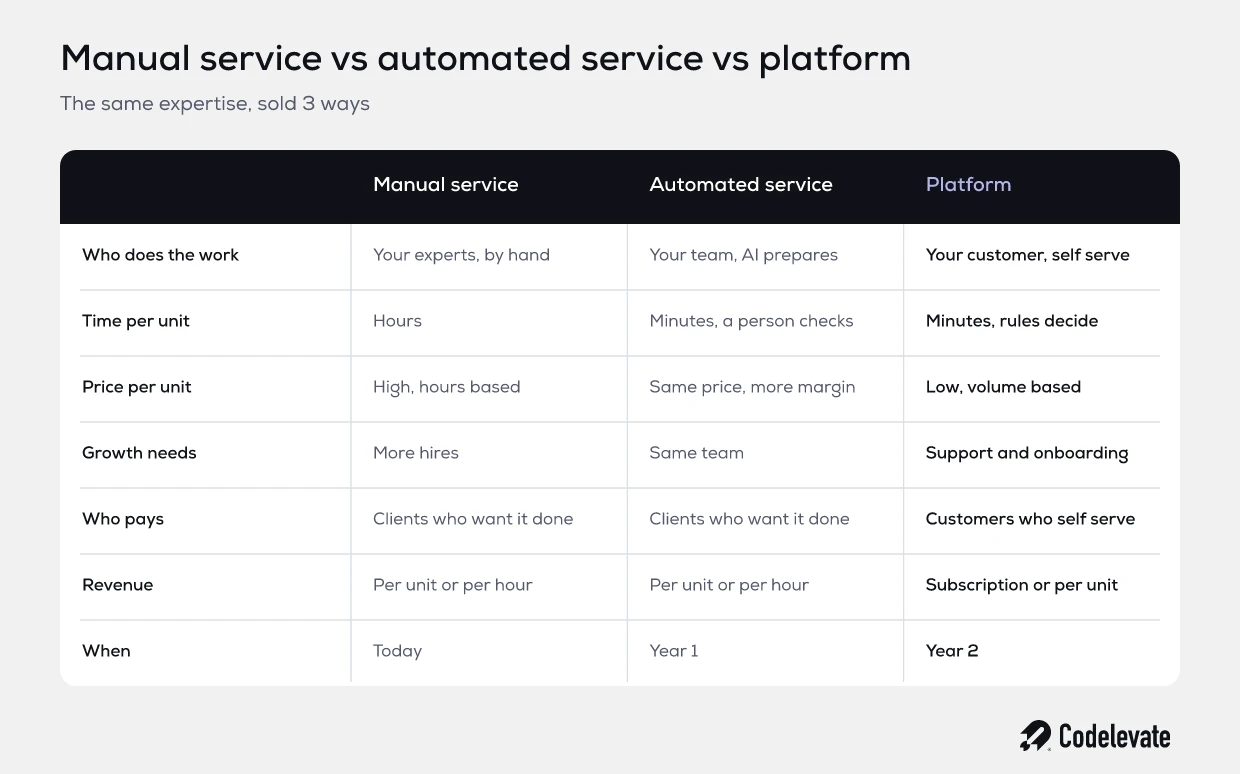
That is different from a productised service. Our article on how to productise your consulting service with AI covers a fixed offer at a fixed price that your team still delivers, with AI speeding it up. For most firms that is the sensible first step. This article goes a step further: software your client operates, while your team only sees the exceptions.
The difference is who does the work. In a productised service, your team does it, faster and more predictably. On a platform, the client does it, and your knowledge sits in the software. That changes your margin, your clients, your support and your risk. So it deserves its own decision, and its own order.
Which services can become a SaaS platform
Not every service makes a good platform. A 3 day strategy session with a board is not software. A calculation that happens 40 times a week under the same rules is. 4 traits decide whether your service qualifies.
• Rule based: the work follows laws, tables, conditions or decision trees you can write down.
• Repeatable: 80% of files follow the same path, and the rest are exceptions you can recognise.
• Volume: it happens hundreds or thousands of times a year, not 12 times.
• Clients who would self serve: there is a group that would rather get an answer themselves than send an email and wait 3 days.
If all 4 hold, you have a candidate. If 1 is missing, internal automation is usually the better investment. A few examples of services that often meet all 4:
• A BPM (Dutch vehicle registration tax) calculation for car importers, based on registration, date and history.
• A subsidy scan that matches a company profile with the schemes that are open, as in our example of an AI powered subsidy platform.
• Certificate management for a training provider: who expires when, who needs to retake a course.
• A compliance check of documents against a fixed list of requirements.
• A pre check for an inspection or energy label, so the inspector makes fewer wasted visits.
What they share: the client has a question that keeps coming back, and you have the answer in your head, in a spreadsheet, or in your team's habits. A spreadsheet with 14 tabs called "BPM_final_v7_NEW" is not a product. It is a start, though.
The order
The biggest mistake is starting with the platform. It sounds logical: the client wants to calculate on their own, so build something where the client calculates on their own. But a process that runs 5 different ways inside your firm cannot be handed to a client. The software will get the exceptions wrong, and your client will call your team anyway, this time with a complaint.
So it works in 4 phases, with a fifth layer underneath.
• 1. The Blueprint (10 to 20 working days, 2,500 to 10,000 euro depending on the number of processes): the process mapped as it really runs, the bottlenecks priced in hours and euro, the AI opportunities ranked, SaaS feasibility, a milestone roadmap with fixed prices, and a first rough prototype in your own repository. It is yours to keep, even if you build the rest in house.
• 2. The Foundation (4 to 8 weeks, fixed price from the Blueprint): 1 source of truth for procedures, rules, templates and data. Your company runs on it, and later your AI and your platform do too.
• 3. The Automations (18,000 to 45,000 euro per major process): 1 bottleneck per milestone, integrated with Exact, AFAS or your sector tool, with a person approving where a mistake is expensive. The same team handles more volume.
• 4. The Platform (staged, from 25,000 euro, year 2): your expertise as a product your clients pay for, built on the process that is already proven internally.
• Operations, from the first automation: monitoring, a named engineer on the alert, the AI cost per unit capped, a 1 page report every month, and model and rule updates.
Why is the platform year 2? Because your team is the first and best user. During the automations, the software runs on real files, with a specialist who sees every result. Every error is caught by someone who knows the right answer. After a year you know which rules hold, which exceptions are common, and what the software costs per file. That is exactly what you need before a client presses the button without a specialist.
There is a financial reason too. Internal automation pays for itself in the people you do not have to hire. That payback does not depend on whether clients will ever pay for software. The platform then becomes a second revenue line on top of a process that already earns, not a bet on a market you do not know yet.
Want the steps towards your own platform in 1 place, with the questions to answer first? Download the free SaaS AI blueprint. It is a working document, not a brochure, and it is separate from the paid Blueprint above.
Worked example
What follows is a worked example. It is an illustration with assumptions, not a client case. It is based on a comparable vehicle tax file process we automated, where processing time went from 4 to 8 hours per file to under 5 minutes.
Take a firm that does BPM calculations for business car importers. BPM is the Dutch tax paid when a vehicle is registered in the Netherlands. The assumptions:
• Price per manual calculation: about 100 euro.
• Volume: 2,400 calculations a year, so 240,000 euro in revenue from this service.
• Time per calculation: 1.5 hours on average, including requesting documents, checking and reporting.
• Team: 3 specialists with about 4,200 productive hours a year between them.
This team is at 3,600 of its 4,200 hours. Another 400 calculations and someone has to be hired. A specialist in this field is not found in a month, and a fourth person for 400 extra files makes the margin thinner, not fatter. Growth does not stop here for lack of clients. It stops for lack of hours.
After automation, the software collects the data, applies the rules and prepares a draft. The specialist checks and signs off in about 10 minutes. For 2,400 calculations that is 400 hours instead of 3,600. The same team can now handle double the volume or more, and has time for the complex files clients happily pay more for. The price stays 100 euro, and the margin per calculation goes up.
Then the platform, in year 2. There is a group of clients you do not serve today: small dealers who import 5 or 10 cars a year. For them, 100 euro per calculation is too much, so they calculate in a spreadsheet themselves, or guess. For that group you build a self service version: enter the registration, check the data, download the result with its reasoning.
• Single calculation on the platform: 19 euro.
• Subscription for dealers with volume: 149 euro a month.
• Suppose 60 subscribers and 1,500 single calculations in year 2. That is 107,280 euro plus 28,500 euro, 135,780 euro in total.
That revenue comes from a market you could never serve by hand. It does not need an extra specialist, because the process has run internally for a year. It does cost something else: support, onboarding, hosting and maintenance. More on that below. And note: these are assumptions to show the arithmetic. The Blueprint works it out with your own numbers, including whether those small clients really exist and what they would pay.
Pricing models for your platform
Your pricing model decides who uses the platform and whether your existing service suffers. 3 models work for service firms.
Per unit
The client pays per calculation, per scan or per file. It is the model your client already knows, just at a lower price. The upside: the barrier is low and revenue grows with usage. The downside: revenue fluctuates, and high volume clients start negotiating.
Subscription
The client pays monthly or yearly, often in tiers based on volume or number of users. That gives you predictable revenue, which also makes your company worth more if you ever sell it. The downside: a client who uses the platform twice a year will not subscribe. That group needs a single price.
Service plus software
The platform does the standard work, and the client can add a specialist per file. For example: 19 euro on your own, 49 euro with a specialist check, 100 euro fully handled. This model fits service firms best, because it does not replace your existing service but builds an entry point beneath it.
The big risk in every model is cannibalisation. A client paying 100 euro today could move to 19 euro. You solve that with a clear line. Standard files may go to the platform. Complex files, risky files and anything that needs your signature stay a service. If you cannot draw that line, your process may be less rule based than you thought.
What changes inside your company
A platform is not a project that is finished on launch day. You go from a company that delivers files to a company that also delivers software. That takes a few things you do not do today.
• Support: clients log in at 21:00 with a question. You need a help centre, clear error messages and someone who picks up tickets.
• Onboarding: a new client must be able to run their first calculation without talking to your team. That is a design question, not a sales question.
• Billing: subscriptions, single payments and credit notes, automated and connected to your accounting.
• GDPR and liability: you process client data in your own software. You need a data processing agreement, and your terms must say who is responsible when a result is wrong.
• Rule updates: rates, laws and conditions change, often on 1 January. Someone has to update the rules in the software before the client notices.
• An internal owner: someone in your company decides what the platform does and does not do. Without that person it becomes a pile of client requests.
What does not change: your service stays. The platform takes over the standard work, and your specialists do the work that needs judgment. In practice that service often gets more expensive per hour, because the simple work is gone. Your team moves up to the files clients genuinely pay for.
"Our customers pay for our service, not for software"
This is the objection we hear most, and it is usually true for your current clients. They pay for certainty that it is right, for someone they can call, and for a name on the report. That does not change.
Ask yourself 2 questions. What does a client pay per file today, and how many files is that a year? And how many clients do you leave alone because they cannot or will not pay that price? The platform does not replace your service. It is your service at a price point the manual version can never reach. It reaches clients you do not see at all today.
And if your clients truly will not pay for software, you still have the internal automation. It pays for itself in the people you do not have to hire. That is why the platform sits at the end of the order, not the start. You make the decision once you have the numbers.
Risks, and when not to do it
A platform is a second business inside your business. It is not the right step for everyone, and sometimes it is not the right step yet. These are the situations where we advise you not to start.
• Your process is not stable: 5 advisors working 5 ways in 5 tools. Standardise first, or you automate the chaos.
• Your volume is low: 50 files a year will not carry software. A good template and a fixed way of working are enough.
• Your clients want to hand off responsibility: if the client pays so they do not have to do it, they will not do it themselves on a platform either.
• The decision is too risky to leave to the client: where results carry large legal or financial consequences, a person must sit in between. That is possible, but it is service plus software, not self service.
• Nobody inside wants to own it: a platform without an owner dies slowly of small requests.
• You want the platform in month 1: then you skip the phase where you learn what the software must do. That is the most expensive way to learn it.
There is a technical risk as well. A prototype built in a weekend with an AI tool often looks right. The question is who reviews the data model, the authorisation rules and the integrations before 500 clients work in it. For a product clients pay for, that is not a detail.
Who builds it and what happens after launch
On a programme like this, owners want to know 3 things before they sign. Who works on it, what happens after launch, and what if month 1 disappoints?
Who works on it: 2 engineers, by name, from the Blueprint to the platform in year 2. No rotating team, no handover to another department. The people who map your process also build the automation and the platform. You can read more about how we set up a SaaS product on our SaaS development page.
After launch: Operations starts the day the first automation runs. Monitoring, a named engineer on the alert, the AI cost per unit capped, and every month 1 page with what ran, what broke and what it cost. The response time is set in the Blueprint. As a planning value, we use 1,250 euro per month per automation, or 3,500 euro per month for the whole company.
If month 1 disappoints: Exit after month 1: pay for what is delivered, keep everything. The code is in your repository, and the accounts are yours.
Codelevate turns Dutch B2B service companies into software companies: we map the expert process you run by hand, automate it so the same team handles the volume, and build the platform your customers pay for, with 2 engineers by name from the blueprint to year 2. Codelevate, Amsterdam and Sofia, since 2019. 24 published cases, 8 of them B2B platforms.
From service to platform starts with your own process
Selling your expertise as software is the logical next step for a service firm with a repeatable process and volume. Your clients are going to try the work themselves. The question is whether they do it with your knowledge or without it.
Do not start with the platform. Map your process, automate it internally, and let your team be the first user. Then open it to clients at a price the manual service can never reach, while your service stays for the work that needs judgment.
Want to think it through on your own first? The free SaaS AI blueprint lists the questions to answer before you build.
Want to know if your service can become a platform? Send us what you have. 1 of the 2 engineers reads it with you in 20 minutes, and you get 1 of 3 answers in writing the same day: do it in house, hire, or the Blueprint.


.svg)
.svg)


