
Having custom software built: when your service should become software
When you start looking into having custom software built, the question in your head is usually: who can build this for me? It is a fair question, but it is not the first one. The better first question is: which part of my service is a repeatable, rule based expert process, with a price per unit and enough volume?
The process decides the software, not the other way round. A builder who starts with screens starts at the wrong end. A builder who starts with how your people handle a file, an application or a certificate today builds something that keeps working when the volume doubles.
This article is for the owner, managing partner or operations lead of a Dutch B2B service company with 10 to 200 people. Think subsidy advisors, vehicle tax and customs specialists, training and certification providers, compliance consultancies, accountancy and administration offices, inspection firms and insurance brokers. Your core service is expert work done by hand, you charge per file or per hour, and your growth stops at the next vacancy.
It is not for you if you are still looking for an idea without paying customers, if you want a consumer app, if you mainly compare hourly rates, if you need 1 Zapier flow, or if you are running a 6 month tender.
In this article you will learn the signs that your service is ready to become software, when a standard package or a no code tool is the better answer, what to have ready before you talk to any builder, how custom software development runs in phases, and the 3 questions to ask every builder.
Key takeaways
• Start with the process, not the builder: which expert work is repeatable, follows rules, has a price per unit and happens often enough.
• Custom software is the right call only when your process is what sets you apart. If it is standard in your sector, a package is usually faster and cheaper.
• No code works for 1 team and a short flow. With many exceptions, links to Exact or AFAS and growing volume, it gets fragile.
• Bring 4 things to the first conversation: the process as it really runs, monthly volumes, the exceptions, and the systems it passes through.
• Good custom software grows in steps: map the process, build 1 source of truth, automate 1 bottleneck at a time, and only then a platform for your customers.
• The code, the repository and the accounts belong to you from day 1, not to the builder.
• Ask every builder 3 questions: who works on it, what happens in month 4, and what if month 1 disappoints.
Having custom software built starts with your process, not a builder
Most projects that go wrong do not go wrong on technology. They go wrong because nobody first wrote down how the work actually runs today. You end up building the version of the process that lives in a single person's head, and discover in testing that 3 colleagues each do it differently.
That is not unusual. At a subsidy advisory we worked with, 5 advisors worked 5 ways in 5 tools. Nobody was doing it wrong. There had simply never been an agreed way, because with 5 people you could get by without one. Software forces you to make that agreement.
In 2025 the Dutch government commissioned a study into AI use by small and medium sized firms. One owner put the need plainly: they wanted someone who could help map everything properly. You can read it in the government study on AI use in Dutch SMEs (in Dutch). That wish sits behind almost every custom build. See the process first, then build.
So custom software is not a product you buy like a laptop. It is your expertise written down as rules, steps and checks, so a system does the standard work and your people handle the exceptions. The better you know the process, the smaller, cheaper and more reliable the software gets.
7 signs your service is ready to become software
Not every process belongs in software. These 7 signs show up again and again at service firms where it pays off. If you recognise 5 or more, it is worth looking into properly.
• You charge per unit. Per return, per application, per certificate, per file. Then the value of time saved is simple arithmetic.
• The volume is already there. Dozens to thousands of the same kind of job per year, not 4 large projects.
• The work follows rules. An experienced colleague can explain why a file ends the way it does, even if there are many rules.
• Hiring caps your growth. A vacancy has been open for months, or you turn work away because nobody can pick it up.
• The knowledge sits in a few heads. When 1 colleague goes on holiday, part of the work stops.
• Data gets retyped. From an email into a spreadsheet, from the spreadsheet into Exact or AFAS, and back again.
• Your customers ask for visibility. They want to see the status, upload documents themselves or run a first check without calling you.
The last sign is the most interesting one. When customers ask to look into your process themselves, there is a product hidden in your service. That is the moment custom software becomes more than an internal tool.
An example from our own work: a specialist in Dutch vehicle tax (BPM) calculations for car importers spent 4 to 8 hours of manual work per file. After automation, a file takes under 5 minutes. It worked because the process was already settled: the same rules, the same sources, high volume. Exactly the 7 signs above.
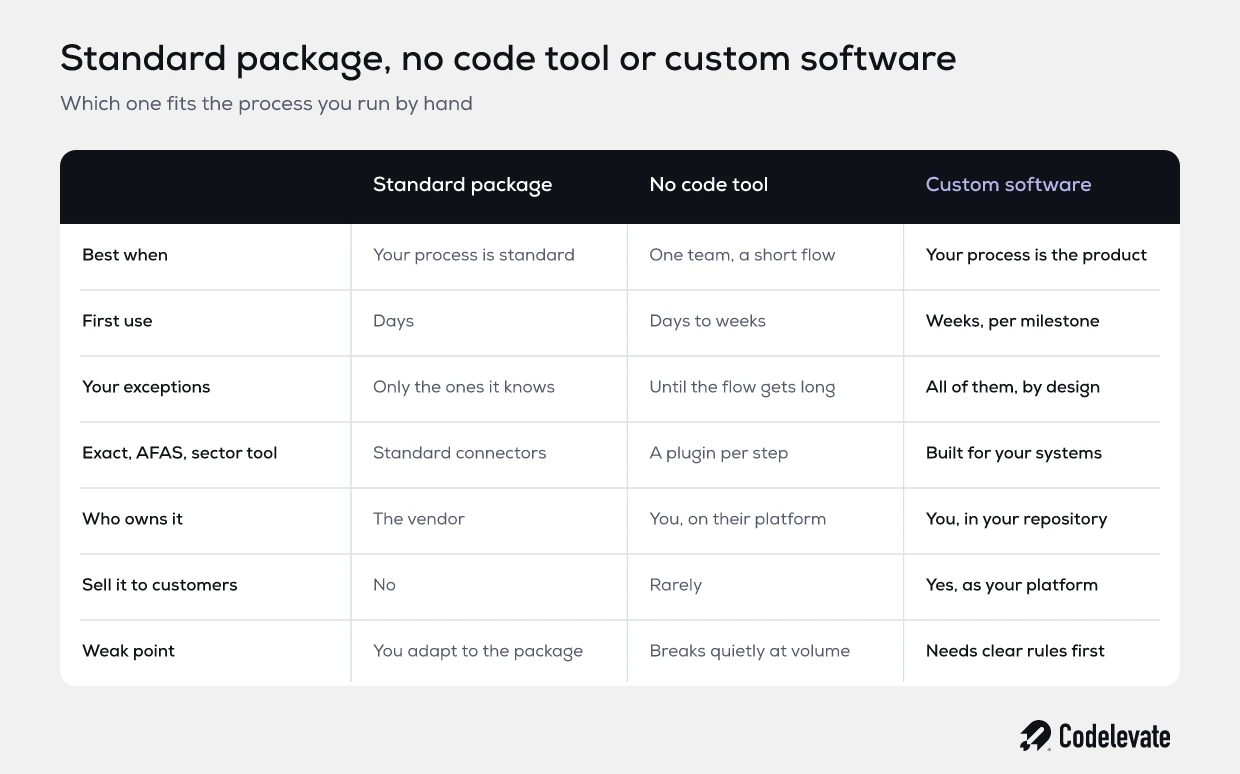
Standard package, no code or custom software: an honest comparison
Custom software is not always the right answer, and a builder who never says so is selling hours. There are 3 routes, and each has its place.
When a standard package is better
If your process works the way it works across your whole sector, there is often a package for it already. Bookkeeping, payroll, scheduling or a standard CRM. Those packages have been tested by thousands of users, and you pay per user per month.
The price you pay is adjustment: you fit your work to the package. For processes where you do not stand out, that is fine. Nobody picks an accountancy office for the way it sends its own invoices.
When no code is enough
No code tools like Make, n8n or an Airtable base are strong for 1 team with a short, clear flow. A form that creates a task, an email that fills a folder, an overview for 5 people. Quick to build, low in cost, and often a good way to test a process first.
It gets harder when the flow grows long, when there are many exceptions, or when the volume goes up. Then you have a chain of separate steps, each with its own connector, and nobody notices when step 7 quietly stops on a Tuesday afternoon. A spreadsheet with 14 tabs is also custom software, just without the tests.
In no code vs custom development: how to choose we go deeper into that tipping point.
When custom software is the right choice
Custom software pays off when your process is the product. When the way you assess a subsidy application, calculate vehicle tax or issue a certificate is the reason customers come to you. Then you do not want to squeeze that process into a package that does it differently.
It also pays off when you want to sell it to your customers later. You cannot resell a package. A no code flow on someone else's platform, rarely. Software in your own repository, yes.
Want to put the process on paper before you talk to anyone? Use the free AI product requirements template. It helps you describe the process, the exceptions and the integrations in 1 place, and you can hand it to any builder.
What to have ready before you talk to any builder
The first conversation gets much better if you bring 4 things. They do not need to be pretty. A photo of a whiteboard or a rough spreadsheet is enough.
The process as it really runs
Not the process from the quality manual, but how it went last week. Which step comes first, who does what, where the work waits for someone. Ask the 2 colleagues who do most of it to write it down separately. The differences between those 2 versions are the most valuable thing you can bring.
Volumes and the price per unit
How many files, applications or certificates per month? How long does 1 take, and what do you charge for it? With those 3 numbers, any serious builder can tell you in the first call whether there is a case. Without them, you are talking about feelings.
The exceptions
Which 20% of cases run differently? A customer who sends data in another format, a rule that differs per sector, a file that has to go back to the customer. Exceptions decide most of the build time. If you only discover them in testing, you pay for them twice.
The systems it passes through
Exact, AFAS, Twinfield, a sector tool, SharePoint, Outlook, a government or trade body portal. Write down which systems the work touches, whether they have an API and who manages them. A missing integration is often the biggest unknown in a quote.
And write 1 sentence about who decides. Does the owner sign alone, or does a second partner need convincing too? Then the builder knows who the proposal has to be written for.
Worked example: from manual work to internal tool to customer product
An example, not a client. Take a training and certification provider with 40 people. The company trains technicians for field work and issues 6,000 certificates a year. Its customers are employers who must prove their people are certified.
Step 1: the manual work today
For each certificate, a staff member checks attendance, the exam result, the validity rules for the customer's standard and the trainee's details. Then she creates the certificate, adds it to the register and schedules a reminder for recertification. That takes 45 minutes on average.
6,000 certificates times 45 minutes is 4,500 hours a year. That is about 2.8 full time staff, just for certificate administration. If trainee numbers grow by 30%, another vacancy opens.
Step 2: the internal tool
Once the process is mapped, 85% of certificates turn out to be standard: fixed rules, complete data. The system checks those itself, and a staff member approves the result. That takes 8 minutes instead of 45. The other 15% stays manual, because that is where the judgment is.
The arithmetic: 5,100 standard cases times 8 minutes is 680 hours. 900 exceptions times 45 minutes is 675 hours. Together 1,355 hours instead of 4,500. The same team can handle more than 3 times the volume, and the exceptions get no less attention.
Step 3: the customer product
Employers call regularly to ask whose certificate expires soon. On top of the internal tool you build a customer portal: the employer sees the status of all its technicians, gets an alert before expiry and books recertification directly.
Say 8,000 technicians are in the portal through their employers, and the provider charges 12 euro per technician per year. That is 96,000 euro a year in new revenue on top of the training. The service has become a product customers pay for, even in a month when they send nobody to training.
Note the order. The portal was only possible because the internal tool already knew the rules. Start with the portal and you build a nice front end on a process that still runs on paper.
You see the same pattern at a tax specialist who works per return, or at a subsidy advisor. With a subsidy matching engine we built, finding the right schemes went from hours of expert searching to seconds. After that, the same knowledge could go to customers as a service.
How the work runs: in phases, in your own repository
Custom work fits badly into 1 big quote. We work in phases, and after each phase you hold something you keep, even if you stop. A full cost breakdown is in a separate article; here are the outlines only.
• The read. Free, 20 minutes with 1 of the 2 engineers. The same day you get 1 of 3 answers in writing: do it in house, hire, or the Blueprint.
• The Blueprint. 10 to 20 working days, 2,500 to 10,000 euro depending on the number of processes. The process mapped as it runs, bottlenecks priced in hours and euro, AI opportunities ranked, SaaS feasibility, a milestone roadmap with fixed prices and a first rough prototype in your own repository.
• The Foundation. 4 to 8 weeks, fixed price from the Blueprint. 1 source of truth for procedures, templates, rules and data, so the knowledge does not leave with an employee.
• The Automations. Fixed price per automation, 18,000 to 45,000 euro per major process. 1 bottleneck per milestone, integrated with Exact, AFAS or your sector tool, with a person approving where a mistake is expensive.
• The Platform. From 25,000 euro, staged, usually in year 2. Your expertise as a product your customers pay for.
Everything happens in your own repository and your own accounts, from the first commit. The Blueprint is yours, even if you then decide to build it in house or hire. For comparison: a senior developer in the Netherlands earns 65,000 to 95,000 euro gross a year according to Search Company. With about 30% employer costs on top, that is roughly 85,000 to 125,000 euro a year, and finding one often takes months.
You can read more about how we approach this for service firms on our custom development page.
The 3 questions to ask every builder
Before you compare prices, ask these 3 questions. The answers tell you more about the project than the number at the bottom of the quote.
Who works on it, by name
Names, not job titles. Who designs the data model, who writes the code, who reviews it? And are those the same people in month 1 and in month 10? With us it is 2 engineers by name, from the Blueprint to year 2.
Month 4, after launch
Launch is the start. Rules change, the Exact integration gets an update, the volume doubles. Ask who does the monitoring, who gets the alert when something stops and how fast they respond, and what the maximum AI cost per file is.
With us that is Operations: monitoring, a named engineer on the alert, a monthly 1 page report and updates to models and rules. As a planning value, 1,250 euro per month per automation. The response time is set in the Blueprint, so it fits your process.
When month 1 disappoints
Ask what you keep if you stop after the first month. In many projects the answer is nothing, because everything sits on the builder's platform. With us: Exit after month 1: pay for what is delivered, keep everything. The code is already in your repository, so you do not have to ask for it.
Who this is not for
Having custom software built is a serious step, and for some companies it is the wrong one. We would rather say that up front.
• You do not have a repeatable process yet. If every project is different, there is nothing to automate. Settle on 1 way of working first.
• You are looking for an idea without paying customers. Then the first job is selling, not building.
• You want the lowest hourly rate. Then you are comparing hours, and a nearshore team is cheaper on paper. The question is who on your side writes the tickets and reviews the work.
• You need 1 Zapier flow. Build it yourself, or have a freelancer do it in an afternoon.
• You want AI to decide on its own where a mistake is expensive. We always build a person into the places where it matters.
• You are running a 6 month tender with a long list of requirements. We are not a good fit for that, and that is no judgment on the tender.
Start with the process, and the software follows
The question of who can build it for you comes once you know what needs building. Look first at the expert work you do by hand, with a price per unit and enough volume. Once that process is settled, you choose between a package, a no code tool or custom software on facts rather than a sales pitch.
Codelevate turns Dutch B2B service companies into software companies: we map the expert process you run by hand, automate it so the same team handles the volume, and build the platform your customers pay for, with 2 engineers by name from the blueprint to year 2.
Want to put the process on paper yourself first? Download the free AI product requirements template and fill it in with the 4 things from this article: the process, the volumes, the exceptions and the systems.
Send us what you have. 1 of the 2 engineers reads it with you in 20 minutes, and you get 1 of 3 answers in writing the same day: do it in house, hire, or the Blueprint. Book the read.


.svg)
.svg)


