
EU AI data residency: what your AI feature actually sends outside Europe
Your AI feature works. Then your biggest customer's security team sends over a questionnaire, and one line on it stops the deal: list every location where our data is processed. The honest answer is that nobody on your team knows all of them.
That is not incompetence. It is the normal outcome of how AI features actually get built. Someone picks a model provider and checks its compliance page. Someone else adds a vector database, because retrieval was needed. Someone adds tracing, because debugging a prompt without it is miserable. Someone wires in an evaluation tool to stop shipping regressions. Every one of those calls was sensible on its own, and every one of them opened a new path for customer data to leave Europe.
This article is for founders, CTOs, and product or operations leaders at SaaS and enterprise companies who serve EU customers and are either shipping an AI feature now or trying to get one past a procurement review. If you want a general legal summary of GDPR, this is not that article. If you want to know which parts of your architecture actually decide the answer, and what to fix before the questionnaire lands, read on.
You will get a plain definition of what EU AI data residency covers and what it does not, the 3 questions that keep getting collapsed into one, the 9 places customer data leaves an AI feature, a worked example, 3 architecture patterns with their real trade-offs, and the questions to settle at proposal stage so this is designed in rather than retrofitted.
Key takeaways
• EU AI data residency is not one property of your stack. It is the combined behaviour of every service your AI feature touches, and the model is usually the only one anyone checks.
• Residency, processing location, and jurisdiction are 3 separate questions. An EU region answers the first, sometimes the second, and never the third.
• Storing data in Europe and running inference in Europe are configured separately at most providers. The default for one is not the default for the other.
• The expensive leaks are rarely the model call. They are observability traces, evaluation runs, error payloads, and the small helper APIs nobody documented.
• The EU AI Act's high-risk deadline moved to December 2027, but the transparency duties that landed in August 2026 did not move, and customer security reviews never waited for the law anyway.
• EU sovereign cloud options became genuinely usable in 2026, which removed the old excuse that frontier models simply were not available in Europe.
• Retrofitting residency after launch typically costs more than building it in, because it usually means changing your retrieval layer and your entire observability setup at once.
• The deciding question at proposal stage is not which model to use. It is which categories of customer data are allowed to reach a third party at all.
What EU AI data residency actually means
EU AI data residency is the guarantee that the customer data flowing through your AI feature stays stored and processed inside the European Union, across every service in the request path and not only the model provider. That last clause is the whole article, because it is the part that gets dropped.
Most teams treat this as a single yes or no. It is really 3 questions, and they have different answers.
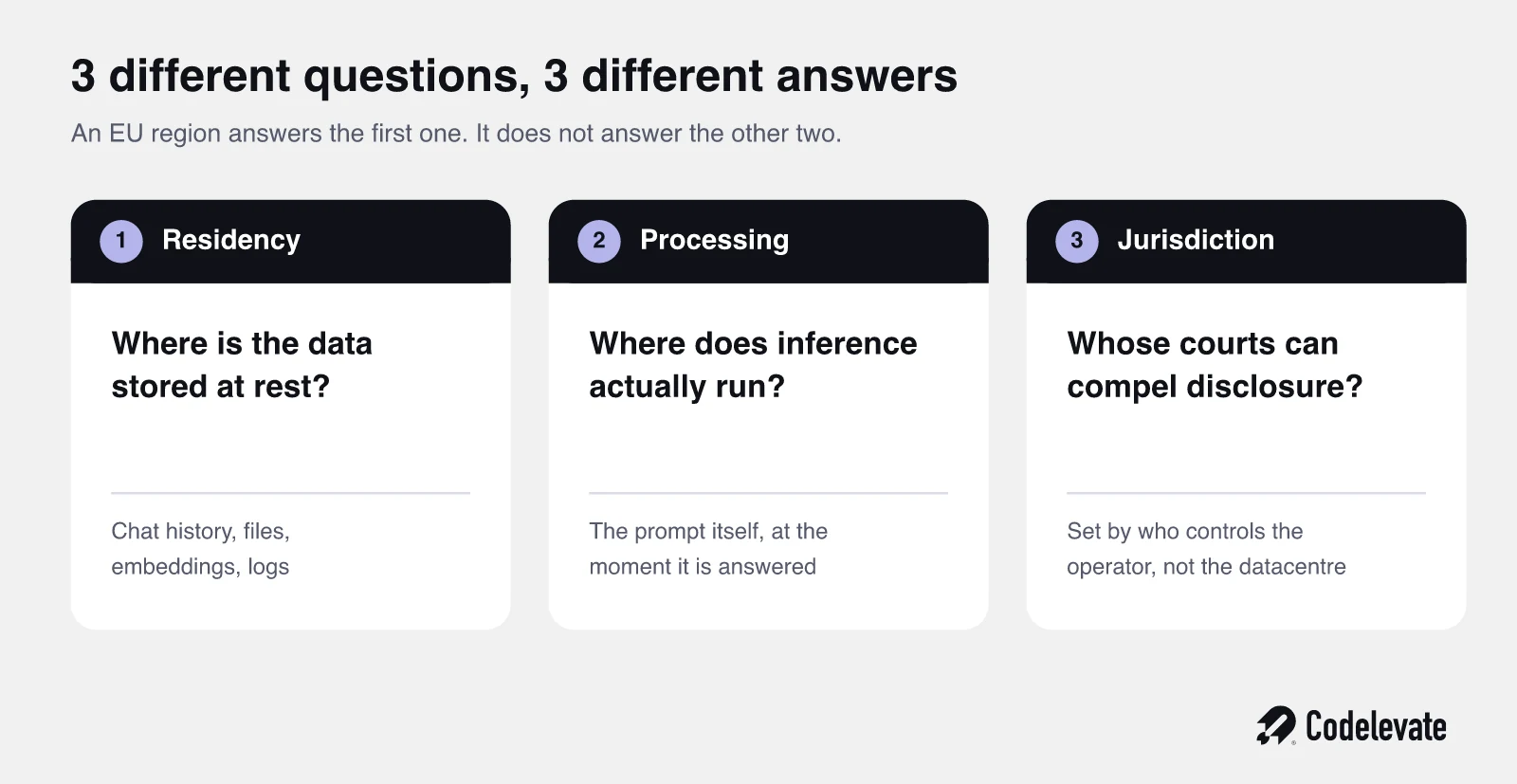
The first question is residency in the narrow sense: where the bytes sit when they are saved. Chat history, uploaded files, the embeddings in your vector index, the logs. This is the one every vendor compliance page answers clearly, because it is the easiest to guarantee and the easiest to market.
The second question is processing location: where the inference actually happens at the moment a prompt is answered. This is a separate setting at most providers, and it is worth stating plainly because it surprises people. OpenAI, for example, documents data residency and inference residency as distinct capabilities with distinct eligibility. Storing your data in Europe does not by itself mean your prompts are being reasoned about in Europe. If the questionnaire asks about processing and you answer with a storage fact, you have not answered it.
The third question is jurisdiction, and it is the one almost nobody addresses in writing. Jurisdiction is not about geography, it is about control. A datacentre in Frankfurt operated by a company whose parent is subject to another country's disclosure laws sits in a different legal position than one operated by an EU-incorporated entity with EU-resident staff. This distinction is precisely why AWS structured its European Sovereign Cloud as separate German companies rather than just another region, announcing general availability in January 2026 with its first region in Brandenburg, operated exclusively by EU residents. You may decide jurisdiction is an acceptable risk for your product. What you cannot do is pretend an EU region resolved it.
Why an EU region stopped being a sufficient answer in 2026
Two things changed, and they pulled in opposite directions.
The regulatory clock got looser. The Digital Omnibus on AI moved the compliance deadline for standalone high-risk AI systems from August 2026 to December 2027, and product-embedded high-risk AI to August 2028. If your plan was to sprint at a 2026 deadline, you got time back. The transparency obligations that applied from August 2026 did not move, and the prohibitions have been live since February 2025.
The commercial clock got tighter. Enterprise buyers, hospitals, banks, and public sector procurement never waited for the law. They ask now, in the security questionnaire, before signature. Our clients in healthcare and fintech consistently hit residency questions in sales conversations long before any regulator looks at them. A deferred legal deadline does not defer a stalled deal.
Meanwhile the technical excuse expired. For a couple of years there was a real argument that keeping everything in Europe meant accepting noticeably weaker models. In 2026 that argument is much thinner. Frontier models are available through EU regions of the major cloud platforms, and dedicated sovereign options exist. The trade-off shifted from capability to cost, effort, and how quickly new model versions reach you. That is a very different conversation, and a much less comfortable one, because it means the answer is now a choice rather than a constraint.
The 9 places your AI feature sends data out of Europe
Here is the part that catches teams out. When we audit an existing AI feature, the model provider is almost always configured correctly, because it is the obvious thing to check. The leaks are everywhere else.
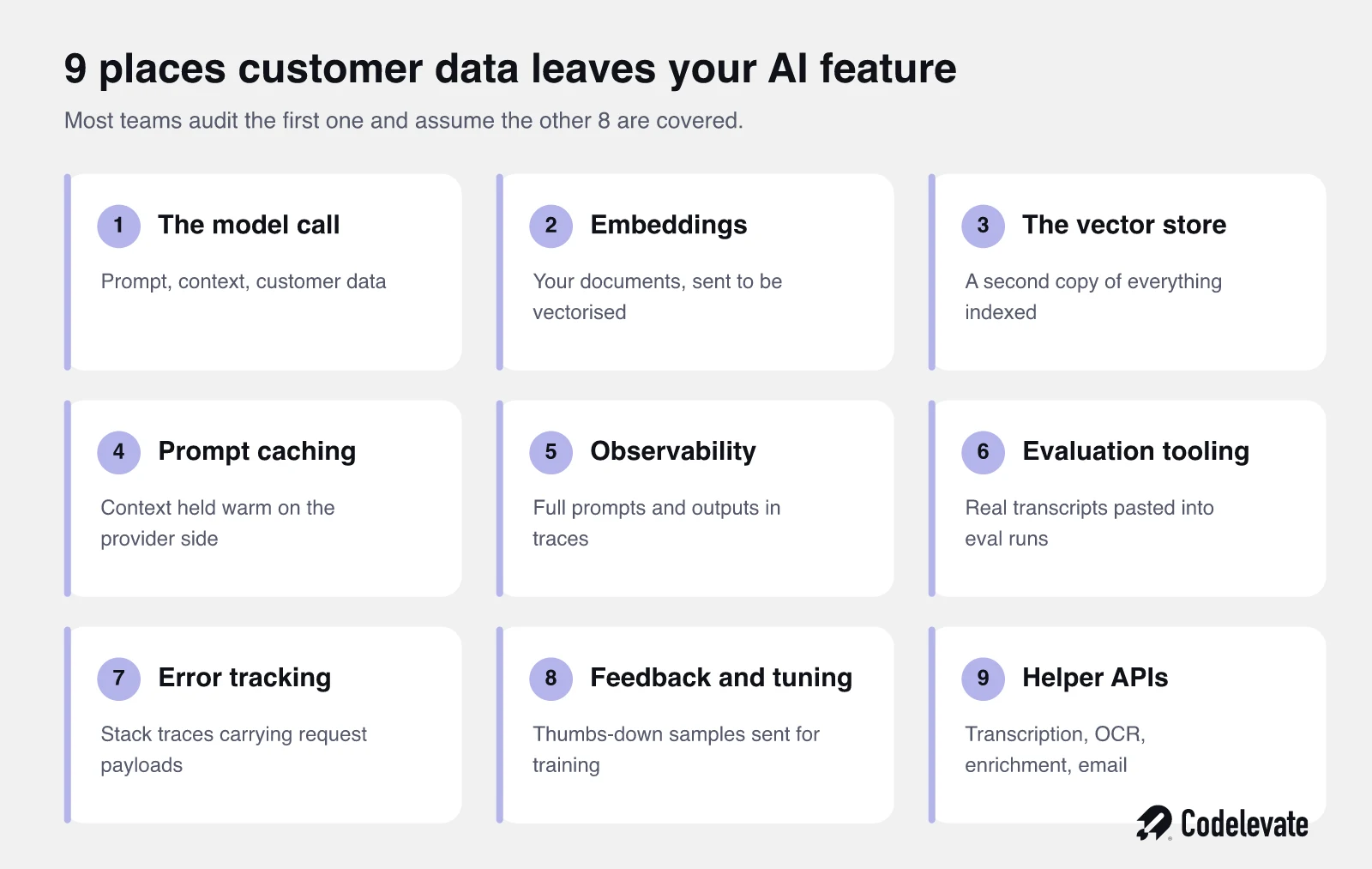
Work through them in this order, because the later ones are the ones that get missed.
The obvious 3
The model call carries the prompt, the system instructions, and whatever customer context you attached. Embeddings send your documents somewhere to be converted into vectors, which is a full read of the source text even though the output looks like numbers. The vector store then holds a second copy of everything you indexed, and it is a genuine copy, not a reference.
Teams usually get the first one right and treat the other 2 as plumbing. They are not plumbing. A vector database on a US-hosted plan holds your customer's documents just as surely as your primary database does.
The 3 nobody documents
Observability and tracing tools capture full prompts and full outputs by design, because that is what makes them useful. If your traces go to a service hosted outside Europe, you have built a complete, searchable, indefinitely retained mirror of every customer conversation, in a system your security review probably never looked at.
Evaluation tooling is worse, because it involves humans. Someone builds an eval set out of real transcripts, because synthetic examples never catch the interesting failures. Those real transcripts then live in the eval platform, get replayed on every test run, and sometimes get shown to annotators. Nobody wrote a data flow diagram for this. It grew out of a debugging session.
Error tracking and application monitoring quietly capture request payloads inside stack traces. Your APM was configured before the AI feature existed, by someone who was thinking about latency, not about the fact that a future feature would put patient notes or client financials inside the request body.
The last 3
Prompt caching keeps context warm on the provider side to save money and latency. That is a retention decision made for you by a performance feature, and its geography follows the provider, not your intention.
Feedback and fine-tuning pipelines take the conversations your users flagged, which by definition are the messy real ones, and send them somewhere to improve the model. Check whether that somewhere is inside your residency boundary and whether the data is retained after the training run.
Helper APIs are the long tail and the most common surprise: transcription for a voice feature, OCR for uploaded documents, a data enrichment lookup, the transactional email service that delivers the agent's output. Each was added by a different person on a different sprint. Together they often move more sensitive data across borders than the model does.
If you want the full playbook for scoping an AI build so these surfaces get named before they get built, the SaaS AI Blueprint walks through the architecture decisions that come with them.
A worked example: the assistant that failed its own security review
Consider a Dutch healthtech company with about 80 employees, selling scheduling and patient communication software to clinics. They add an AI assistant that drafts patient follow-up messages from consultation notes. It works well and clinics like it.
The build looked responsible. The model provider was configured to an EU region and had a signed data processing agreement. The team could point at that on request. Then a hospital group ran a proper review, and the picture came apart in about a week.
The vector index holding the consultation notes was on a managed plan whose default region was in the United States, chosen 6 months earlier when someone was prototyping and never revisited. The tracing tool captured every prompt, which meant every note, and stored it for 30 days on infrastructure outside the EU. The eval set that the team used to check quality contained roughly 400 real anonymised consultations, except the anonymisation had been done by a script that missed dates and clinic names. The transcription service for the voice notes feature, added by one engineer in a single afternoon, had never been reviewed at all.
Four leaks, none of them the model, none of them malicious, all of them the result of ordinary decisions made in the order that engineering work naturally happens. The fix took about 7 weeks: move the vector store, switch to self-hosted tracing with prompt redaction, rebuild the eval set properly, and replace the transcription vendor. Doing the same work at design time would have cost a few days of architecture discussion.
That ratio, days at the start against weeks later, is the pattern we see repeatedly. It is not a technology problem. It is a sequencing problem.
3 ways to keep an AI feature in Europe
Once you accept that residency is an architecture decision, there are 3 realistic shapes it can take. Most products should not use the strictest one.
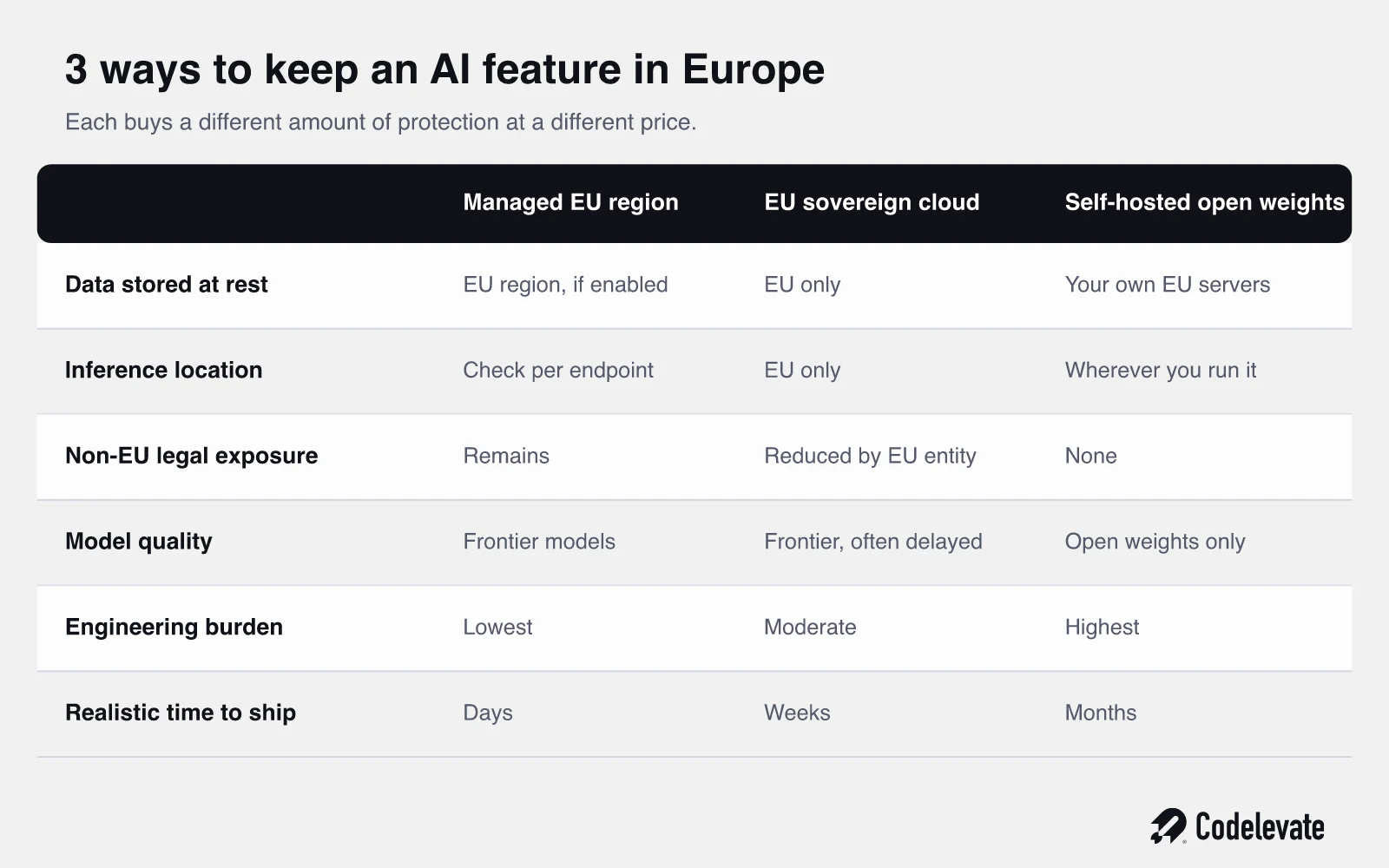
Managed EU region
Run frontier models through the EU regions of a major cloud platform, pin every supporting service to the same region, sign the paperwork, and turn on zero retention where it is offered. This is the right answer for most B2B SaaS products. It ships in days, keeps you on current models, and satisfies the large majority of security questionnaires. It does not remove non-EU legal exposure, so if your buyer's concern is specifically about foreign disclosure law, it will not close that gap.
EU sovereign cloud
Use a provider structured as an EU-controlled entity with EU-resident operations. This is the option that genuinely addresses the jurisdiction question, and it became practical during 2026. The costs are real: fewer services, newer model versions arriving later, and a smaller pool of engineers who have worked with it. Choose it when you sell into government, defence, healthcare systems, or regulated finance where the jurisdiction question is explicitly asked and explicitly scored.
Self-hosted open weights
Run open weight models on infrastructure you control inside the EU. Nothing leaves, full stop. The honest cost is that you now own GPU capacity planning, model upgrades, evaluation, uptime, and the security of the serving stack, and you accept a capability gap against frontier models on hard reasoning tasks. This is the correct answer far less often than the internet suggests. It fits when the data genuinely cannot leave your perimeter, or when your volume is high and predictable enough that the economics work independently of compliance.
A practical note: these are not mutually exclusive. A common and sensible pattern is routing by data class, where ordinary requests go to a managed EU region and the small share of requests touching the most sensitive fields go to a self-hosted model. It costs more to build than a single path, and much less than forcing everything down the strictest route.
What belongs in the contract, not just the architecture
Architecture without paperwork does not survive a review, and paperwork without architecture is a claim you cannot support. You need both. The items that come up most often:
• A signed data processing agreement with every processor in the chain, not only the model provider.
• The vendor's sub-processor list, plus notification rights when it changes, since your residency posture can shift because someone else changed a supplier.
• Zero data retention enabled and confirmed in writing wherever it is available.
• A written statement of where inference runs, not just where data is stored, because these are different commitments.
• Retention periods for logs and traces, which is usually the gap between what your policy says and what your tooling actually does.
• Your own data flow record, kept current, listing every service the AI feature touches and what each one receives. This single document answers most security questionnaires in an afternoon instead of a fortnight.
That last one is the highest return item on the list, and the one most teams skip because it feels like documentation rather than engineering. It is the artefact your enterprise buyer actually wants.
How to scope residency before you build
At Codelevate we treat this as a discovery question, not a deployment question, because by deployment the expensive decisions are already made. On AI platform builds we work through 6 questions before any architecture is chosen.
• Which categories of customer data will reach the AI feature at all, and which of those are you willing to let leave your infrastructure?
• Who is the strictest buyer you intend to sell to in the next 2 years, and what does their security review ask for today?
• Does any part of this fall into a high-risk category under the EU AI Act, which changes documentation duties as well as residency?
• Which supporting services does the feature need, and what is the residency position of each one, listed individually?
• What gets logged, where do the logs go, and how long do they stay there?
• Who owns this decision after launch, when someone adds a new tool in month 8?
Answering those 6 usually takes a couple of workshop sessions and reshapes the build. It is also the difference between an AI feature that clears procurement and one that stalls in it. If you want a second opinion on how your current feature would hold up, our AI development team does this review as part of scoping. For the regulatory side, our EU AI Act explainer covers the obligations in plain language, and the AI agent security checklist covers the controls that sit alongside residency.
The short version
EU AI data residency is not a property of your model provider. It is the weakest link across every service your AI feature touches, and the model is usually the strongest link because it is the only one that got checked. Separate the 3 questions, residency, processing, and jurisdiction, answer each one deliberately, then write down the answer in a data flow record you can hand to a buyer.
Do that at design time and it costs a few days. Do it after a hospital group or a bank has already asked, and it costs weeks of rework on your retrieval and observability layers, while the deal waits.

If you are earlier in the process and want the full build playbook, including how to scope an AI project so residency, security, and compliance are settled at the design stage, download the SaaS AI Blueprint. And if you already have a feature in production and want an honest read on where its data actually goes, book a free call with our team. We would rather map it with you now than after the questionnaire arrives.


.svg)
.svg)


