
AI software development in 2026: what actually changes
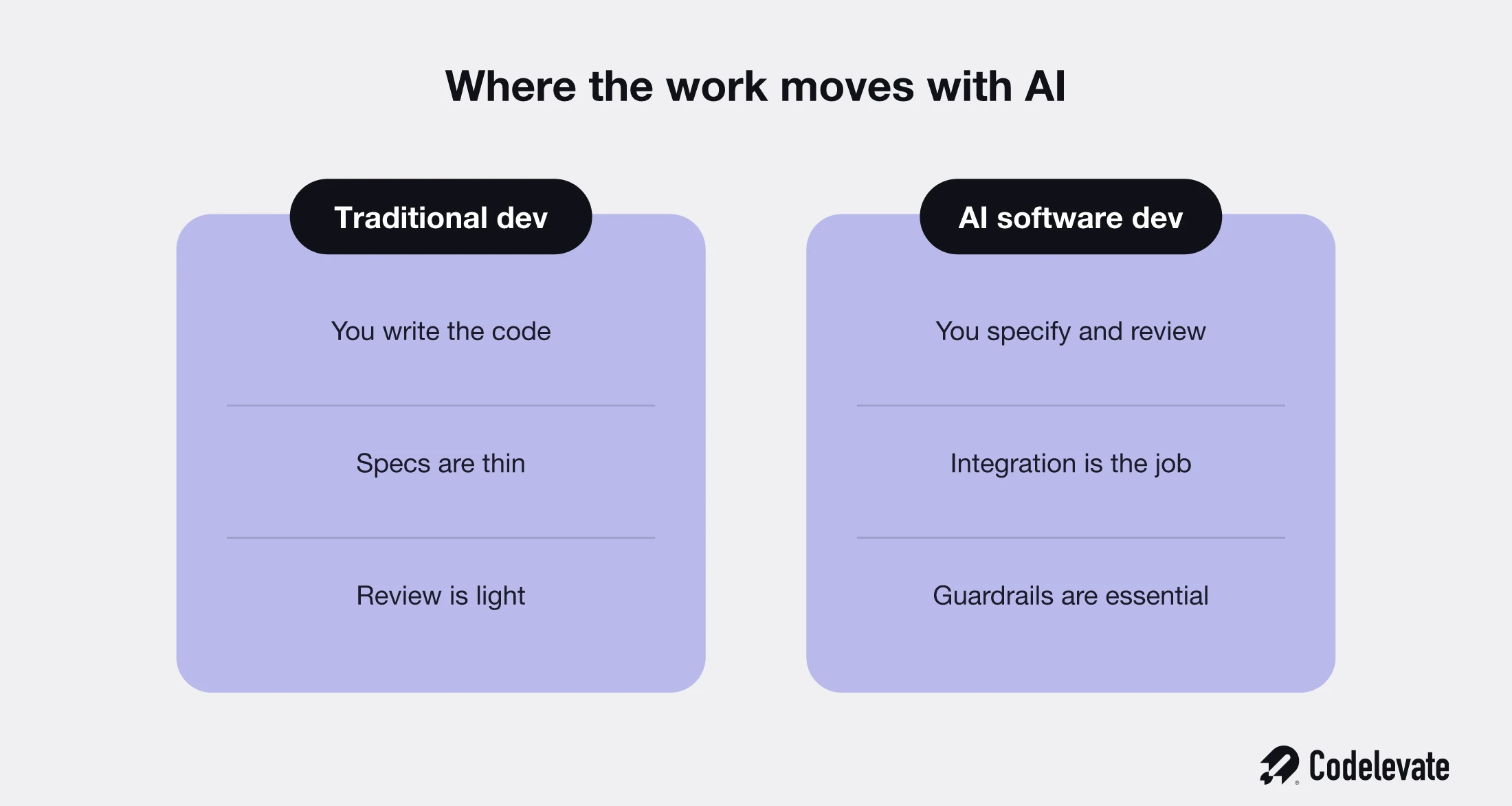
The popular story about AI software development is that it makes coding faster. That is true, and it is also the least interesting part. If faster typing were the whole change, you could measure the gain in saved keystrokes and move on. The real shift is bigger and more uncomfortable: AI moves the hard part of building software away from writing code and toward specifying, reviewing, and integrating it.
This article is for founders and engineering leaders deciding how to adopt AI in how their teams build, not whether to. You will learn what AI software development actually means in 2026, what genuinely changes about the work, what stays exactly the same, the new risks that come with AI-built code, where it helps most and least, and a practical way to adopt it without creating a mess you pay for later.
Framed well, AI software development is a transformation in how your team spends its time. Less of the day goes into typing out known patterns, and more goes into the judgment that decides whether software is correct, safe, and worth shipping. Framed badly, it is a fast way to generate a large amount of code that nobody fully understands. The difference between those 2 outcomes is the whole game.
What AI software development actually means
AI software development is building software with AI models deeply in the loop, helping to generate, review, test, and maintain code, rather than a person writing every line by hand. It is not a single tool and it is not the same as a chatbot that answers coding questions. It is a change in the workflow itself, where the developer increasingly directs and verifies work that an AI does a first pass on.
The important reframe is this. You are not replacing engineers with a model. You are changing what engineers spend their time on. The model is fast at producing plausible code. It is not accountable for whether that code is correct, secure, fits your architecture, or will still make sense in a year. That accountability stays with people, and it is where the work now concentrates.
What actually changes when you build with AI
Once you see AI as a shift in where effort goes, the specific changes become clear. Most of them move work from the keyboard to the judgment around it.
The bottleneck moves from writing to specifying
When a model can produce a working function from a clear description, the slow step is no longer typing the function. It is describing what you actually want, precisely enough that the output is right. Vague requests produce vague software. Teams that get value from AI write sharper specifications, because the quality of what comes out is now tied directly to the quality of what goes in. This is why specification has quietly become one of the most valuable skills on an AI-assisted team.
Prototypes appear in hours, production still takes work
A working prototype that used to take a week can now appear in an afternoon. That speed is real and it is genuinely useful for validating ideas. The trap is mistaking the prototype for the product. The gap between a demo that works on the happy path and software that holds up with real users, real data, and real edge cases has not closed. If anything, fast prototyping makes that gap easier to underestimate, because the start looks so finished.
Review and testing become the main job
If AI writes a first draft of the code, the most important human activity becomes reading it critically. Does it do what was asked? Does it handle the cases that matter? Is it secure? Is it consistent with the rest of the system? Review stops being a quick check at the end and becomes the central craft. The same goes for testing, which has to be more thorough precisely because the author of the code was not a human who understood the whole context.
Integration is where the time goes
Generating a component is the easy part. Wiring it into your real systems, your data, your authentication, and your existing code is where the effort concentrates, and AI helps less there because that work depends on context only your team has. This mirrors what happens with any AI build: the model is rarely the expensive part, and the integration around it usually is.
Maintenance and technical debt change shape
Code that is generated quickly and reviewed lightly can pile up faster than anyone can keep track of. Technical debt does not disappear with AI, it just accumulates at a new speed. Teams that stay healthy treat AI-generated code with the same standards as hand-written code: it has to be understood, owned, and maintainable, or it becomes a liability that slows every future change.
If you want a structured way to decide where AI fits in your product before you change how your team builds, our free SaaS AI Blueprint walks founders through exactly that, in a short download with no sales call required.
What does not change, and why it still decides success
It is tempting to think AI changes everything. It does not. The fundamentals that separated good software teams from poor ones still separate them, and arguably matter more now because AI can produce volume so quickly.
- Architecture. The big structural decisions about how a system is organized still need experienced human judgment. A model will happily generate code inside a bad structure forever.
- Security and data handling. Whether sensitive data is protected and access is controlled is not something to delegate to a first-pass generator. It is a deliberate human responsibility.
- Ownership. Someone has to understand the system well enough to change it safely. Code nobody understands is a risk no matter who or what wrote it.
- Product judgment. Deciding what is worth building, and what good looks like for your users, is still the human part that no model replaces.
The pattern is consistent. AI speeds up the production of code, but it does not remove the need for the judgment that makes code into a reliable product. The teams that do well keep that judgment firmly in human hands and use AI to move faster within it.
Where AI helps most, and least, across the build
AI is not equally useful at every part of building software, and knowing where it helps and where it does not is most of what separates a smooth adoption from a frustrating one.
It helps most with work that is well understood and repetitive: scaffolding a new service, writing boilerplate, generating a first set of tests, drafting documentation, refactoring tidy but tedious code, and explaining or debugging unfamiliar code. A good model saves real hours here and rarely does harm, because a person can check the result quickly. A developer who would have spent a morning wiring up a standard form and its validation can now spend twenty minutes directing and checking it, then move on.
It helps least with work that depends on deep context or carries real risk: the architecture of a system, novel domain logic that has never been written before, security-critical code, and the ambiguous product decisions about what to build at all. Here the model can produce something that looks right and is quietly wrong, and the cost of a mistake is high. These are the parts to keep firmly in experienced human hands.
The practical rule is simple. Let AI accelerate the known, and keep people in charge of the novel and the risky. Teams that invert that, handing the hardest decisions to a generator while labouring over the boilerplate themselves, get the worst of both worlds.
The new risks of AI-built software
Building with AI introduces failure modes that traditional development did not have, and most of them hide well because the output looks polished.
- Hidden technical debt. Code that works in the demo but is hard to understand, inconsistent, or poorly structured slows every future change and is easy to ship without noticing.
- Subtly wrong or insecure code. A model can produce code that passes a quick look and a simple test while being incorrect or insecure in ways that only show up later, under real conditions.
- Prototypes that never reach production. The most common failure is a fast, impressive prototype that stalls because the team underestimated the work to make it safe, integrated, and maintainable. We cover this gap in detail in our guide on taking an AI-generated prototype to production-ready SaaS.
- Over-trust. The biggest risk is human, not technical. When the output looks confident, it is easy to review it less carefully, which is exactly when mistakes slip through.
None of these are reasons to avoid AI software development. They are reasons to do it with discipline. The teams that get burned are usually the ones that treated speed as the only goal.
How to adopt AI software development well
Adopting AI in how you build is less about picking a tool and more about keeping the right habits as you move faster. A few practices separate the teams that benefit from the teams that create a mess.
- Specify clearly before you generate. The clearer the description, the better and safer the output. Treat the specification as real work, not a throwaway prompt. Our guide on specification driven development for SaaS and AI goes deep on this.
- Keep human review gates on anything that ships. AI can draft, but a person who understands the system signs off on what goes to production.
- Start narrow. Apply AI to a contained part of the work first, learn how it behaves on your codebase, then widen it as trust grows.
- Hold the line on architecture and security. Keep those decisions with experienced people, and do not let a fast generator quietly set them.
- Measure the result, not the speed. The goal is better software shipped faster, not more lines of code. Track whether quality and delivery actually improved.
Done this way, AI becomes a multiplier on a good team rather than a way to paper over a weak process. The discipline is the difference.
What a healthy AI software process looks like
If you want a quick way to tell whether your team is using AI well or quietly accumulating a problem, these signs are a good gauge.
- Every change that ships has been read and understood by a person who could have written it themselves.
- Specifications are getting clearer over time, not vaguer, because the team has learned that input quality drives output quality.
- Test coverage is rising alongside the speed of delivery, not falling behind it.
- Architecture and security decisions are still made deliberately by experienced people, not inherited from whatever the model produced first.
- The team can explain how any part of the system works, and change it safely, including the parts AI wrote.
When those things are true, AI is making a good team faster. When they start to slip, the speed is being borrowed against future trouble, and it is worth slowing down to fix the process before the debt compounds.
Build in house, hire a partner, or both
How you adopt AI software development depends on where your team is. If you already have strong engineers, the move is to upgrade their workflow and keep the judgment in house. If you are a founder without a full engineering team, a partner can build with AI on your behalf while keeping the architecture, security, and review standards that protect you. Many teams do both: a partner to move fast and set the foundation, then an in house team to own it over time. If cost is part of the decision, our breakdown of what it costs to build with AI is a useful companion.
How Codelevate approaches AI software development
We use AI heavily in how we build, and we keep the parts that decide whether software is any good firmly with our people. Our AI development team uses models to move fast on the parts that suit them, then applies real review, testing, integration, and architecture to turn that speed into software that reaches production and holds up. The work is staged, so you see value early and never trade reliability for a quick demo.
That balance is the point. Speed without judgment produces code you cannot trust. Judgment without speed loses to teams that have both. AI software development, done well, is how you get both at once.
The takeaway
AI software development in 2026 is not just faster coding. It is a shift in where the real work lives, from writing code to specifying, reviewing, and integrating it, with the fundamentals of architecture, security, and ownership mattering more than ever. The teams that win treat AI as a multiplier on a disciplined process, not a shortcut around it.
Two ways to start: grab the free SaaS AI Blueprint to map where AI fits in your product, or book a free call and we will help you adopt it without the mess.


.svg)
.svg)


