
How to measure the ROI of an AI agent
In this article you will learn how to measure the ROI of an AI agent in a way you can actually defend to a board or a co-founder. We will cover why most teams get this wrong, the simple formula that keeps you honest, a worked example with real numbers, and the hidden costs that quietly turn a promising agent into a money pit. This is written for founders, operations leaders, and CTOs who are weighing a real automation, not chasing a demo.
Here is the uncomfortable backdrop. Deloitte's research on AI returns found that financial payback from AI is proving slow and hard to pin down, even as investment climbs. The problem is rarely that the technology does not work. It is that teams measure the wrong things, forget half the costs, and judge a one-year investment after one quarter. Get the measurement right and the decision gets easy.
Why most teams cannot measure AI agent ROI
3 mistakes show up over and over.
The first is measuring activity instead of outcomes. "The agent handled 4,000 tickets" sounds impressive and tells you nothing about money. What did those 4,000 tickets cost a human to handle before, and what do they cost now?
The second is counting only the build. People price the project as a single number, ship it, and stop counting. But an AI agent keeps spending after launch: model and usage fees every month, plus the human time to review its work and fix it when it drifts. Leave those out and your ROI is fiction.
The third is judging too early. Most agents cost the most in year one, when you pay to build them, and pay back over the following years. Measure at month three and almost everything looks like a loss.
Fix those 3 and you are already ahead of most companies pouring money into AI without knowing if it works.
What AI agent ROI actually means
ROI is not complicated. It is the value an agent creates, minus what it costs you, divided by what it costs you, over a defined period. The discipline is in being honest about both sides and naming the period out loud.
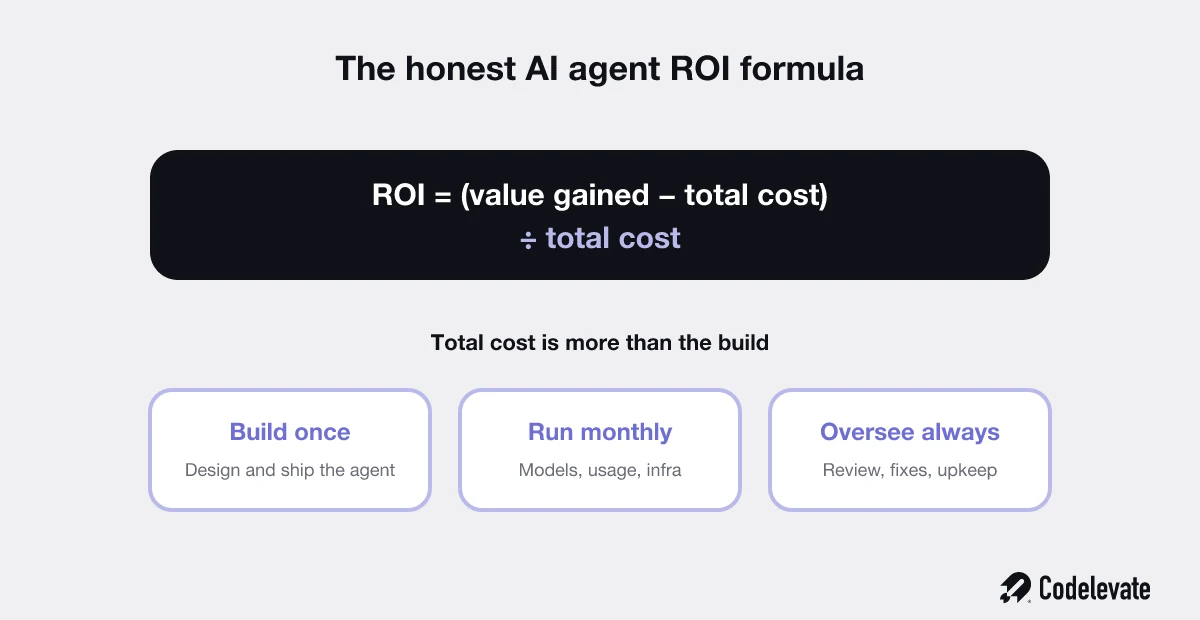
The trap sits in the words "total cost". For an AI agent that figure has three parts: the one-time cost to build and integrate it, the recurring cost to run it, and the ongoing cost to oversee it. Most failed business cases only counted the first one. Always state the time window too. "ROI of 40 percent" is meaningless until you say "in year two".
Hard ROI and soft ROI: count both, but keep them apart
Some of the value an agent creates lands directly in the bank. Hours saved, fewer costly errors, and extra revenue are hard ROI. You can put a euro figure on each one and defend it. This is the number your business case lives or dies on, so keep it conservative.
Other benefits are real but harder to price. A team that stops doing soul-crushing manual work tends to stay longer. Customers who get answers in minutes instead of days tend to renew. Lower risk from fewer compliance slips is worth something, even if you cannot name the exact amount. This is soft ROI.
The honest move is to count both, but never blend them into one inflated figure. Lead with the hard number, then list the soft benefits separately as upside. That way nobody can accuse you of padding the case, and you still get credit for the value that does not fit neatly in a spreadsheet.
Step 1: Baseline the work before you automate
You cannot prove savings against a number you never wrote down. Before you build anything, measure the task you plan to hand to the agent, as it runs today.
This baseline is the single most valuable thing you can do, and the step almost everyone skips. Spend a week measuring the current process honestly. Without it, every ROI claim later is a guess dressed up as a number.
Step 2: Add up the true cost of the agent
Now price the agent across its whole life, not just the build.
Build once. The design, the integration into your systems, the testing, and the work to get it safely into production. This is usually the biggest single line, and it is one-time.
Run monthly. Model and API usage, hosting, and any third-party tools the agent depends on. Usage-based AI costs can swing with volume, so estimate at realistic load, not the quiet pilot.
Oversee always. Someone has to review what the agent does, catch the cases it gets wrong, and maintain it as your systems and data change. This human time is real and recurring, and it is the cost teams most often pretend does not exist. A good rule is to budget oversight from day one rather than discovering it later.
If you want help pressure testing these numbers for your own case, our work as an AI automation agency is built around scoping exactly this before a line of code is written.
Step 3: Count the value on every side
Value is more than saved hours, though that is the easiest place to start. A complete picture counts four kinds of return.
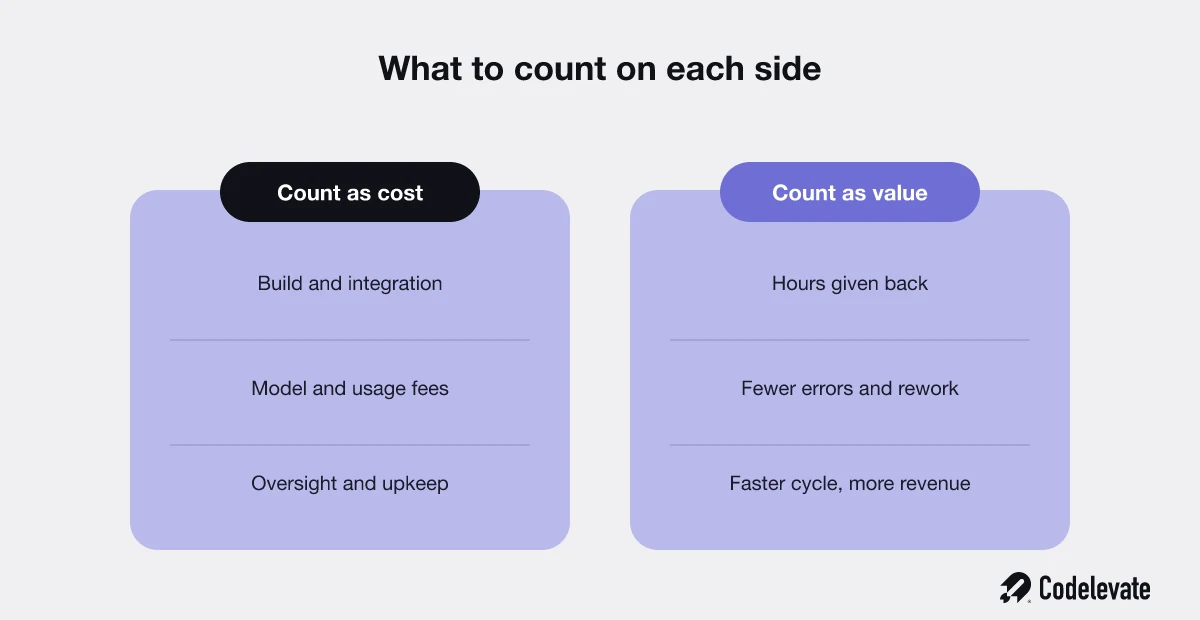
Not every agent delivers all four. The point is to look for each one deliberately, so you neither undersell a genuinely useful agent nor talk yourself into a weak one.
Step 4: Work out the payback period
Numbers make this real, so here is a worked example. Treat it as a model to copy, not a promise.
Say a small team spends 12 hours a week triaging support tickets, at a fully loaded cost of 45 euros an hour. That is 540 euros a week, or about 28,000 euros a year, before you count the cost of slow replies.
You build an agent that reliably handles 75 percent of that triage. The value it returns is roughly 9 hours a week, about 21,000 euros a year in time, plus faster responses.
Now the honest cost. The build is 18,000 euros, one time. Running it costs about 350 euros a month, so 4,200 euros a year. Oversight takes a person 2 hours a week to review and correct it, another 4,680 euros a year.
Read year one on its own and this looks like a failure. Read across two years and the agent pays for itself in a little over a year and then returns more than 130 percent in year two. That is the whole reason naming the time window matters. The same agent is a bad idea over three months and a clearly good one over two years.
A second pattern: when the value is speed, not saved hours
The triage example above is a cost-saving case, where the return is mostly hours given back. Plenty of agents earn their keep a different way, and the math looks different too.
Imagine an agent that drafts tailored proposals in minutes instead of the two days a salesperson used to take. You might save only a few hours per proposal, so the hours-saved number alone looks thin. But if faster, more consistent proposals lift your win rate by even a couple of points, the value sits in revenue, not in payroll. A handful of extra deals a year can dwarf the time savings.
When you measure this kind of agent, do not force it into an hours-saved frame. Tie it to the metric it actually moves, whether that is conversion rate, response time, or customer retention, and value that. The formula does not change. Only the line in the "value gained" column does.
Keep measuring after the agent goes live
ROI is not a number you calculate once to win approval and then forget. The cost and value both move after launch, so the measurement has to keep running. Set up a simple scorecard you review monthly for the first quarter, then quarterly.
This takes an hour a month and turns a one-time guess into a living number. It also tells you early when an agent has stopped earning its keep, so you can fix it or retire it instead of paying for it out of habit.
The hidden things that quietly kill AI agent ROI
Even a well-built agent can lose money if you ignore these.
Oversight creep. If the agent is wrong often enough that a human checks everything it does, you have not saved the work, you have moved it. Track the share of output that needs human correction. If it is not falling over time, the ROI is not there.
Usage surprises. Model and API costs scale with volume. An agent that is cheap in a pilot can get expensive at full load. Estimate at real volume and watch the monthly bill.
The wrong target. Automating a task that only takes two hours a week was never going to move the numbers, no matter how clever the build. Pick tasks that are frequent, repetitive, and expensive in human time. Choosing the right thing to automate matters more than how well you automate it.
Building what does not last. A quick prototype that cannot scale, breaks on edge cases, or needs constant patching turns oversight cost into a permanent tax. The build quality you start with sets the running cost you live with. This is where treating the agent as real software, not a demo, pays off, and where an experienced AI development company earns its fee.
Who gets real ROI from AI agents
Being honest about fit saves a lot of wasted budget.
The clearest wins come when you have a task that is high volume, repetitive, rule-heavy, and currently done by people whose time is expensive. Support triage, data entry, document processing, first-line research, and routine reporting are classic examples. If that describes a real workflow in your business, the math usually works.
The math usually does not work when the task is rare, highly judgment-based, or so cheap in human time that there is nothing to save. In those cases an agent can still be interesting, but do not expect it to pay for itself, and be honest about that going in. The teams that get burned are the ones that automate something because it is impressive, not because it was costing them money.
What counts as a good AI agent ROI?
People want a benchmark number, a "good agents return X percent". Be careful with those. Industry averages are noisy, and a lot of reported AI returns are either inflated by soft benefits or quietly negative. MIT's 2025 research on business AI found that the large majority of organizations had seen no real return on their AI spending at all. So the honest benchmark is not some published average. It is your own baseline.
A useful agent should pay back its build cost within a year or two and then return clearly more than it costs to run and oversee. If your two-year model shows a payback period beyond two or three years, the case is weak and you should either narrow the scope or pick a better task. If it pays back in under a year, you have a strong one. Judge every agent against the specific process it replaces, not against a headline figure from a vendor.
A simple way to start
You do not need a big program to find out whether an AI agent will pay off. Pick the single most repetitive, most expensive task your team complains about. Spend one week measuring it honestly, using the baseline questions above. Price a realistic agent across build, run, and oversight. Then put the two side by side over a two-year window. The decision tends to make itself.
Want a structured way to do this before you commit a budget? Our free guide, The SaaS Founder's AI Blueprint, walks through where AI actually pays off in a product and where it does not. And if you would like a second pair of eyes on your own numbers, you can book a free call and we will help you model the payback before anyone writes code.



.svg)
.svg)


