
How to productise your consulting service with AI
Your best consultant has a process. It lives in their head, in a folder of past deliverables, and in the 3 questions they ask in a first meeting that nobody else on the team knows to ask. That process is the most valuable thing your firm owns. It is also the reason you cannot grow past the hours your senior people are willing to work.
Productisation is the standard answer, and almost all the advice about it is written for solo consultants. Pick a package, put a fixed price on it, sell it again and again. That advice falls apart inside a real firm, because what your clients actually pay for is judgment, and judgment does not package.
Here is the more useful way to think about it. You do not productise the service. You productise the part of the service that is identical every single time, which in most firms is 60% to 80% of the hours. AI is what makes that part cheap enough to stop charging for, so you can charge properly for the part that is left.
This article is for owners and partners at consulting firms of roughly 5 to 100 people: subsidy and grant advisors, HR and finance consultancies, engineering and compliance firms, IT and marketing advisory. If you are a solo consultant selling a coaching package, the generic advice probably fits you better. If you have staff, a delivery process, and more demand than senior capacity, read on. You will get a stage-by-stage teardown of a consulting engagement showing what can actually be productised, the 3 levels of productisation with honest economics, a worked example, the 5 ways this fails, and how to price it once AI is doing the work.
Key takeaways
• You cannot productise judgment. You can productise the intake, the evidence gathering, the analysis against a standard, the first draft, and the follow-up, which is most of the hours.
• The asset that makes it a product is your firm's standard, not the AI. The model is the delivery mechanism. Your codified checklist and rubric are the moat.
• There are 3 levels: an internal accelerator, a productised fixed-price offer, and a client-facing tool. Most SME firms should stop at level 2.
• Level 3 turns you into a software company with software costs, software support, and a product roadmap. That is a different business, not a bigger version of yours.
• If you tell clients AI does the work, you invite a discount. Price the outcome and the accountability, never the hours the AI saved.
• Firms that skip codification and bolt a chatbot onto the workflow get a faster junior consultant, not a product.
• The bottleneck is almost never the technology. It is that your best consultant's standard has never been written down.
• Start with the single engagement type you sell most often. One service, one standard, one measurable stage.
What productising actually means
Productising a consulting service means turning a repeatable part of how you deliver into a fixed, defined thing with a known scope, a known price, and a known process, so that selling it again does not consume the same senior hours it did the first time. That is the whole definition. Everything else is implementation detail.
It helps to separate 2 things people constantly blur together. A productised service is still delivered by your people, but with a fixed scope and price and a standardised process behind it. A product is software your client uses without you. They sit at opposite ends of a spectrum, they demand very different amounts of capital and very different skills, and confusing them is the single most expensive mistake in this whole area.
The reason this matters now, rather than 5 years ago, is that the economics moved. The consulting industry's own numbers make the point better than any argument. McKinsey has said publicly that about a quarter of its global fees now come from outcome-based pricing rather than time, and industry analysis has noted its internal generative AI tools saving consultants around 30% of their time. When delivery gets 30% faster, an hourly model quietly punishes you for getting better at your job. That pressure reaches a 20-person firm the same way it reaches a global one, just later and with less warning.
Why the usual productisation advice fails
Read 5 articles on this and you will find the same instruction: identify your repeatable service, package it, price it, sell it. It sounds obvious, and firms who try it usually stall within a month. There are 3 reasons, and they are worth naming because each one has a fix.
The first is that the service genuinely is not repeatable at the level people describe it. "Grant application support" is not one thing. It is a different thing for a first-time applicant with clean financials than for a scale-up with 3 subsidiaries and a rejected application from last year. Package it at that altitude and you have written a fixed price around a variable amount of work, which is how firms lose money on their own products.
The second is that the interesting part is not repeatable, and everyone knows it. Your senior people will resist packaging because they can immediately name 6 exceptions. They are right. The mistake is treating that as an argument against productisation, when it is actually an argument about which layer to productise.
The third is that packaging alone does not remove any work. It just moves the risk to you. A fixed price on the same manual process means the same hours with less upside. Without something that genuinely compresses delivery, a productised offer is a worse version of what you had. That is the gap AI fills, and it is why productising is a more realistic project in 2026 than it was in 2021.
The 6 stages of a consulting engagement
Almost every advisory engagement, in almost every discipline, moves through the same 6 stages. Write yours out and you will recognise them. Then score each stage on one question: is this the same every time, or does it depend on this specific client?
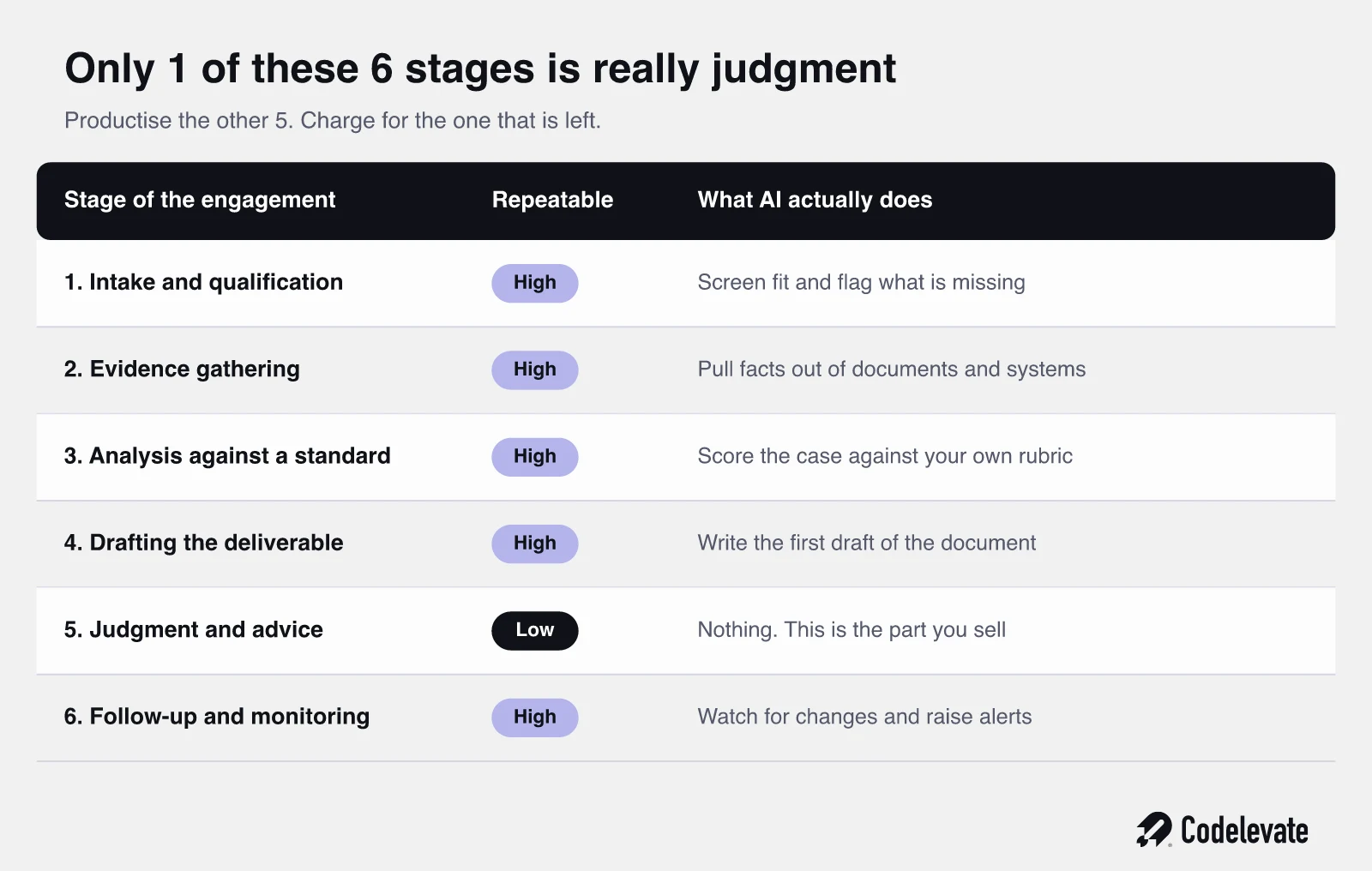
Look at what that leaves. Stage 5 is the work. It is the moment a senior person reads the analysis, weighs it against everything they know about this client's situation, and says do this, not that. It is unrepeatable, it is why clients hire you rather than buying a template, and it is usually the smallest share of the hours on the timesheet.
Everything around it is preparation and packaging. Your consultant reads the same kinds of documents, pulls out the same kinds of facts, checks them against the same criteria, and writes them into the same document structure they used last month. That work is skilled, it is necessary, and it is not judgment. It is your standard, executed by hand, over and over, by people who are expensive precisely because they can also do stage 5.
The practical exercise is unglamorous and takes an afternoon. Take your 10 most recent engagements of one type. For each, estimate the hours that went into each of the 6 stages. Most firms doing this honestly find 60% to 80% of the time sits outside stage 5, and that the split is remarkably consistent across clients. That consistency is the signal. Consistent work is productisable work.
One caution before you go further. Do this on one service line, not your whole business. Firms that try to map everything at once produce a diagram nobody uses. Pick the engagement type you sell most often, because volume is what pays back the effort.
The thing you actually productise is your standard, not the AI
This is the part that separates firms who get a real asset from firms who get a slightly faster junior consultant.
When a firm decides to use AI on stage 3, the instinct is to give a model the client's documents and ask it to analyse them. What comes back is generic. It reads like something any competitor could have produced, because it is. The model has no idea what your firm considers a strong application, what disqualifies a case, or which 4 red flags your founder learned to spot the hard way in 2019.
The valuable move is to write that down first. Concretely, that means 4 things: the checklist your senior people actually run through, the scoring rubric that separates a strong case from a weak one, the decision rules for the common exceptions, and a library of your own past deliverables as worked examples. None of this is technical. It is a documentation project with an engineering project attached, and firms consistently underestimate the first half.
Once that standard exists in writing, AI becomes genuinely useful, because you are no longer asking a model for an opinion. You are asking it to apply your opinion consistently at speed. That is a much easier task for the technology and a much more defensible asset for you. Your competitor can buy the same model tomorrow. They cannot buy 200 of your past engagements and the rubric you derived from them.
There is a second benefit that firms notice about 3 months in. The act of codifying the standard improves the human delivery too. Ambiguities that were absorbed by experienced staff become visible and get resolved. Junior consultants get better faster because the thing they were supposed to absorb by osmosis is now written down. Several firms we have worked with would have taken the codification exercise on its own merits, even if the AI part had never been built.
If you want a structure for writing this down in a form a development team can actually build from, our AI product requirements template is a practical starting point for turning a delivery standard into a buildable spec.
The 3 levels of productisation, and where most firms should stop
Productising with AI is not one decision. It is 3 quite different businesses, and the advice online pushes almost everyone toward the third one, which is usually wrong.
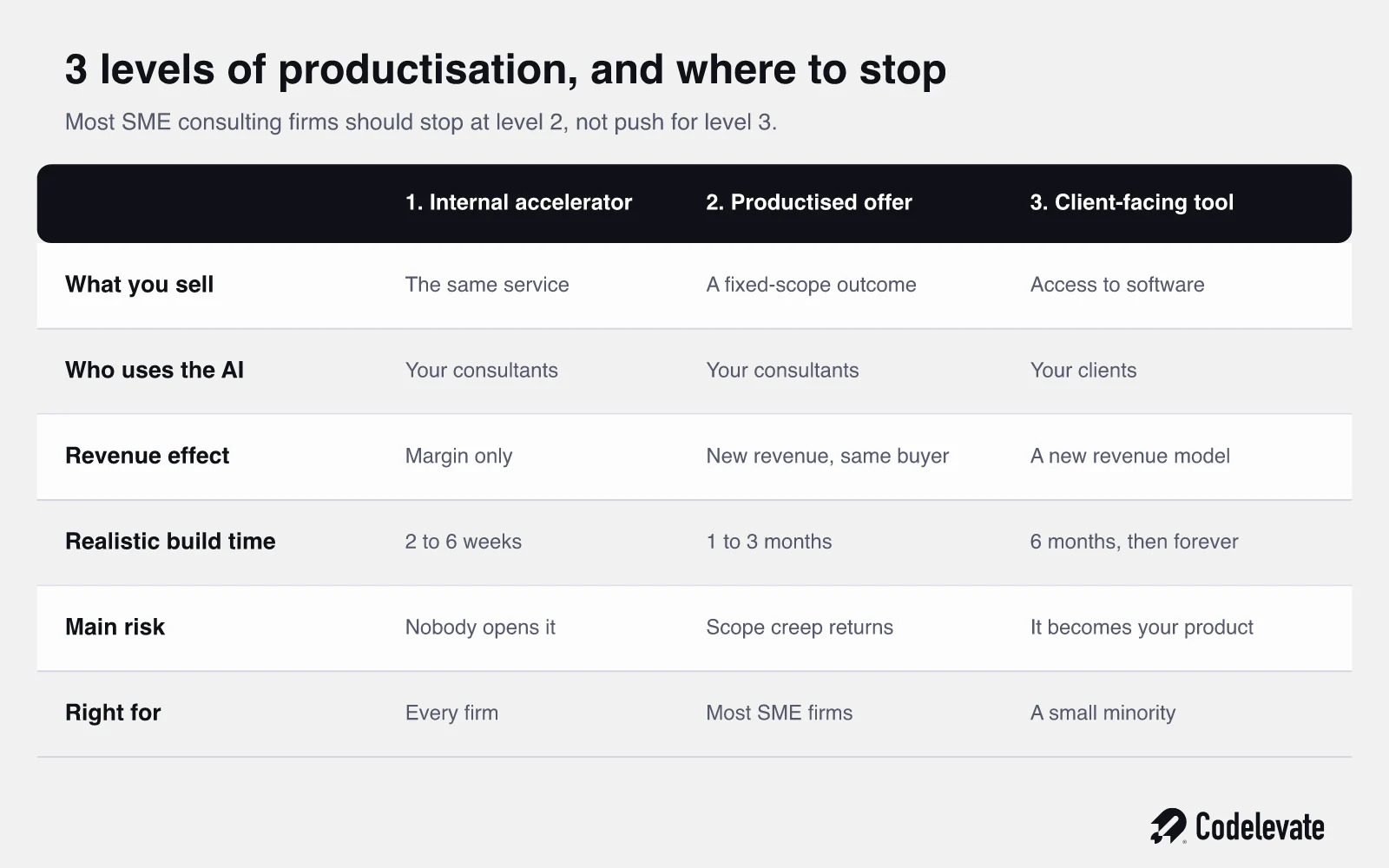
Level 1: the internal accelerator
Your consultants keep delivering the same service, but stages 1 to 4 and 6 run through a system built on your standard. The client sees no change except speed and consistency. Nothing about your commercial model moves.
This is where every firm should start, and many should stay for a year. It is cheap, it is low risk, and it answers the only question that matters before you invest more: does the standard actually hold up when it is applied mechanically to real cases? If it does not, you have just saved yourself from selling a broken product. If it does, you have a margin improvement funding the next step.
Level 2: the productised offer
Now you sell something new. A fixed-scope, fixed-price engagement that exists because your delivery cost dropped: a subsidy scan, a compliance readiness assessment, a data maturity review. Same buyer, same expertise, a smaller and more defined promise at a price that would have been uneconomic when the work was manual.
This is where the commercial upside actually lives for most SME firms, and it is chronically skipped because it is less exciting than building software. Level 2 gets you a lower-priced entry offer that brings in clients who would never have signed a full engagement, gives your sales conversations something concrete, and creates a natural path into your larger work. It changes your revenue mix without changing what kind of company you are.
Level 3: the client-facing tool
Your clients log in and use the thing themselves, usually on a subscription. This is a genuine product, and it is a different company. You now own onboarding, support, uptime, security reviews, a roadmap, churn, and a product team, and the revenue arrives in small monthly amounts rather than project fees, which is a real cash flow change on the way up.
Level 3 is right for a minority of firms: those with a large, homogeneous client base, a standard that holds with almost no exceptions, and either the capital or the appetite to run 2 business models at once for a couple of years. It is a good ambition. It is a bad starting point, and starting there is the most common way this whole effort dies.
A worked example: a 25-person subsidy consultancy
Take a Dutch firm advising SMEs on innovation subsidies. 25 people, mostly consultants, a strong reputation, and a permanent problem: the partners are the bottleneck on every deal, and the firm turns away smaller clients because a full application engagement cannot be delivered profitably below a certain fee.
They map one engagement type, the standard grant application. The stage breakdown comes out roughly like this. Intake and eligibility screening, 6 hours. Gathering financials, project descriptions and technical documentation from the client, 14 hours. Checking the case against scheme criteria, 10 hours. Drafting the application, 18 hours. Partner review and strategic shaping, 7 hours. Post-submission monitoring and correspondence, 5 hours. 60 hours, of which 7 are the partner's judgment.
At level 1 they build an internal system: intake questions scored against eligibility rules, extraction of the relevant facts from uploaded client documents, an automatic check against the scheme's published criteria, and a first draft of the application in the firm's own structure. Drafting drops from 18 hours to 5 of editing. Evidence gathering drops from 14 to 6. Total delivery falls to about 33 hours, and the partner still spends the same 7 on the part that matters.
At level 2 something more interesting happens. The eligibility screen that used to cost 6 hours now costs 30 minutes, so they can sell a fixed-price subsidy scan for a few hundred euros: a short report telling a company which schemes it plausibly qualifies for and what it would need to apply. That was never sellable before, because the cost of producing it exceeded what a small company would pay. It now runs at a healthy margin, it reaches companies far below their old minimum fee, and a meaningful share of those scans convert into full applications. They have added a new revenue line and a lead generation engine using the exact same expertise.
Notice what they did not do. They did not build a portal where clients write their own applications. That would have put them in competition with software vendors, on software margins, against a client base that mostly does not want to do this work themselves. Level 2 was the right ceiling, and recognising that is the decision that made the project work.
5 ways this goes wrong
None of these are technology failures. Every one is a decision made too early or not at all.
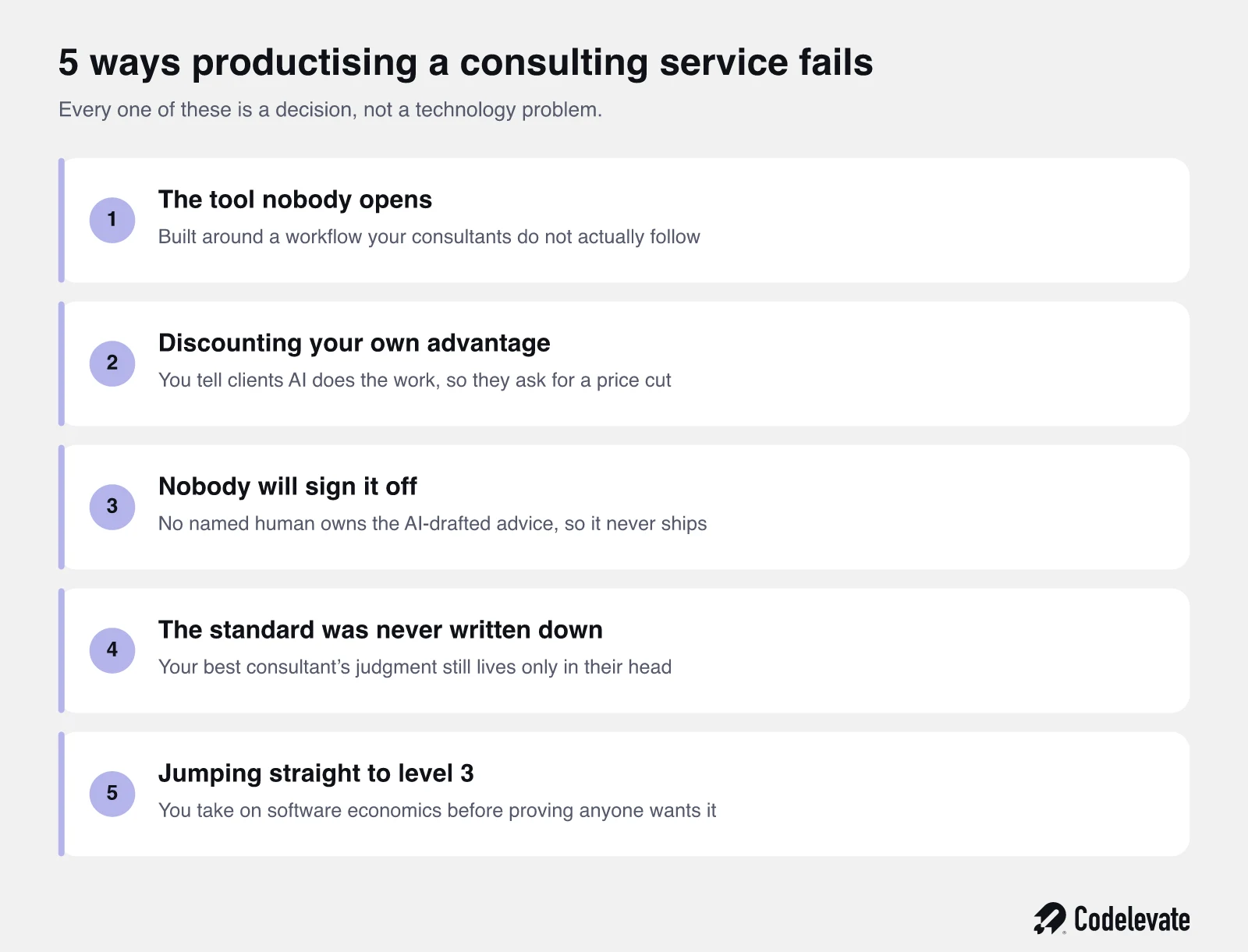
The one worth expanding is the third, because it stops more projects than the rest combined. Somebody has to sign the advice. If your firm's name goes on a document, a named human has to be accountable for it, and that person needs to see enough of the reasoning to stand behind it. Systems that produce a polished output with no visible trail get quietly abandoned, because no experienced professional will put their name to something they cannot check. Build the review step and the audit trail from the start. In regulated advisory work, this also intersects with the transparency and human oversight duties in the EU AI Act, so it is worth settling early rather than after your first uncomfortable client conversation.
The second failure mode deserves a word too, because it is a commercial trap that feels like honesty. Firms proudly tell clients that AI now does the analysis. The client hears that the work got cheaper and asks for a lower fee. You are selling an outcome and the accountability behind it, not a headcount. How you produce the work is your business, in the same way your clients do not itemise which of their staff touched a deliverable.
How to price it once AI does the work
The pricing question is where most of the value is won or lost, and there is a short answer: price the outcome, and never let the client's mental model be hours.
Three things follow from that. Set the price of a productised offer against what the result is worth to the buyer and what alternatives cost them, not against your delivery cost. A subsidy scan that identifies 40,000 euros of accessible funding is not priced off 30 minutes of compute. Second, do not publish a price that only works for the easy 70% of cases. Define the boundary of the fixed scope precisely, in writing, and have a named path for what happens when a case falls outside it, because unbounded fixed-price work is how firms rediscover why they billed hourly.
Third, treat the productised offer as the first rung of a ladder rather than a standalone product. Its job is partly margin and partly qualification. A client who buys a small fixed-price assessment has already decided you are credible, and the conversation about the larger engagement starts from a completely different place than a cold proposal.
Where to start, realistically
If you want to make progress in a quarter rather than a year, the sequence matters more than the tooling.
• Pick one engagement type. The one you sell most often, not the most interesting one.
• Break it into the 6 stages and put honest hour estimates against each, using your last 10 real engagements rather than memory.
• Write down the standard for the one stage with the most hours. The checklist, the rubric, the exceptions. Expect this to take longer than you think and to be uncomfortable.
• Build the smallest thing that applies that standard to real cases, and run it in parallel with your normal process for a month so you can compare the output against what your consultants actually produced.
• Only then decide whether there is a level 2 offer in it, and price that offer against the buyer's outcome.
Most of that list is not a technology project. The technology part is real but it is the second half, and it goes badly when the first half is skipped. If you want a broader view of where AI fits across your operations before you commit to one service line, our guide on mapping the AI opportunities in your workflow covers that groundwork, and what an AI consultant actually does is useful if you are weighing outside help.
This is the work we do with advisory firms as an AI development company: mapping delivery, finding the repeatable share, codifying the standard with your senior people, and building the layer that runs it. The mapping usually tells a firm something uncomfortable and useful within 2 sessions, well before anything gets built.
The short version
You cannot productise judgment, and you do not need to. The repeatable 60% to 80% of a consulting engagement is what AI can carry, and what is left is precisely the part clients were paying a premium for anyway. The asset you build is not the model, it is your firm's standard written down in a form that can be applied consistently. Start with an internal accelerator, graduate to a productised fixed-price offer, and be honest about whether a client-facing product is a business you actually want to run.
Firms that do this stop trading growth for headcount. Firms that skip the codification and buy tooling get a faster version of the same bottleneck.
If you want the wider playbook on where AI earns its place in a business and where it does not, download the SaaS AI Blueprint. And if you already know which engagement you would productise first and want a straight read on whether it is worth building, book a free call with our team. We will map the stages with you and tell you honestly if the answer is not yet.

.svg)
.svg)


