
What does an AI consultant actually do?
In this article you will learn what an AI consultant actually does, when hiring one is worth it, when it is a waste of money, and how to tell a genuinely useful advisor from someone selling hype. This is written for founders, CTOs, and operations leaders who know AI could help their business but are not sure where to start or who to trust.
Let us be honest about the backdrop first. AI consulting has become a crowded, noisy market, and a lot of it is slideware. Gartner has reported that many AI projects stall before they ever deliver a return. A good consultant exists to keep you out of that statistic. A bad one helps you join it, expensively. Knowing the difference is the point of this guide.
What is an AI consultant?
An AI consultant is someone you bring in to help you decide where artificial intelligence fits your business, and then to help you get it working without the usual mistakes. That is the whole job in one sentence. Everything else is detail.
In practice the role sits between two worlds. On one side is your business, with its real problems, its budget, and its people. On the other is the fast-moving world of models, agents, and tools that most teams do not have time to track. A good consultant translates between the two: they understand your business well enough to spot where AI genuinely helps, and they understand the technology well enough to know what is actually possible today, not in a press release.
Note what this is not. It is not a coder for hire, and it is not a person who says yes to every AI idea you have. The value is in judgment, not enthusiasm.
The areas AI consulting usually covers
"AI consulting" is a broad label, and it helps to know which kind you actually need. Most engagements fall into a few buckets.
• Strategy and use-case discovery. Working out where AI fits your business and which problems are worth solving first. This is the highest-leverage kind, and the one most teams underinvest in.
• Automation. Finding repetitive, rule-heavy work and handing it to AI, often with agents that plug into your existing tools. This is the core of what an AI automation agency does.
• Custom AI build. Designing and shipping a product or feature powered by AI, from a support assistant to a full internal platform.
• Data readiness. Getting your data into a state where AI can actually use it, which is where many projects quietly succeed or fail.
• Governance and safety. Putting guardrails around AI so it stays compliant, behaves as intended, and does not expose you to risk, which matters more once the system touches real customers and data.
• Change management. AI is as much about people as tools. A good consultant helps your team actually adopt and trust the new way of working, not just install it.
• Upskilling. Helping your own team learn to use and run AI, so you are not dependent on outside help forever.
A single advisor rarely does all of these well, and the real job across every one of them is aligning AI to a business goal you can measure. Knowing which kind you need keeps you from hiring a strategist when you need a builder, or the reverse.
What a good AI consultant actually does
Here is the part most articles skip. The main job of a good AI consultant is to kill most of your AI ideas.
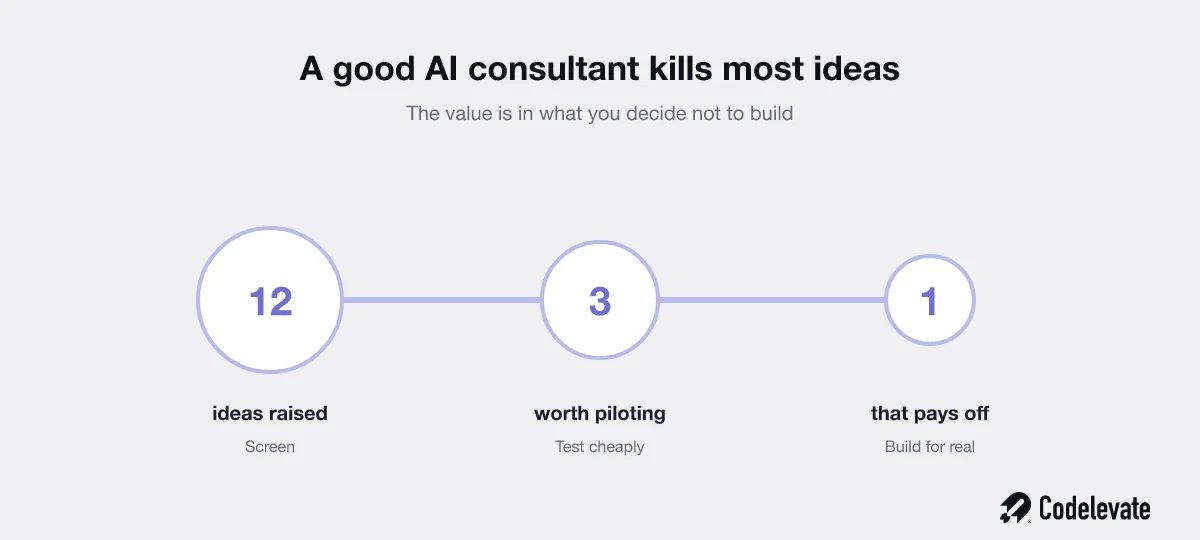
Most businesses arrive with a list of things they think AI should do. A strong advisor treats that list as a starting point to filter, not a plan to execute. They screen every idea against a simple question: is this frequent, expensive, and a genuine fit for what AI does well? Most ideas fail that test. The few that pass are where the money is.
Around that core, the real work breaks into a few things:
• Finding the few high-value use cases. Not the flashiest, the ones with a clear payback and a real owner in your business.
• Translating between business and tech. Turning a vague "we should use AI" into a specific, buildable spec that an engineering team can execute.
• De-risking the build. Choosing the right approach, avoiding dead ends, and making sure what gets built can actually go to production and stay there.
• Saying the expensive thing out loud. Telling you when an idea will not pay off, before you have spent six figures finding out yourself.
The best consultants make themselves measurable. They tie their advice to a number: hours saved, revenue influenced, or risk reduced. If an advisor cannot explain how their recommendation makes or saves you money, that is a warning sign, not a detail.
What AI consulting is not
A few myths cost businesses real money, so it is worth naming them.
It is not a magic strategy deck. A 40-slide "AI roadmap" that never turns into a working system is a cost, not a result. Good consulting ends in something running, or in a clear, honest decision not to build.
It is not a way to look modern. Adopting AI to appear innovative, rather than to solve a costed problem, is how you end up in the pile of stalled projects. The technology should serve a business outcome you can name.
It is not a one-time event. AI is not a single install. The models change, your data changes, and what worked last year drifts. A useful advisor sets you up to keep improving, not to declare victory and leave.
The signs you actually need one, and when to skip it
Being honest about fit saves you a lot of money, so here is the plain version.
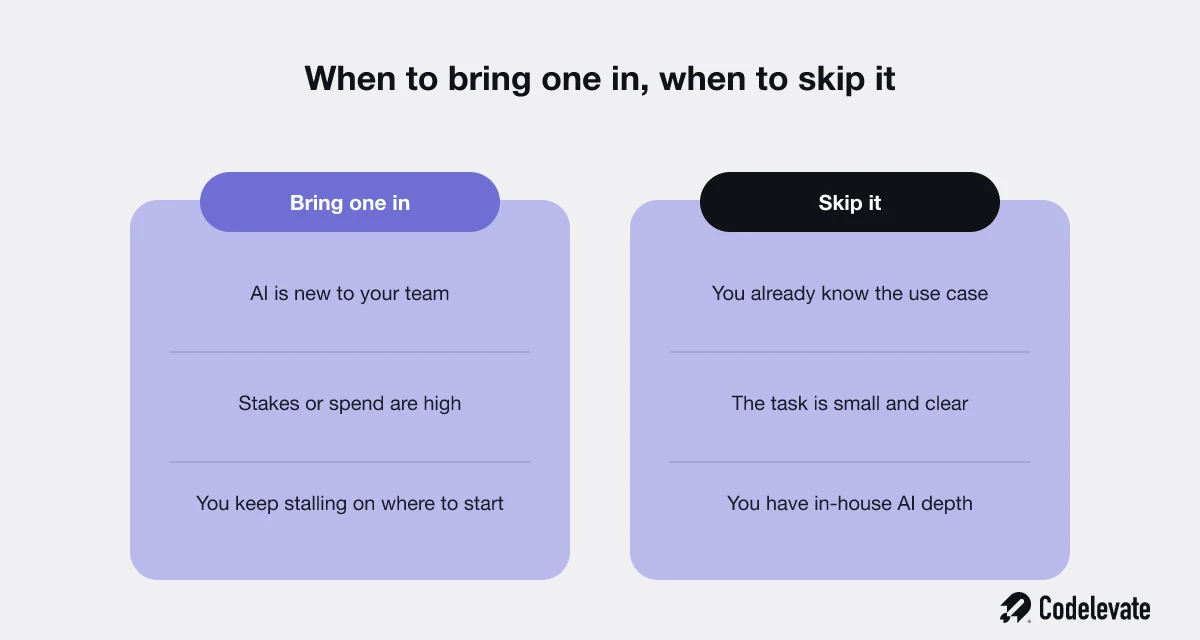
Bring one in when at least one of these is true:
• AI is new to your team, and you do not yet have the in-house judgment to separate real opportunities from noise.
• The stakes or the spend are high enough that a wrong first move is expensive to unwind.
• You keep stalling. You know AI could help, but you have been going in circles for months on where to actually start.
Skip it, or at least wait, when the opposite is true:
• You already know the specific use case and just need it built. In that case you need builders, not advisers.
• The task is small, clear, and low-risk. You can often test it yourself with off-the-shelf tools before paying anyone.
• You already have real AI depth in-house. If your team can do the judgment, spending on outside judgment is waste.
The honest answer for many companies is that they need a short burst of good advice to pick the right first project, then builders to deliver it. Paying for endless strategy without ever shipping is the trap.
How to spot a bad AI consultant
Because the market is noisy, knowing the red flags is as useful as knowing the green ones. Be careful when you see these:
• They say yes to everything. If every idea you raise is "a great use case for AI", they are selling, not advising.
• They lead with tools, not your problem. A good advisor asks about your business for a long time before naming a single technology.
• They cannot tie advice to money. If they will not talk about payback, cost, or risk in concrete terms, the recommendation is decoration.
• They hand over a deck and disappear. Strategy with no path to something that runs is the classic way AI budgets evaporate.
• They hide the downsides. Every real AI project has limits, failure modes, and ongoing costs. An honest advisor tells you those up front.
The through line is simple. A good AI consultant is on the hook for your outcome. A bad one is on the hook for their invoice.
What a good engagement actually looks like
When it is done well, an AI consulting engagement tends to move through a few clear stages, and each one produces something you can use.
First, discovery. The advisor learns your business, your workflows, your data, and your constraints. This is where a good consultant spends real time, because the quality of everything later depends on it.
Second, prioritization. Together you turn a long list of possibilities into a short, ranked set of opportunities, each with a rough payback and a named owner. This is the filtering step, and it is where most of the value is created.
Third, a small proof. Rather than a big bet, a good advisor pushes for a cheap, fast test of the top idea, to learn whether it works in your real environment before you commit a budget.
Fourth, a build plan. If the proof holds up, you get a concrete plan to build it properly, with the engineering rigor to reach production and stay there. This is often where a consultant hands off to, or works alongside, a delivery team. It is the same discipline we bring as an AI development company, where the advice and the build are not separate worlds.
Notice that at every stage you get a usable output: a decision, a ranked list, a working test, a plan. If an engagement is not producing those, it has drifted into expensive theatre.
How much does an AI consultant cost?
Pricing varies a lot, but it usually follows one of three shapes. Hourly or daily rates suit short advisory bursts, and senior AI advisors are not cheap, often landing in the higher professional-services range. Fixed project fees suit a defined piece of work, like a discovery sprint or a proof of concept, and give you a known number up front. Retainers suit an ongoing relationship where the advisor stays close as you build and learn.
The number that matters is not the rate, it is the ratio. Good advice is cheap relative to the mistake it prevents. A short engagement that stops you from sinking a six-figure budget into the wrong AI project has paid for itself many times over, even at a senior rate. A cheap engagement that ends in a deck nobody uses is expensive at any price.
So judge cost the way you would judge the AI projects themselves: against the value created or the loss avoided, not against the hourly figure. If an advisor cannot help you frame that trade-off for your own situation, they are not the right one.
Questions to ask before you hire one
A short, direct conversation tells you most of what you need to know. Ask these before you sign anything:
• Can you point to AI work you have actually shipped, not just advised on?
• How do you decide which ideas are not worth pursuing?
• How will we measure whether your advice paid off?
• What happens after the strategy, and who builds it?
• What are the ongoing costs and failure modes I should expect?
The answers matter less than the manner. A good advisor welcomes these questions and gives concrete, specific answers. Someone who gets vague or defensive when you ask how success is measured is telling you something important.
In-house, agency, or independent consultant?
There is no single right answer, only trade-offs worth understanding.
An independent consultant is often best for the early judgment: what to do, what to avoid, and where to start. They are flexible and usually senior, but a solo advisor rarely builds and runs a full system for you.
Hiring in-house makes sense once AI is core to your product and you need it continuously, not as a project. The cost and the hiring difficulty are the catch, and good AI talent is scarce and expensive.
An agency or specialized partner fits when you want the advice and the build under one roof, so the strategy does not get lost in a handoff. This is the model many founders prefer, because it closes the gap between the plan and the working software. Some teams get the same effect with a fractional leader, for example through a CTO as a Service arrangement, where senior technical judgment guides the work without a full-time hire.
The right choice depends on how central AI is to your business and how much of the work you want to own yourself. What matters is not the label, it is whether the person or team can both decide well and deliver.
What a good first 30 days looks like
If you are still not sure what you are buying, picture a well-run first month. It is short, cheap relative to what follows, and it produces decisions rather than promises.
In the first week or two, the advisor is mostly listening. They sit with your team, watch how work actually gets done, and look at your data and your tools. By the end of that, they can describe your real problems back to you more clearly than you did, which is a good sign in itself.
In the back half, the conversation turns to choices. You end up with a ranked shortlist of opportunities, an honest view of which ones to drop, and one clear candidate to test first, with a rough cost and expected payback attached. If a proof of concept makes sense, you have a plan for a small, fast one.
What you should not have after 30 days is a vague sense of possibility and a large bill. A good engagement leaves you with a decision you can act on, even if that decision is to wait.
How to get value without wasting money
You do not need a big engagement to get most of the benefit. A practical path looks like this.
Start by writing down the 3 most painful, most repetitive problems in your business, in plain language and with a rough cost attached to each. This alone sharpens the conversation and stops you from chasing shiny ideas.
Then use a short, focused burst of expert advice to pressure test those problems and pick one to start with. The goal of that first engagement is a decision, not a deck. From there, run a small proof before committing serious budget, and only scale what actually works.
Done this way, you spend a little to avoid spending a lot on the wrong thing. That is the entire economic case for good AI consulting: it is cheap insurance against expensive mistakes.
Want to sharpen your own thinking before you talk to anyone? Our free guide, The SaaS Founder's AI Blueprint, walks through where AI actually pays off in a product and where it does not. And if you would like a straight, no-hype answer on your own situation, you can book a free call and we will tell you what is worth building, what is not, and what it would take.

.svg)
.svg)


