
What does custom software cost in 2026? Build price, timeline and running cost
You have 3 quotes for custom software on the table. One says 25,000 euro, one says 60,000, the third bills by the hour. You compare the build price, because that is the number at the top of the page.
That number is the smallest line on the real bill. What custom software costs only shows when you look 2 years ahead: the build, the running cost after launch, your own time, and the manual work that carries on until the software is live. Only then can you compare the quotes fairly, with each other and with the other routes you have.
This article is for the owner, managing partner or operations lead of a Dutch B2B service company with 10 to 200 people. Your core service is expert work done by hand, priced per file, per application or per hour, with volume. You have no technical team of your own, and your growth is capped by how many people you can hire.
It is not for you if you are at the idea stage, building a consumer app, comparing hourly rates only, looking for 1 Zapier flow, or running a public tender. Other articles serve those cases better.
In this article you will learn what custom software development costs in 2026 in honest bands, which 4 cost lines a quote usually leaves out, why a fixed price from 1 call is a guess, and how 4 routes compare over 2 years in a worked example. You will also read when custom software is not worth it.
Key takeaways
• The build price is rarely the largest cost. Over 2 years, running cost, your own time and the manual work that continues often weigh more.
• A senior developer in the Netherlands earns 65,000 to 85,000 euro gross a year according to a Dutch recruiter, and hiring often takes months.
• A nearshore team charges 45 to 70 euro an hour. Cheaper per hour, but someone on your side has to write the tickets and review the work.
• A no code tool is the cheapest start, but it usually covers the copying and forwarding, not the judgment in your process.
• A fixed price per milestone only exists after the process is mapped. A fixed price from 1 call is a guess with a margin on top.
• Always work back from what your manual process costs per month. You pay that month either way, including the months you spend choosing.
• Custom software is not worth it when volume is low, the process still changes every month, or standard software already does the job.
• Ask every supplier the same 5 things: who, where it runs, what running it costs, who answers in month 4, and how you get out.
What does custom software cost in 2026?
The short answer: building 1 automated process costs between 18,000 and 45,000 euro in most cases in 2026. A platform your own customers log into and pay for starts around 25,000 euro per phase and grows with each phase. Running it afterwards costs a monthly amount you should see on the quote, not discover at the first outage.
The cost pages you find online quote bands from a few thousand euro for a small tool to well over 100,000 euro for a large platform. All of that is true, and none of it helps you. The gap between 25,000 and 100,000 euro is rarely in the screens. It is in the connections to the systems you already run, the exceptions in your process, and the question of who is responsible after delivery.
Hourly rates give you a second reference point. According to an overview by Ilmtec on software development outsourcing in the Netherlands in 2026, a senior developer in Amsterdam costs 75 to 110 euro an hour fully loaded, and a nearshore team in Poland, Portugal or the Baltics 45 to 70 euro an hour. AI tools have made writing code faster and cheaper. Deciding what should be built has not become cheaper.
So the useful question is not what the build costs. The useful question is what custom software costs you over 2 years, compared with what your manual process costs you over the same 2 years.
The build price is the smallest line on the bill
A quote for custom software usually shows 1 line: the build. If you want the total cost, add 3 more lines underneath. Together they are what you actually spend over 2 years.
Line 2: running it after launch
Software that sits inside your process runs every day. Someone has to watch that it works, someone gets the alert when it fails, and someone updates the rules when the law or a tariff changes. If there is AI inside, add model updates and a cost per processed file that you want capped.
Many suppliers call this maintenance and bill it by the hour when you call. That sounds cheap until a Tuesday with 400 files in the queue and nobody sure who picks it up. Ask for a fixed monthly amount, an engineer by name on the alert, and a monthly report of what ran, what broke and what it cost.
Line 3: your own time
Every route takes time from you or from your best people. With a nearshore team you write the tickets and review the work. With a no code tool you build and repair it yourself. With a new hire you recruit, manage, and cover for them when they are on holiday.
Those hours appear on no quote. They are expensive all the same, because they are the hours of the people doing the expert work your customers pay for.
Line 4: the manual work that carries on
Until the software runs, your manual process runs as it does today. Every month spent choosing, hiring or waiting costs you the full price of that manual work. Most cost overviews forget this line, and it is often the biggest one.
Work it out for your own process: units per month, times hours per unit, times internal cost per hour. That figure is your baseline. Everything you spend on custom software sits against it.
Why a fixed price from 1 call is a guess
A supplier who names a fixed price after 1 call does not know your process. They know your description of it. That is a different thing, and the difference always sits in the exceptions.
At a subsidy advisory we mapped, 5 advisors worked 5 ways in 5 tools. The owner described 1 process. In practice there were 5, each with its own spreadsheets and its own rules for the grey cases. A quote based on that first call would not have been a price. It would have been an estimate of the wrong job.
A supplier who still gives a fixed price from 1 call does 1 of 2 things. They add a generous margin for everything they do not know, and you pay that margin. Or they price tight and bill the difference later as change requests, and you pay it anyway, without being able to plan for it.
A fixed price per milestone becomes honest only once the process is mapped as it really runs. That means: who does what, in which tool, with which exceptions, which connections to Exact, AFAS or your sector software are needed, and where a mistake is expensive. After that, you can put a price on each bottleneck that holds.
That is how our Blueprint works. For 2,500 to 10,000 euro, depending on the number of processes, and in 10 to 20 working days, the process is mapped as it runs. You get the bottlenecks priced in hours and euro, the AI opportunities ranked, a roadmap with fixed prices per milestone, and a first rough prototype in your own repository. It is yours to keep, also if you decide to build it in house afterwards.
Want to put your own requirements on paper before you talk to anyone? Use our free AI product requirements template. It helps you pin down scope, cost and supplier choice, so every quote you get answers the same brief.
A worked example: a service company with 30 people
An example makes this concrete. The company below is made up and is not a client. The figures are assumptions you replace with your own.
Take an inspection and certification firm with 30 people. Its core process is preparing an inspection file. It handles 1,500 a year. An advisor spends 2 hours on each one on average: collecting data, retyping it into the sector software, checking it against the rules and formatting the report. Internal cost is 60 euro an hour.
• Cost per file: 2 hours times 60 euro is 120 euro.
• Cost per year: 1,500 files times 120 euro is 180,000 euro.
• Cost per month: 15,000 euro.
Suppose automation brings the manual work down from 2 hours to a 30 minute review by an advisor, who approves the file before it goes out. The firm then saves 1.5 hours per file, 2,250 hours a year, about 135,000 euro. That is 11,250 euro a month. It is also what every month of waiting costs. Whether those 30 minutes are realistic, you only know once the process is mapped.
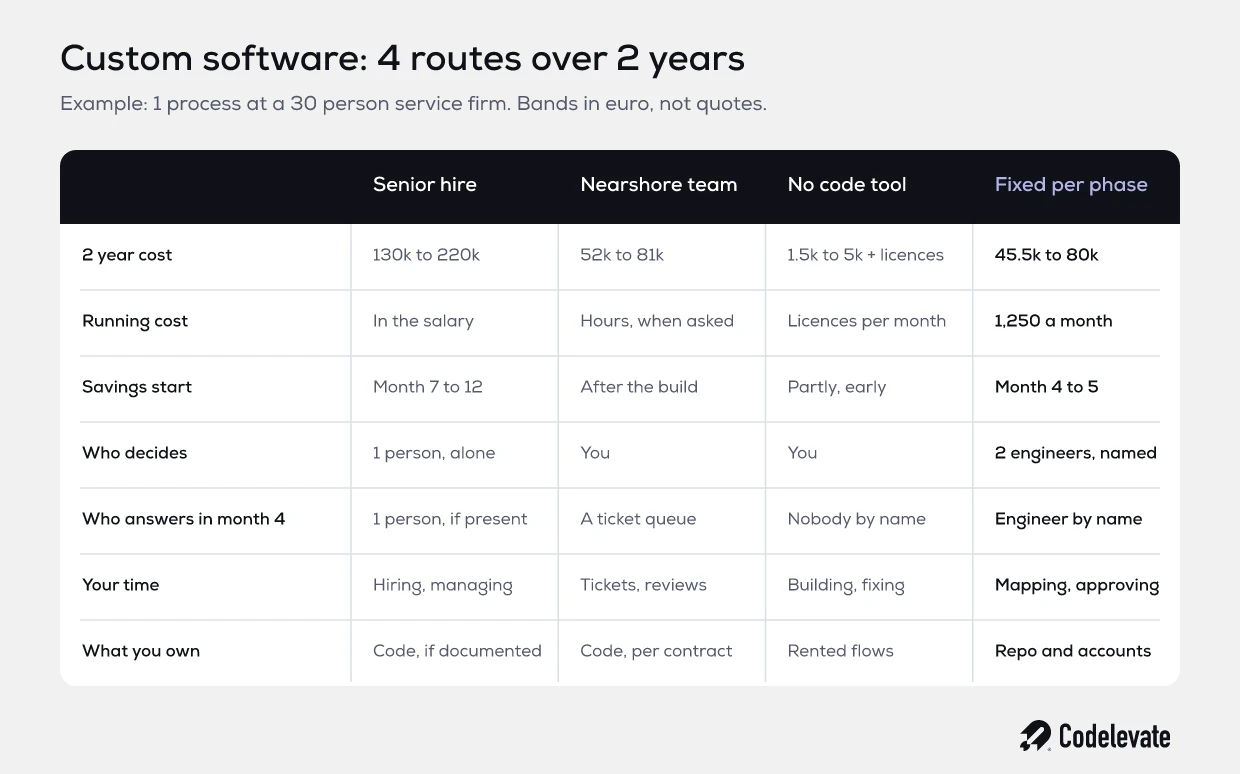
The owner has 4 routes. Below is the 2 year cost of each, in bands, not quotes.
Route 1: hire a senior developer
According to Search Company, a Dutch recruiter, a senior developer in the Netherlands earns 65,000 to 85,000 euro gross a year in 2026 nationally, and 70,000 to 95,000 in the Randstad. With employer costs, pension and tooling, most owners budget 85,000 to 125,000 euro a year. The same source describes searches that run for months, including a client who searched for 8 months with a budget that was too low.
Say hiring takes 3 to 6 months and the first version another 4 to 6 months. Over 2 years you pay 18 to 21 months of salary, roughly 130,000 to 220,000 euro. Savings start somewhere between month 7 and month 12. You do end up with someone in house who can take on other processes after this one.
The risk: 1 person, with nobody reviewing their work and no cover for illness or holidays. If they leave, the hiring starts again and the knowledge leaves with them.
Route 2: a nearshore team
At 45 to 70 euro an hour, an 800 hour build costs 36,000 to 56,000 euro. Add 20 hours a month for support and changes over 18 months: 16,000 to 25,000 euro. Together roughly 52,000 to 81,000 euro over 2 years.
That is a fair price, and if you have a senior in house to run the team, it is a good route. If you do not, that person is you. Count on a day a week writing tickets, answering questions and reviewing work you cannot judge. Then you bought hours, not a process.
Route 3: a no code tool
Automation shops serving smaller companies sell rented flows in tools like n8n or Make from 1,500 to 5,000 euro entry, plus monthly licences. For forwarding emails, moving data between systems and filling a template, that works well. It is the cheapest start of the 4.
It stops at judgment. Checking against the rules, the grey cases, the connection to your sector software, and the question of who repairs it when the tool changes its pricing or its connectors. In this example a tool might take 15 to 30 minutes off each file, not 1.5 hours.
Route 4: a fixed price per phase
This is the route we offer, so read it knowing that. First the Blueprint at 2,500 to 10,000 euro. Then 1 automation, priced fixed between 18,000 and 45,000 euro. From launch it runs for 1,250 euro a month: monitoring, an engineer by name on the alert, the AI cost per file capped, a 1 page monthly report, and model and rule updates. With launch in month 4 or 5, that is 20 months, 25,000 euro.
Together over 2 years: 45,500 to 80,000 euro. Savings start around month 4 or 5. In this example the firm's knowledge is already in 1 place. If it is not, a Foundation comes first, 1 source of truth for procedures and data, priced in the Blueprint.
What the example shows
Routes 2 and 4 land close together on price. That is honest, and it is also the lesson. The difference between the routes is not mainly the amount. It is 3 other things: who decides what gets built, how much of your time goes into it, and who answers when something breaks in month 4.
The biggest number in the example is not the build. It is the 11,250 euro a month left on the table while the process runs by hand. Starting to save 6 months earlier is worth 67,500 euro. That is more than the gap between the cheapest and the most expensive quote.
That is why payback is a better yardstick than build price. In this example route 4 pays for itself within a year of launch. Route 1 costs more, but gives you someone in house for a second and third process. If you have a roadmap with 5 processes, that arithmetic can flip.
When custom software is not worth it
Custom software is not always the answer. Sometimes it is an expensive way to solve a problem that a subscription or a better spreadsheet also solves. It is usually not worth it when:
• Volume is low. At 300 files a year at 120 euro, the manual work costs 36,000 euro a year. A route of 45,500 euro or more barely pays back in 2 years.
• The process is not stable yet. If the rules change every month because you are still working out how you want to do it, you are automating a moving target.
• Standard software already does it. If Exact, AFAS or your sector software has a module for it, use that first.
• 1 connection solves the problem. A Zapier or n8n flow for a few hundred euro is then the right answer.
• Nobody owns the process. Without someone who decides how it should be done, any supplier will build your disagreement into the software.
• You want the AI to decide alone where a mistake is expensive. We advise against that, whoever builds it.
If you recognise yourself in 1 of these, the cheapest software is the software you do not have built. An honest supplier tells you so.
How to compare quotes for custom software
Quotes are hard to compare because they price different things. The first prices hours, the second screens, the third a project. So ask every supplier the same 5 questions, and ask for the answers in writing.
• Who works on it, by name? Not the team, but the 2 people who write and review your code, and where they sit.
• Where does it run? In your accounts and your repository, or in the supplier's?
• What does running it cost per month? Including the AI cost per file and a cap on it.
• Who answers in month 4? When something breaks on a Tuesday: which name, within what time?
• How do you get out? What do you pay and what do you keep if month 1 does not convince you?
A supplier who cannot answer these 5 questions before you sign will not answer them after you sign either. They are the questions that decide, in month 4, whether your software is an asset or a worry.
Also look at what the quote leaves out. A good quote has a list of what is not in this milestone. If you cannot find that list, you do not know where the change requests start.
Building a SaaS product for outside customers, with subscriptions and users of its own, rather than an internal process? Different cost lines apply. They are in our article on SaaS development costs.
What happens after launch, and if month 1 disappoints
The 3 questions every owner asks belong in the conversation about price, not after it.
Who works on it? With us, 2 engineers by name, from the Blueprint to year 2. The same 2 people map your process, build it and sit on the alert. Codelevate, Amsterdam and Sofia, since 2019, and we tell you up front who sits where.
What happens after launch? From the first automation, operations run: monitoring, an engineer by name on the alert, the AI cost per file capped, a 1 page monthly report, and updates when models or rules change. The response time is set in the Blueprint, so you know it before you sign.
And if month 1 disappoints? Exit after month 1: pay for what is delivered, keep everything. The code sits in your repository from the first commit.
An example of what this produces: at a vehicle tax (BPM) file processor, processing time went from 4 to 8 hours per file to under 5 minutes. For a subsidy matching engine, hours of expert searching became seconds. Our page on custom software development shows how we set up that kind of work.
Codelevate turns Dutch B2B service companies into software companies: we map the expert process you run by hand, automate it so the same team handles the volume, and build the platform your customers pay for, with 2 engineers by name from the blueprint to year 2.
What custom software really costs you
Custom software in 2026 usually costs 18,000 to 45,000 euro to build for 1 process. That is the smallest part of the bill. Over 2 years, running cost, your own time and above all the manual work that continues until launch count for more.
So work from your own process: what 1 unit costs by hand, how many you do a month, and how many months each route takes before the savings start. Then compare not only amounts, but who decides, who answers in month 4 and how you get out.
Want to work this out on your own first? Download the free AI product requirements template and put your process, your volume and your requirements in 1 place. Every quote you get after that will answer the same question.
Send us what you have: a process description, a price list, a spreadsheet or a quote you do not trust. 1 of the 2 engineers reads it with you in 20 minutes, and you get 1 of 3 answers in writing the same day: do it in house, hire, or the Blueprint.

.svg)
.svg)


