
What is AI development as a service? Meaning, models, and when to use it
AI development as a service is getting AI software built and kept running for you as an ongoing, subscription-style engagement, instead of hiring an in-house team or commissioning a one-off project. You get continuous access to a team that designs, builds, integrates, and maintains your AI, and you pay a predictable monthly fee for it rather than a large upfront cost or a full payroll. In plain terms, it is a dedicated AI development department you rent, and can scale up or down, without the overhead of owning one.
This guide explains what AI development as a service actually is, what is included, how it compares to the alternatives, what it costs, and the honest cases where it is the right choice and where it is not. It is written by a team that delivers AI this way, so what follows is how the model works in practice, not a brochure.
It is written for founders, CTOs, and product leaders who need to build and run real AI but do not want to gamble on a single project or spend a year assembling an in-house team.
Key takeaways
The short version, before we earn it:
• AI development as a service means an outside team builds and maintains your AI on an ongoing basis, for a predictable recurring fee.
• It is a middle path between hiring in-house, which is slow and costly, and a one-off project, which ends the moment you most need support.
• It usually covers the whole lifecycle: discovery, building, integration, and the ongoing monitoring, retraining, and support that keep AI working.
• You get a team, not a person, so you have a range of skills without hiring each one, and continuity when someone is away.
• Pricing is a monthly retainer or a dedicated-team rate, which makes budgeting predictable and lets you scale up or down.
• It fits companies that will keep building AI, not those with a single, finished, one-time need.
• The real value is continuity and accountability: the same team owns your AI over time and stays responsible for it working.
What is AI development as a service?
AI development as a service is a delivery model where a specialist partner provides ongoing AI software development as a managed, recurring service, rather than as a fixed project or through people you employ directly. You describe what you want to build and run, and the partner supplies the team, the process, and the responsibility for delivering it over time. The defining word is ongoing: this is a continuous partnership, not a piece of work that ends.
It helps to place it against the two things it sits between. Hiring in-house gives you full control but is slow, expensive, and hard to staff across every skill AI needs. A one-off project agency delivers something and then leaves, which is fine until the model drifts or the business changes and there is nobody who knows the system. AI development as a service keeps a capable team attached to your product on a subscription, so you get the speed and breadth of an agency with the continuity and ownership of an in-house team. It is, in effect, software development as a service focused on AI.
The reason the model exists is that AI is never really finished. A model that works today drifts tomorrow, an API changes, data shifts, and the business asks for the next thing. Owning that reality with a full in-house team is expensive, and handing it to a project shop that has moved on is risky. A standing service is the arrangement that matches how AI actually behaves once it is live.
What AI development as a service includes
The point of the model is that it covers the whole lifecycle, not just the exciting build phase. A good service takes responsibility from the first idea to the AI still working a year later, which is exactly the part a project engagement leaves out.
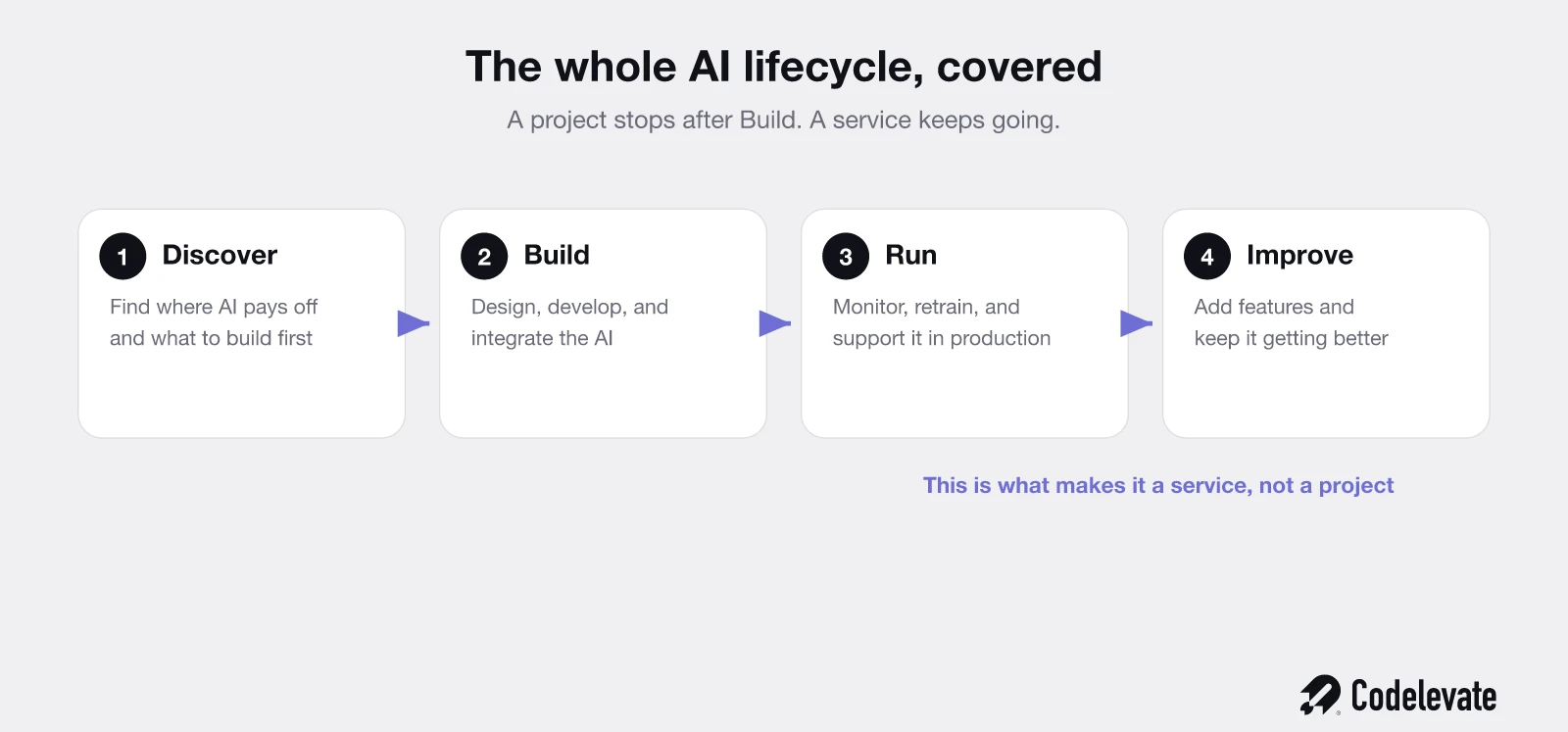
It starts with discovery and strategy: working out where AI actually pays off in your business and what to build first, so the effort goes at the right target. Then comes the build itself, designing and developing the models, integrations, and software, and wiring it into the tools you already use. That is where a project would stop, and where this model keeps going.
The part that makes it a service rather than a project is everything after launch. AI in production needs monitoring, because models drift and dependencies break; it needs retraining and tuning as your data and needs change; and it needs ongoing support when something goes wrong at an awkward hour. A standing team also handles the steady stream of improvements and new features, so your AI keeps getting better instead of freezing on the day the project ended. You are paying for a capability that stays alive, not a deliverable that ages.
The benefits of AI development as a service
The reasons companies choose this model over the alternatives come down to a few concrete advantages, most of which are about time and risk rather than just cost.
• Speed. You get a working team in days, not the months it takes to recruit and onboard AI engineers one by one.
• A whole team, not a hire. AI needs data, machine learning, backend, and DevOps skills together, and a service brings all of them without you hiring each role.
• Continuity. The same team stays with your product, so the knowledge does not leave when a contractor's project ends or an employee resigns.
• Predictable cost. A monthly fee turns AI from an unpredictable capital expense into an operating cost finance can plan around.
• Flexibility. You scale the team up for a big push and down when things are quiet, without hiring and firing.
• Shared accountability. One partner is responsible for your AI working over time, which is very different from a project that ends at handover.
Put together, these add up to the model's real promise: you get the capability of an AI department without the cost, delay, and management load of building one, and someone stays responsible for it long after launch.
What it looks like in practice
The model is easiest to understand through a typical month. A company signs on with a recurring engagement, and the first few weeks go into discovery and the first build: the team maps where AI helps, then ships a first working feature, say an intake flow that reads incoming requests and routes them. That alone would be a project. The difference shows up in month three.
By then the feature is live, and real life has happened to it. The volume has grown, so the team tunes it for cost. A supplier changed an API, so they fix the integration before it breaks anything. The business has asked for a second feature, so that goes into the build queue. None of this is a new negotiation or a scramble for whoever is free, it is the same team continuing the same work. That continuity, the fact that the people who built it are the people who keep it alive and extend it, is the entire point of paying for a service instead of a project.
AI development as a service vs the alternatives
There are four ways to get AI built, and the honest comparison is about speed, cost, and who is still there when it needs work. The right answer depends on how much AI you will build and how much you want to own.
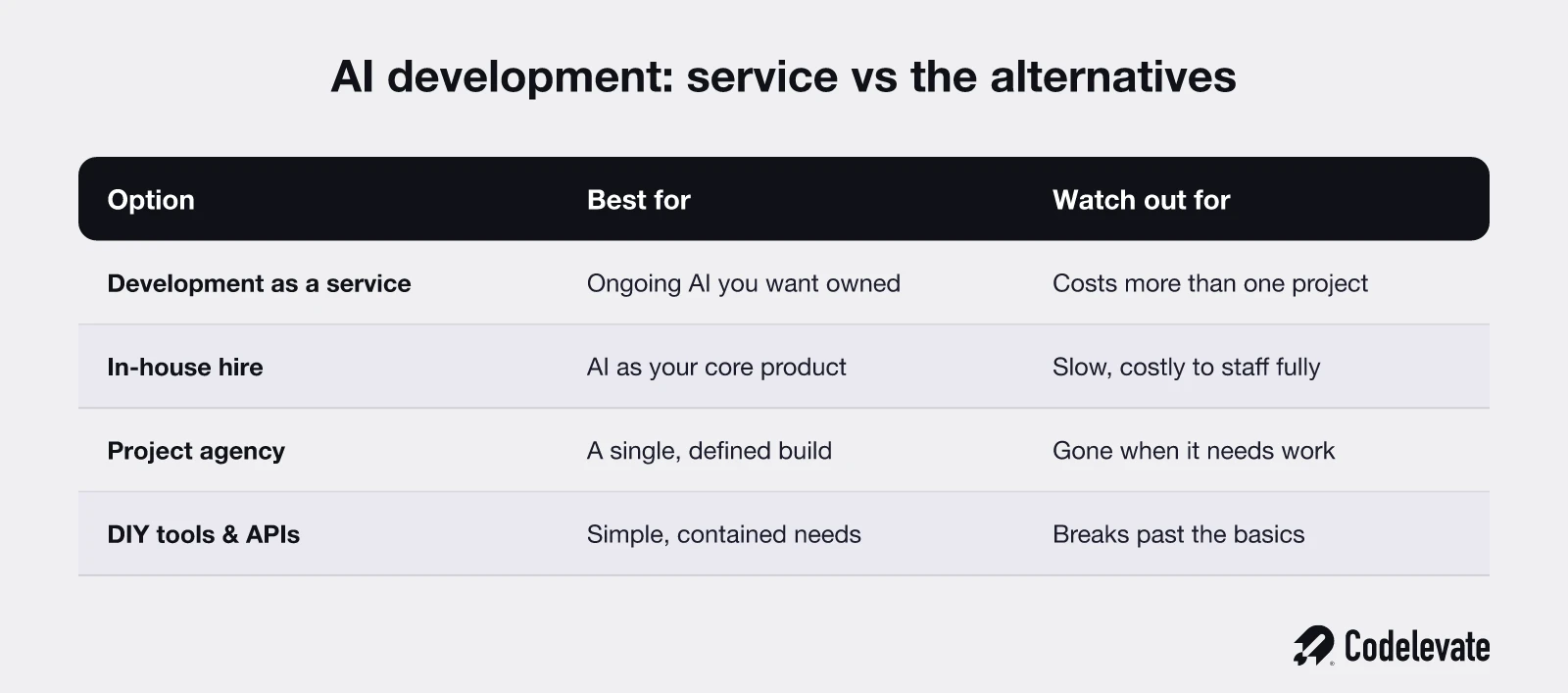
Hiring in-house gives you the most control and the deepest long-term knowledge, and it is the right end state for a company where AI is the core product. The catch is time and cost: senior AI engineers are expensive and slow to hire, and you need several skills, data, machine learning, backend, DevOps, that rarely live in one person. In-house makes sense once you have enough ongoing AI work to keep a full team busy and the maturity to manage them.
A one-off project agency is the fastest way to get one specific thing built, and for a contained, well-defined build it works well. The risk is what happens after. The agency delivers and moves on, so when the model drifts or you need the next feature, you are either re-negotiating a new project or scrambling for whoever is free. Projects are great for a defined piece of work and poor for anything that has to live and evolve.
A DIY approach, using off-the-shelf AI tools and APIs yourself, is genuinely right for simple, contained needs. If you can wire up a ready-made service in an afternoon, do that. It stops working once the AI has to be reliable, integrated, and maintained, which is the point where a service earns its fee.
AI development as a service wins in the common middle: when you will keep building and running AI, want it done in weeks rather than a year, and need the same team to stay responsible for it over time. That describes most companies that are serious about AI but are not, themselves, AI companies, which is why the model has grown.
If you want to work out where AI pays off in your business before choosing how to build it, our free SaaS founder's AI blueprint walks through prioritising the opportunities that are worth it.
What does AI development as a service cost?
Pricing follows the model: it is recurring and predictable, not a single large invoice. The two common shapes are a monthly retainer, where you pay a fixed fee for an agreed amount of the team's capacity, and a dedicated-team rate, where you pay for a defined team, a few engineers, a lead, the relevant specialists, working continuously on your product. Both turn AI development from an unpredictable capital expense into a steady operating cost you can plan around.
The honest way to judge the cost is against the alternatives, not in isolation. A senior in-house AI team is a large, fixed payroll plus recruiting time before anyone writes a line of code. A series of one-off projects looks cheaper per piece but adds up, and leaves gaps between engagements where nobody owns the system. A service sits between them: more than a one-off project in a given month, far less than building and carrying a full in-house team, and predictable enough that finance can sign off on it. The value is not just the rate, it is that the capability is always there and always someone's responsibility.
When AI development as a service is the right choice
The model fits a specific and common situation, and it is worth being honest about when it does not. It is the right call when you have real, ongoing AI work, when you want to move faster than hiring allows, and when you do not have, and do not want to build, a full in-house AI team yet. Most companies adding AI to a product they already run fit this exactly, and for them a standing service is the lowest-risk way to move quickly and keep the result alive.
It is the wrong call in a few cases. If your need is a single, finished, one-time build with no life after launch, a fixed project is cleaner and cheaper. If AI is your entire product and your core competitive edge, you will eventually want that capability in-house, though a service is often the right way to start while you hire. And if the task is genuinely simple and contained, a ready-made tool beats any engagement. The rule is the same one that governs every build-or-buy decision: choose the service when the work is ongoing and worth owning, not when it is a one-off you can close out.
How Codelevate delivers AI development as a service
Because this is how we work, the shape of it is worth showing rather than describing. We start with discovery to find where AI actually pays off, then provide a dedicated development team that builds, integrates, and then keeps your AI running, monitored, retrained, and improved, on a predictable monthly basis. You get a team with the range AI needs, not a single hire, and the same people stay with your product over time so the knowledge does not walk out the door.
What makes it work is that we stay accountable for the outcome, not just a deliverable. As an AI development company, we are on the hook for your AI still working next quarter, which changes how carefully it gets built. For companies that also want senior technical direction without a full-time hire, we offer that through CTO as a service, so the strategy and the build sit under one roof.
The promise is the one this guide argues for: a capable AI team, attached to your product, delivered as a predictable service, so you move fast without betting on a single project or waiting a year to hire.
The bottom line
AI development as a service is the practical middle path for building and running AI: an outside team owns the whole lifecycle, from finding the opportunity to keeping the model alive, for a predictable recurring fee. It gives you the speed and breadth of an agency with the continuity of an in-house team, and it matches how AI really behaves, as something that is never finished and always needs an owner. Use it when you have ongoing AI work worth owning, choose a fixed project only for one-time builds, and bring it fully in-house when AI becomes your core product. Get that choice right and you get AI that keeps working, without the cost and delay of building the team yourself.
Free download: our SaaS founder's AI blueprint helps you find where AI pays off in your business. And if you want a straight answer on whether a service, a project, or a hire is right for your case, you can book a free call with our team and we will map it out with you, with no obligation.

.svg)
.svg)


