
AI automation vs RPA in 2026: how to actually decide
Most articles about AI automation vs RPA answer a question you should not be asking. They line up two technologies, list the differences in a neat table, and leave you to guess which one fits your business. That is backwards. The technology is the last decision in an automation project, not the first one, and teams that start there are the ones whose programme quietly stalls about 8 months later with 3 half-working bots and nobody willing to own them.
This article gives you the method we use at Codelevate before writing a line of automation code: score the process on 4 questions, then let the score tell you whether you need RPA, AI automation, both, or neither. You will get the scoring framework, the bands that turn a score into a decision, a worked example on supplier invoices, an honest read on what each option costs to run, and the failure modes we see most often in the wild.
It is written for founders, CTOs, and operations leaders who already have a process bleeding hours every week and a budget approved to fix it. If you want a shortlist of automation vendors, this is not that article. If you are trying to work out why your last automation project underdelivered, keep reading.
Key takeaways
• RPA and AI automation are not competitors. They fail in completely different places, so the process decides which one you need.
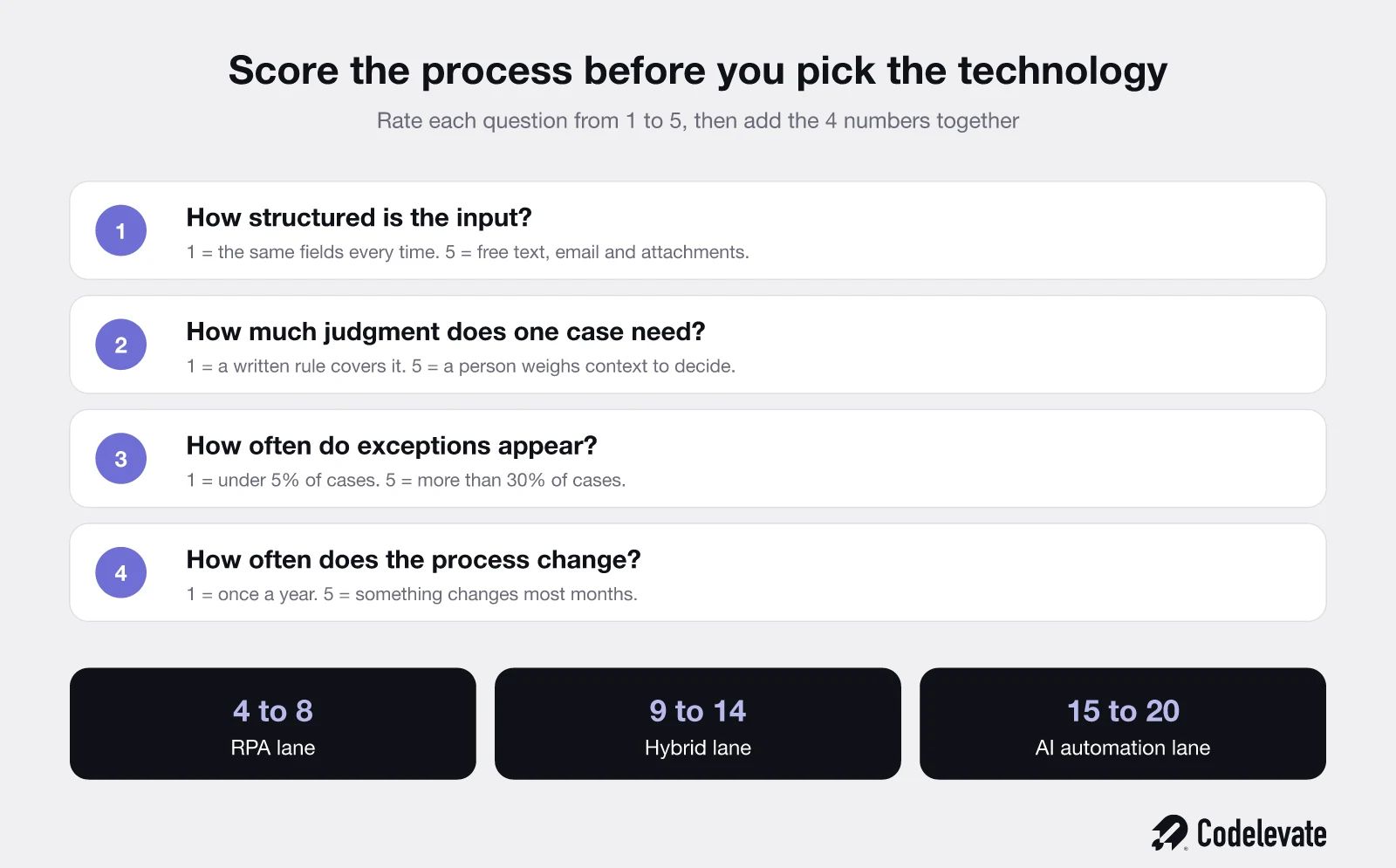
• Score the process on 4 things: how structured the input is, how much judgment each case needs, how often exceptions appear, and how often the process changes.
• A total of 4 to 8 points is an RPA process. 15 to 20 is an AI automation process. Most real processes land in the hybrid middle.
• RPA is cheap per run and expensive to maintain. AI automation is close to the reverse.
• The pattern that holds up in production is hybrid: AI reads and decides, deterministic code acts.
• Gartner expects more than 40% of agentic AI projects to be cancelled by the end of 2027, mostly for cost and scoping reasons rather than capability ones.
• Vendor labels stopped being reliable in 2026, so judge the process in front of you rather than the product page.
Why AI automation vs RPA is the wrong first question in 2026
The comparison itself has become unreliable, because the labels no longer describe the software. Gartner uses the term agent washing for the practice of rebranding existing chatbots and RPA tools as agentic AI without adding real agentic capability, and estimates that only around 130 of the thousands of vendors claiming the label are the real thing. In the same forecast, Gartner expects over 40% of agentic AI projects to be cancelled by the end of 2027, driven by escalating costs, unclear business value, and weak risk controls.
Read that list of cancellation reasons again. Not one of them is a limitation of the technology. They are all scoping problems. A project gets cancelled because somebody chose a capability and then went hunting for a process to justify it, rather than measuring a process and choosing the smallest capability that would fix it.
Deloitte's global intelligent automation research found the same thing from the other direction. Immature, fragmented processes that resist a single unified flow have topped their list of barriers to automation across four consecutive surveys, ahead of vision, IT readiness, and resistance to change. Organisations were not blocked by their tools. They were blocked by processes that varied too much to automate as written.
So the useful question is not which technology is better. It is: what does this specific process actually demand? Answer that honestly and the technology choice becomes almost mechanical. Skip it and you will spend 6 months discovering that your invoice process has 14 undocumented variants that nobody mentioned in the kickoff.
What RPA actually is, and where it still wins
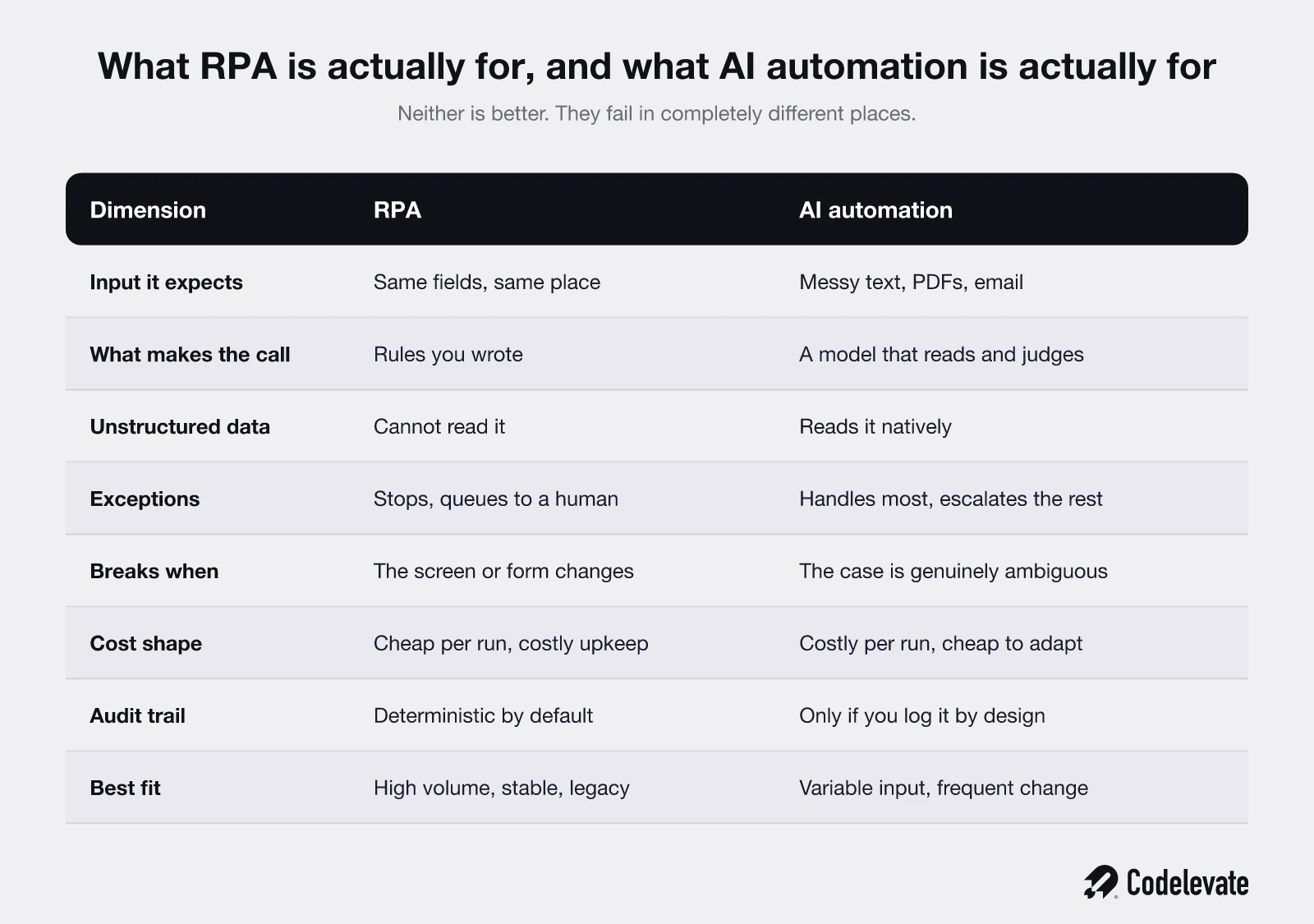
RPA is software that repeats a fixed sequence of interface actions, exactly the way you recorded it, every time. It clicks buttons, copies fields, moves between screens, and follows the rules you wrote. It does not understand what it is doing, and that is deliberate. Determinism is the product.
This makes RPA genuinely excellent at a narrow and valuable class of work: high volume, stable, repetitive tasks running against systems that have no usable API. The 30-year-old ERP with a green screen. The supplier portal that will never publish an integration. The nightly reconciliation between two systems that will not talk to each other. In those places RPA earns its keep, runs cheaply, and produces an audit trail that a compliance officer can follow without a translator.
Its weakness is equally specific. RPA has no tolerance for variation. Change the layout of a screen, add a field to a form, receive the same information as a PDF instead of a spreadsheet, and the bot does not adapt. It fails, or worse, it succeeds incorrectly and writes bad data quietly for a fortnight. Every one of those changes turns into a maintenance ticket, and the maintenance never stops. Teams that measure this honestly usually find their RPA estate costs more to keep alive in year 3 than it did to build in year 1.
What AI automation actually is, and where it earns its cost
AI automation uses a language model to interpret input, make a judgment, and then trigger an action, usually through APIs rather than by clicking a screen. The important difference is not intelligence in the marketing sense. It is that the decision logic is not written in advance by you. The model reads what actually arrived and works out what it means.
That single property is what lets AI automation handle the work RPA cannot touch. An email where the customer buried their order change in the third paragraph. A supplier invoice that arrives in 40 different layouts because you have 40 suppliers. A support ticket that needs classifying by intent rather than by keyword. Anything where the input is messy and a human currently reads it before acting is the natural territory.
The cost profile is the mirror image of RPA. Each run costs real money in tokens, so a process running 200,000 times a month has a running cost that RPA simply does not have. In exchange, changes are cheap. When the process shifts, you often adjust an instruction and some examples rather than rebuilding an automation. And the output is probabilistic, which means you need evaluation, logging, and a defined escalation path from day one. Skip that and you have not built automation, you have built an unmonitored intern with database access.
Score the process on 4 questions
Here is the part that replaces the vendor bake-off. Take one process, pull up the people who actually run it, and score it from 1 to 5 on each of the following. It takes about 20 minutes per process and it is the best-spent 20 minutes in the whole project.
1. How structured is the input?
Score 1 if every case arrives in the same fields, in the same place, in the same format. Score 5 if it arrives as free text, email threads, scanned documents, or attachments in whatever shape the sender felt like using. This is the single strongest predictor. Unstructured input is the wall that RPA cannot climb, no matter how much you spend on it.
2. How much judgment does one case need?
Score 1 if you could write the complete decision rule on an index card and it would be correct every time. Score 5 if the person doing the job weighs context, history, and tone before deciding, and two experienced colleagues might reasonably disagree. Be honest here. Teams routinely score this a 2 and then discover the rule has 30 exceptions living in someone's head.
3. How often do exceptions appear?
Score 1 if fewer than 5% of cases fall outside the happy path. Score 5 if more than 30% do. This number quietly decides your economics. An RPA bot handling 95% of cases cleanly is a success. An RPA bot that stops and queues a third of everything to a human has just moved the work rather than removed it, while adding a system to maintain.
4. How often does the process change?
Score 1 if the process and the systems behind it change roughly once a year. Score 5 if something changes most months: a new supplier format, a regulatory tweak, a vendor redesigning their portal. Rate of change is what turns a working RPA deployment into a maintenance treadmill, and it is the factor most often left out of the business case.
How to read your score
Add the 4 numbers. The total lands between 4 and 20, and each band points at a different build.
A score of 4 to 8 is an RPA process, and you should resist the urge to put a language model on it. The input is structured, the rules are known, exceptions are rare, and nothing changes. Adding AI here buys you per-run cost and non-determinism in exchange for flexibility you will never use. If the target system has an API, plain integration code beats both options and costs less than either.
A score of 15 to 20 is an AI automation process. The input is messy, the judgment is real, and the ground keeps moving. Rule-based automation will not survive contact with this process, and every month you spend trying will produce another brittle script. This is where the running cost of a model is straightforwardly worth paying.
A score of 9 to 14, which is where most real processes land, is a hybrid. Split the process rather than the technology: let AI handle the reading and the judgment at the front, and let deterministic code handle the acting at the back. More on that pattern below.
There is a fourth answer the framework produces surprisingly often, and it is the most valuable one. If the process scores high on judgment and change but runs only 20 times a month, do not automate it at all yet. Redesign it, standardise it, or leave it alone. Automating a broken process at speed just produces broken outcomes faster, and the cheapest automation project is the one you correctly decline to start.
If you want the longer version of this thinking, including how we size and sequence AI work inside an existing product, our SaaS AI Blueprint covers the scoping and cost model in more depth. It is free.
A worked example: supplier invoices at a logistics company
Take a 60-person logistics business processing about 3,000 supplier invoices a month. Two people in finance spend most of their week on it. The obvious pitch from an RPA vendor is that invoice processing is the textbook RPA use case, and on the surface it is.
Now score it. Input structure: 4, because invoices arrive as PDFs from 180 suppliers, each with their own layout, and around 15% come as photos attached to an email. Judgment per case: 3, because most invoices match a purchase order cleanly, but partial deliveries, credit notes, and rebilled freight charges need somebody who understands the contract. Exception rate: 4, because roughly a quarter of invoices deviate from the happy path in some way. Rate of change: 2, because the process itself is stable even though suppliers come and go.
Total: 13. Squarely hybrid, and nowhere near the pure RPA story the vendor was selling. In practice that means the reading and matching is a job for a model, and the posting into the accounting system is a job for ordinary integration code with hard validation rules. The model extracts line items, matches them to a purchase order, and produces a confidence score. Anything above the threshold posts automatically. Anything below it goes to a review queue with the model's reasoning attached so the finance team can approve in seconds rather than rekey for minutes.
The result is not 100% automation, and any partner promising you that on invoices is selling. It is roughly 70% of volume handled end to end, with the remaining 30% getting faster because the humans review rather than transcribe. That is a real week back for 2 people, and it is achievable in a first phase. A pure RPA build on the same process would have stalled on the 180 layouts, and a pure AI build would have put a probabilistic system in charge of writing to the ledger, which no CFO should accept.
The hybrid pattern that actually works
The architecture that survives production is easy to state: AI reads and decides, deterministic code acts. Keep the model on the interpretation side of the line, where variation lives and where being approximately right is useful. Keep everything that writes to a system of record in ordinary code, with explicit validation, so that the irreversible steps are the predictable ones.
Three things make the difference between this working and this becoming another cancelled project. First, a confidence threshold with a real review queue behind it, so uncertain cases route to a person instead of being guessed. Second, logging of every decision with its inputs and reasoning, because when finance asks why invoice 4471 was approved, "the model decided" is not an answer anybody will accept twice. Third, an evaluation set built from real historical cases, so you can measure accuracy before go-live and detect drift after it.
None of that is exotic, but it is the work that separates a demo from a system. It is also the work most commonly cut from a proposal to hit a price, which is a good thing to check for when you are comparing quotes. If you are deciding how much autonomy to hand the AI side of that split, we go deeper on it in our guide to choosing the right AI agent for process automation.
How we approach this at Codelevate
We score processes before we quote them, and we say no to a meaningful share of the work that comes in, usually because the process needs redesigning rather than automating or because the volume does not justify the build. That is a strange thing for an AI automation agency to advertise, but scoping is where these projects are won or lost, and a project that should not exist is expensive for everybody.
In practice a first engagement usually looks like scoring 5 to 10 candidate processes, picking the 1 or 2 with the best ratio of hours saved to build complexity, and shipping one of them properly with the thresholds, logging, and evaluation in place. One process working reliably beats 6 pilots that nobody trusts, and it gives you real numbers to justify the next phase internally.
The decision, in one line
Stop comparing AI automation and RPA as products and start measuring the process in front of you. Structured input with stable rules is RPA territory. Messy input with real judgment is AI automation territory. Almost everything else is a hybrid where the model reads and the code acts, and the honest fourth answer is that some processes should be fixed rather than automated.
Score your top 3 processes this week using the 4 questions above. It costs an hour and it will tell you more than any vendor demo. If you want the full scoping and cost model written down, take the free SaaS AI Blueprint.
And if you would rather score them with someone who has built these systems and seen where they break, book a free call with our team. We will go through your processes and give you a straight read, including when the answer is that you should not build anything yet.


.svg)
.svg)


