
AI agent evaluation: how to know it is ready for production
Most teams find out an AI agent is not ready for production on the day it goes live, not before. It handles the demo script perfectly, everyone in the room nods, and three weeks later it refunds the wrong customer, loops on a tool call, or tells someone their claim was approved when it was not. The gap between a working demo and a production-ready agent is not a small one, and it is rarely visible until something breaks in front of a real customer.
This article is for the person who has to make that go or no-go call. Not the engineer picking an evaluation framework, but the founder, CTO, or operations leader who commissioned the agent, whether it was built in-house or by an outside partner, and now has to decide whether it is safe to switch on. If that is not your seat, this is still useful background, but it is written for the buyer's side of the table.
In this article you will learn what AI agent evaluation actually means, why most agents fail for reasons that have nothing to do with the underlying model, the five dimensions worth checking before anything goes live, how to build a test set that catches real problems instead of rubber-stamping a demo, what a staged rollout looks like in practice, and the exact questions to put to an AI vendor or agency before you accept delivery.
Key takeaways
• AI agent evaluation is the structured process of checking an agent's behavior across full task trajectories, not just its final answers, before and after it goes live.
• According to LangChain's 2026 State of Agent Engineering report, 57 percent of organizations already have agents in production, and quality is the top barrier to deployment, cited by 32 percent of respondents.
• A 2026 survey of 650 enterprise leaders found 78 percent of companies have AI agent pilots underway, but fewer than 15 percent have reached production scale. The gap is evaluation, not ambition.
• Most AI production failures trace back to data quality, missing context, or weak governance, not model limitations, which means the fix is rarely "use a better model".
• A production-ready agent has been checked on five dimensions: accuracy, cost and speed, resilience under failure, safety and governance, and the actual experience of the person using it.
• A test set built only from clean, happy-path examples will pass every time and tell you almost nothing. Include edge cases, ambiguous requests, and cases where refusing is the correct answer.
• Go live in stages: sandbox, shadow mode next to a human, a limited pilot with real users and low stakes, then full rollout. Skipping straight to full rollout is the single most common mistake.
• If your AI partner cannot describe how they tested the agent before handing it over, that is the clearest warning sign you will get before launch, not after.
What is AI agent evaluation?
AI agent evaluation is the process of testing an AI agent's complete decision path, not just whether it produced the right final answer, against real and adversarial scenarios before it is trusted with production traffic, money, or customers.
That distinction matters more than it sounds. A traditional software test checks whether a function returns the expected output for a given input. An AI agent does not run a fixed function. It reasons over a task, decides which tools to call, calls them in some order, interprets what comes back, and sometimes changes its plan halfway through. Two runs of the exact same request can take completely different paths and both be correct, or both be wrong in different ways for different reasons. Evaluating an agent means looking at that whole trajectory, the reasoning, the tool calls, the order, the recovery when something fails, not just the sentence it eventually outputs.
This is also why evaluation is not a one-time gate you pass and forget. Agents drift as the underlying model updates, as your product changes, and as real users ask things nobody scripted into the test set. Evaluation before launch tells you if the agent is ready to meet customers. Evaluation after launch tells you if it is still the agent you approved.
Why this is the real bottleneck in 2026
Every AI vendor will tell you they can build you an agent. Fewer can tell you, with any precision, how they will prove it is safe to run. That gap between building and proving is where most AI initiatives stall, and the data backs this up.
According to LangChain's 2026 State of Agent Engineering report, 57% of organizations now have agents running in production, up sharply from a year earlier. But quality, meaning accuracy, consistency, and whether the agent sticks to the right tone and policy, is the single biggest barrier to deployment, named by 32 percent of respondents. Latency comes second at 20 percent. Perhaps the most telling number in the report: 89 percent of teams have some form of observability in place to watch what their agent does in production, but only 52.4 percent are running offline evaluations before it gets there. Most companies are set up to notice a fire. Far fewer are set up to prevent one.
A separate 2026 survey of 650 enterprise leaders, covered in Algolia's research on agent evaluation, found that 78% of enterprises have AI agent pilots underway, yet fewer than 15 percent have reached production scale. The same research points to a Gartner finding that 60 percent of AI production failures come from data quality, missing context, or governance gaps rather than any limitation of the model itself. In plain terms: the model is usually fine. What breaks is everything around it, the data it sees, the boundaries it operates inside, and whether anyone actually tested those boundaries before go-live.
For a buyer, this reframes the entire conversation with an AI development partner. The question is not "can your model do this task." Frontier models can do most tasks in a demo. The question is "how do you prove this specific agent, wired into our specific data and our specific workflow, will behave correctly for the thousandth customer, not just the first ten you showed me."
Before you go further, it is worth grabbing a structured reference for these decisions rather than relying on memory during a vendor call. Codelevate's SaaS AI Blueprint lays out the build, integration, and evaluation decisions founders need to get right before shipping AI into a product, and it is free to download.
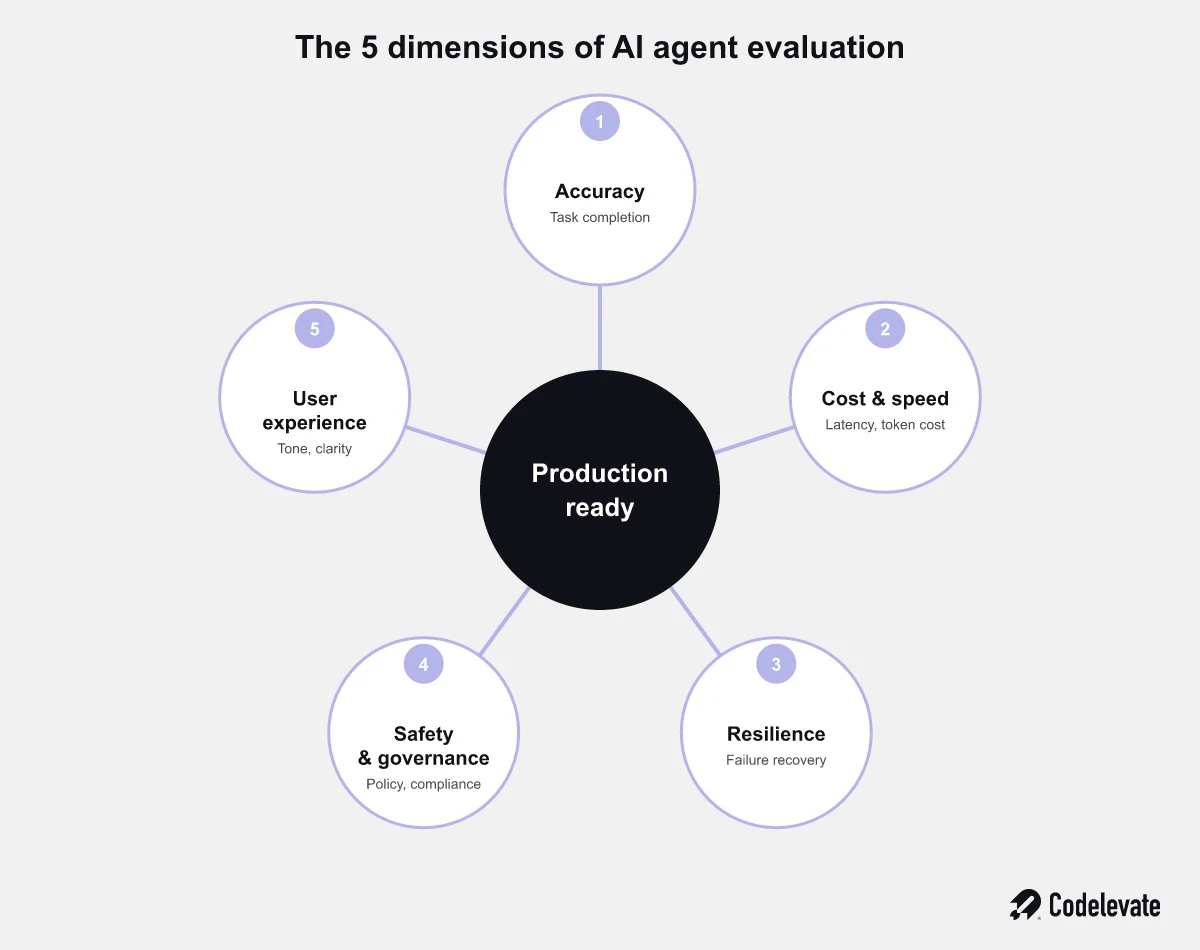
The 5 dimensions of a production-readiness check
A useful evaluation does not try to score "how good is the agent" with one number. It checks five separate things, because an agent can be excellent on one and dangerous on another.
1. Accuracy and task completion
Did the agent complete the actual task correctly, and did it reason its way there in a way you can inspect. This includes whether it retrieved the right information, whether it grounded its answer in real data instead of inventing something plausible, and whether it knew when to stop and hand off rather than guessing.
2. Cost and speed
An agent that is accurate but slow or expensive is not production ready either. If an agent costs more in token usage and tool calls than the task it automates is worth, the deployment does not make financial sense no matter how impressive the reasoning looks. Latency matters just as much once an agent faces a real customer waiting for a reply, which is exactly why it is the second most cited barrier in the LangChain data above.
3. Resilience under failure
What happens when a tool call times out, an API returns malformed data, or the agent hits a case nobody anticipated. Does it retry sensibly, escalate to a human, or does it improvise and hope. Fault injection, deliberately breaking things during testing, is the only reliable way to find this out before a real outage does it for you.
4. Safety, policy, and governance
Can the agent be manipulated into ignoring its instructions through a cleverly worded prompt. Does it stay inside the tools and data it is authorized to touch. Does it follow the compliance and policy rules your business actually operates under, not a generic version of them. This is the dimension enterprises over 2,000 employees flag most often as their second biggest concern, right after quality itself.
5. User experience and interaction quality
Numbers on a dashboard do not capture whether talking to the agent actually feels right. Is the tone correct for your brand. Does it ask for clarification instead of guessing when a request is ambiguous. Does it stay coherent across a long, multi-turn conversation instead of contradicting itself by message six. This is the dimension that is easiest to skip and the one customers notice first.
An agent that scores well on accuracy alone is not evaluated, it is demoed. Production readiness means checking all five, and knowing which one is weakest before a customer finds out for you.
Building a test set that actually catches problems
The single biggest mistake in agent evaluation is testing only with clean examples. A test set built from the ten scenarios you used in the sales demo will pass every time, because those are exactly the cases the agent was tuned and shown against. That tells you the agent can do a demo. It tells you nothing about whether it can survive a Tuesday afternoon with real customers.
A test set worth trusting includes four kinds of cases:
• Real historical cases pulled from actual support tickets, transactions, or workflow logs, not synthetic examples written to be clean and easy.
• Genuine edge cases: the customer with two accounts, the order placed in the wrong currency, the request that technically qualifies but obviously should not.
• Policy traps: anything touching personal data, pricing exceptions, refunds, or legal language, where the correct behavior is often to escalate, not to act.
• Deliberate negative cases, where the right answer is for the agent to refuse, ask a clarifying question, or do nothing at all. An agent that always tries to help is not always the agent you want.
Synthetic data generated to test an agent tends to be cleaner than anything a real user will type, which means it systematically overestimates how good the agent looks. If your test set was written by the same team that built the agent, ask who wrote the hard cases, and whether anyone tried on purpose to break it. That last step, sometimes called adversarial testing or red teaming, is the difference between an agent that was tested and one that was merely demonstrated.
Demo testing versus production evaluation
It helps to see the difference side by side, because most of the disagreement between a vendor and a buyer comes down to which of these two columns each side is actually talking about.
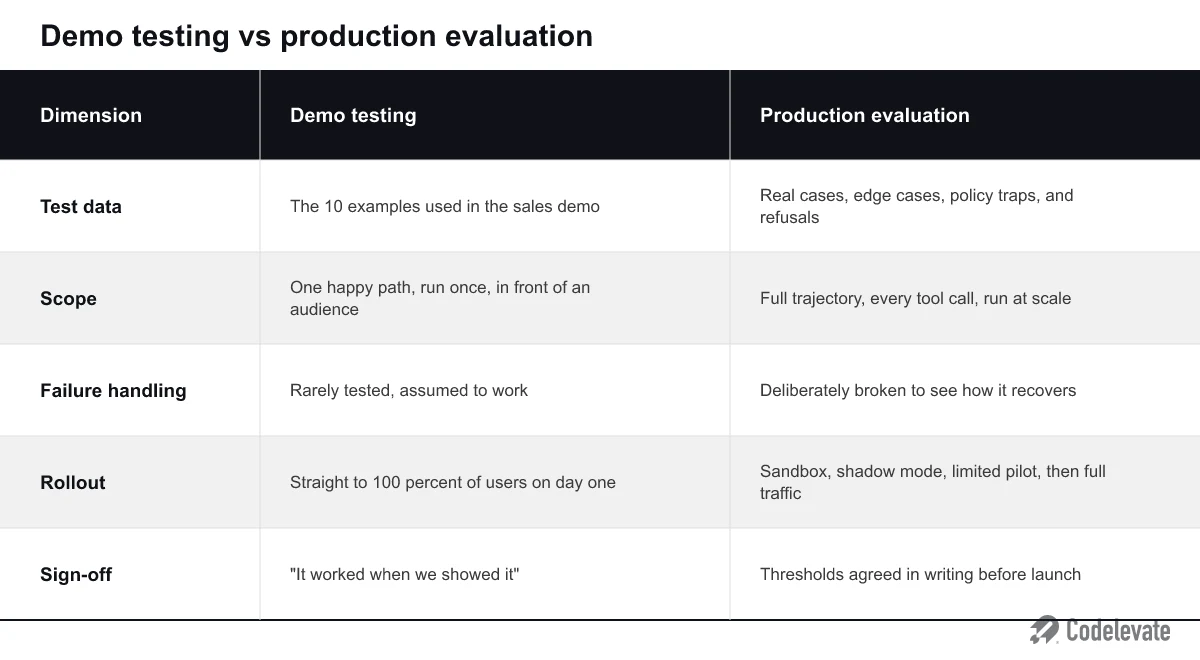
A vendor showing you a working demo has cleared the left column. Production readiness means clearing the right one. If a proposal or a project plan only ever describes the left column, that is worth asking about directly before you sign off on anything.
The staged rollout
Even a well-evaluated agent should not go from an offline test suite straight to 100% of production traffic. The variables that matter most in the real world, the actual distribution of queries, how often edge cases really occur, whether your other systems respond the way the agent expects under load, are exactly the variables a demo and a test suite are built to avoid. A staged rollout is how you find out about those variables at a small, recoverable scale instead of a large, expensive one.
Stage 1: Sandbox
The agent runs against your test set and historical data only, with no connection to live systems or real customers. This is where you catch the obvious failures cheaply.
Stage 2: Shadow mode
The agent runs alongside a human on real, live requests, but its output is never shown to the customer and never acted on automatically. You compare what the agent would have done against what actually happened, which surfaces disagreements you did not think to test for.
Stage 3: Limited pilot
A small, defined slice of real traffic, chosen for low stakes if something goes wrong, with a human reviewing outcomes and a clear rollback switch. This is where you set outcome-based thresholds in advance, for example a maximum override rate per thousand decisions, so that "ready" is a number you agreed on beforehand, not a feeling on launch day.
Stage 4: Full production, with continuous evaluation
Once the pilot clears its thresholds, the agent takes on full traffic, but evaluation does not stop. New real-world failures get added to the test set every week. Regression tests run on every change to the prompt, the model, or the tools. Someone is watching for drift as customer behavior and your own product change underneath the agent.
The pattern across every stage is the same: never expand scope until the current stage has actually met a threshold you set in advance, not one you are negotiating in the moment because a deadline is approaching.
Questions to ask an AI vendor or agency before you accept delivery
If you are commissioning an agent rather than building it in-house, this is the part of the conversation that separates a partner who engineers for production from one who is optimizing for a good demo day.
• Can you show me the test set, not just the results, and how many of the cases in it are real versus synthetic.
• What happens when a tool call fails or times out. Walk me through what the agent actually does, not what it is supposed to do.
• What is the plan for the first 30 days after launch. Who is watching it, and what triggers a rollback.
• What is the cost per completed task, including the cases where the agent gets it wrong and a human has to fix it afterward.
• How do you handle a request that should be refused. Show me an example where the correct answer was to do nothing.
• Who owns the test set and the evaluation results once the project ends. If the answer is nobody but the vendor, that is worth clarifying in the contract.
A partner who has done this before will have real, specific answers to all six, usually with examples from a project you can compare to your own. A generic answer to any of these, especially the first two, is worth treating as a signal rather than a formality.
How Codelevate approaches AI agent evaluation
We build the evaluation plan and the test set alongside the agent itself, not after it is finished, because retrofitting evaluation onto a system nobody designed to be tested is slow and it misses things. Every agent we ship for a client goes through the staged rollout above, sandbox, shadow mode, limited pilot, full production, with the thresholds for moving between stages agreed with the client in writing before we start building, not after the demo goes well.
Security and governance get checked as their own workstream rather than an afterthought bolted onto a launch checklist. If you want the specific checks we run before anything touches production traffic, our AI agent security checklist covers the technical side of that in detail. For teams deciding whether to build this capability in-house or bring in outside expertise, our AI developmenta services page walks through how we structure that engagement end to end, evaluation included rather than priced as an extra.
The transformation this actually buys you
None of this is about slowing a launch down for its own sake. It is about replacing a leap of faith with a decision you can defend, to your board, your customers, or the regulator asking how you knew the agent was safe before you switched it on. Teams that build evaluation in from the start ship agents that survive contact with real customers. Teams that skip it usually find out the hard way, in public, on a day they did not choose.
If you are about to accept delivery of an agent, whether it was built in-house or by a partner, grab the SaaS AI Blueprint before that conversation. And if you want a second opinion on whether an agent already built for you is actually production ready, or you are scoping a new one and want evaluation built in from day one, book a free call with our team.


.svg)
.svg)


