
AI team structure in 2026: the 7 jobs to cover before you hire
A founder told us last month that their board had approved budget for an AI team. Four people: a machine learning engineer, a data scientist, an MLOps engineer, and a data engineer. They wanted to know how long it would take to hire them. The honest answer was that the company did not need any of them yet, and that the org chart on the table was built for a company doing work this one was never going to do.
This is the most expensive mistake in AI hiring right now. Almost every guide to AI team structure is written by a staffing firm, and it describes the team you would build to train models. Most companies are not training models. They are calling someone else's model over an API and trying to make the surrounding system reliable enough to put in front of customers. Those are different problems, and they need different people.
So this article does not give you an org chart. It gives you the 7 jobs that decide whether an AI feature ships or quietly dies, tells you which of them your current team already covers, and names the 2 that nobody owns by default. Then it maps those jobs onto 3 concrete team shapes by stage, gives you 4 tests for whether you genuinely need a machine learning hire, and covers the in-house versus partner decision honestly.
It is written for founders, CTOs, and product leaders at SaaS companies and SMEs who are putting foundation models into a product they already run. If you are training your own models, building a research group, or working on something where the model itself is the intellectual property, the classic machine learning org chart is right for you and this piece is not.
Key takeaways
• AI team structure in 2026 is a question about jobs to be owned, not job titles to be hired.
• 7 jobs decide whether an AI feature reaches production. A normal product team already covers 4 of them.
• The 2 genuinely new jobs are evaluation and ownership after launch. Both are usually unassigned, and that is where projects stall.
• Your first AI feature should need 0 new hires. If it does not, you probably picked the wrong first problem.
• The right first AI hire is a product-minded backend engineer, not a researcher.
• You need a machine learning specialist only if 1 of 4 specific conditions is true. For most SaaS companies, none of them are.
• Gartner expects over 40% of agentic AI projects to be cancelled by the end of 2027, and the reasons it gives are staffing and ownership problems, not modelling problems.
What does AI team structure mean in 2026?
AI team structure is the set of responsibilities a company assigns so that an AI feature can be chosen, built, measured, and kept working in production. In 2026 it is mostly an ownership question rather than a headcount question, because the model layer that used to require a research team is now a vendor API.
That shift is bigger than it sounds. Five years ago, building an AI feature meant collecting training data, choosing an architecture, training, tuning, and serving a model. Every one of those steps required a specialist, so the org chart was full of specialists. Today a competent backend engineer can call a frontier model and get an answer that would have taken a research team 18 months to reach in 2020.
What has not become easier is everything around the model. Getting the right context in front of it. Knowing whether the answer was correct. Deciding what happens when it is wrong. Keeping the cost per request from quietly tripling. Knowing who is responsible in six months when quality drifts and nobody notices. That work has grown, and it is not machine learning work. It is product and engineering work with a new failure mode attached.
McKinsey's State of AI survey puts a number on where the difference actually comes from. Nearly three-quarters of the companies it classifies as high performers say they fundamentally redesigned workflows because of AI, up from around 55% the year before, compared with roughly a quarter of everyone else. The gap between companies getting value and companies not getting value is not model quality. Everybody is calling the same models. The gap is in how the work around the model is organised.
Why the standard AI org chart is the wrong template
Search for AI team structure and you will find the same list on every page: AI product manager, machine learning engineer, data scientist, data engineer, MLOps engineer, and increasingly an AI governance lead. The lists are internally consistent and they are not stupid. They describe a real kind of team. The problem is who publishes them.
Almost all of these articles come from recruiting agencies and outsourcing firms. Their business is placing people, so the answer to every question is a person. A guide that concluded "you probably need 0 new hires and should reassign 2 people you already employ" would be commercially useless to its author. That is not a conspiracy, just an incentive worth naming before you build a hiring plan on top of it.
The practical damage shows up in three ways. First, cost: a four-person specialist team in Western Europe is comfortably 400,000 euros a year fully loaded, spent before you know whether the feature works. Second, speed: those roles take months to fill in a tight market, so the project stalls at the hiring stage rather than the building stage. Third, and worst, fit. A strong machine learning engineer hired to write prompts and wire up API calls will be bored within a quarter and gone within three.
There is a cleaner way to think about it. Gartner predicts that more than 40% of agentic AI projects will be cancelled by the end of 2027, and the causes it names are escalating costs, unclear business value, and inadequate risk controls. Read that list again. Not one of those is a modelling failure. They are all failures of who was responsible for what.
The 7 jobs behind every AI feature that ships
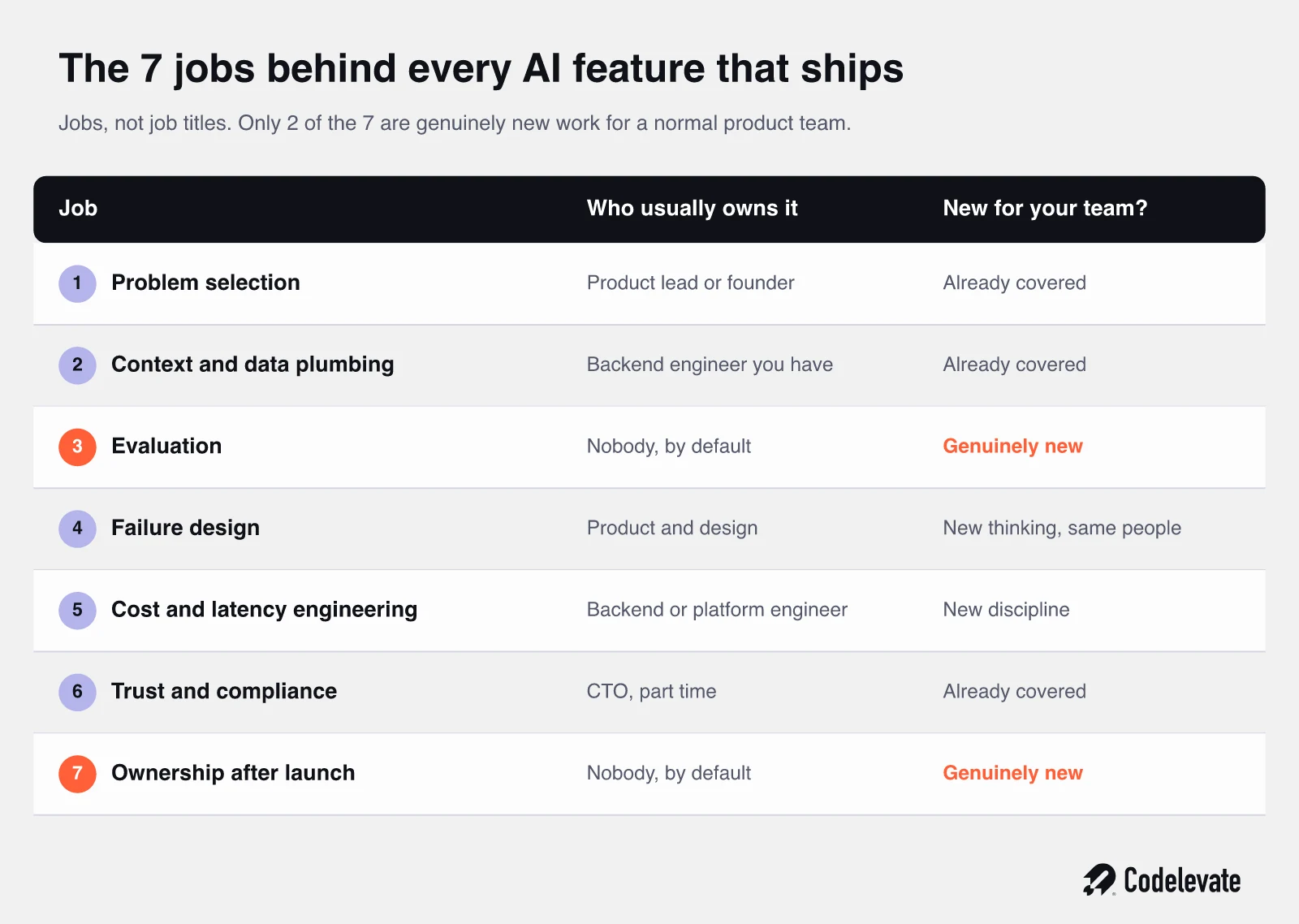
Here is the framework we use when a client asks us to help them staff an AI initiative. Instead of asking which roles to hire, list the jobs that must be owned, then ask who on the current team could own each one. Jobs are not people. One person can hold three of them, and at early stage they usually do.
1. Problem selection
Someone has to decide which workflow gets an AI feature, and, harder, which ones do not. This is the job with the most impact on the list and the one most often skipped, because it feels like it has already been done when someone says "we should use AI for support tickets."
Good problem selection means picking a workflow where the input is messy enough that traditional code fails, the volume is high enough to matter, the cost of being occasionally wrong is survivable, and a correct answer is recognisable. Skip any of those four and no amount of engineering will save the project. This job belongs to a product lead or the founder, and it is rarely a full-time role.
2. Context and data plumbing
The model only knows what you put in front of it. Someone has to get the right records, documents, and history into each request, respecting permissions, without dragging latency or token cost through the roof.
Teams consistently underestimate this. It is the single largest chunk of engineering work in a typical AI feature, and it is ordinary backend engineering: querying systems, shaping data, caching, handling stale records, enforcing who is allowed to see what. Your existing backend engineer can do this. They will need a few weeks to build intuition for how retrieval behaves, but the skills transfer directly.
3. Evaluation
Someone has to define what a correct answer looks like and measure it continuously. This is the first genuinely new job on the list, and on most teams it is owned by nobody.
Traditional software has tests that pass or fail. An AI feature has outputs that are better or worse, and the only way to know which is to build a set of real cases with known good answers and score against it every time you change a prompt, a model, or a retrieval step. Without this you are flying blind. You cannot tell whether a change helped, you cannot safely accept a model upgrade, and you cannot answer a customer who says the quality dropped. Teams that skip evaluation do not find out immediately. They find out four months later, when trust is gone.
4. Failure design
Someone has to decide what happens when the model is wrong, because it will be. Does the answer go straight to a customer or through a reviewer? Can the user see what the system used to reach its conclusion? Can an action be undone? What is the blast radius of one bad output?
This is product and design work, not engineering work, and it is where the difference between a feature people trust and a feature people quietly stop using is decided. Your existing product lead and designer can own it. What they need is the explicit instruction that designing the failure path is part of the feature, not an edge case to handle later.
5. Cost and latency engineering
Someone has to own what a request costs and how long it takes. In traditional software these are optimisation concerns you visit occasionally. In AI features they are product constraints from day one, because cost scales with usage in a way that hosting never did, and because a 9-second response changes what the feature is allowed to be.
The work is concrete: measuring cost per request per feature, caching aggressively, routing easy requests to smaller models and hard ones to larger models, trimming context that is not earning its place. A platform or senior backend engineer picks this up quickly. It is a new discipline rather than a new person.
6. Trust and compliance
Someone has to be able to answer, in writing, what data leaves your systems, where it is processed, how long anyone retains it, and what you would tell an enterprise customer's security team. In Europe this is not optional and it arrives earlier than people expect, usually in the middle of a deal.
This is typically a part-time CTO job with legal support. It does not need a dedicated governance hire until you are meaningfully larger than most of the companies reading this.
7. Ownership after launch
Someone has to own the feature once it is live. Who gets paged when quality drifts? Who reviews the evaluation scores each month? Who decides whether to accept the model provider's next version, and who tests it before it goes in?
This is the second genuinely new job, and it is the one we see unassigned most often. AI features do not fail loudly like a service outage. They degrade. The provider deprecates a model, you move to the successor, the API still returns a 200, and behaviour shifts in ways nobody catches for weeks. If no name is attached to this job, the answer is that nobody owns it, and you will discover that during an incident.
The 2 jobs nobody assigns
Look at the map again and notice the pattern. Jobs 1, 2, 4, and 6 map cleanly onto people you already employ. Job 5 is new work for an existing engineer. Only jobs 3 and 7, evaluation and ownership after launch, have no natural home on a normal product team.
That is not a coincidence, and it explains most of the AI projects we get called in to rescue. A team builds a demo in three weeks, everyone is impressed, and it goes to production. Nobody built an evaluation set, so there is no baseline. Nobody was named as the owner, so when a customer reports that answers got worse, three people investigate for a day and conclude it is probably fine. Six months later the feature is switched off, and the retrospective says the technology was not ready.
The technology was fine. Two jobs were unassigned.
The fix costs almost nothing at the start and is expensive to retrofit. Before you write the first prompt, collect 50 real cases with known correct answers. Put a name against the evaluation set and a name against the live feature, and give both of those people a recurring hour a month. That is the whole intervention. It is not glamorous and it is the highest-return thing on this page.
If you want the longer version of this thinking, our SaaS founder's AI blueprint walks through how to scope, staff, and sequence an AI feature so it survives contact with real users. It is free and written for exactly this decision.
3 team shapes, by stage
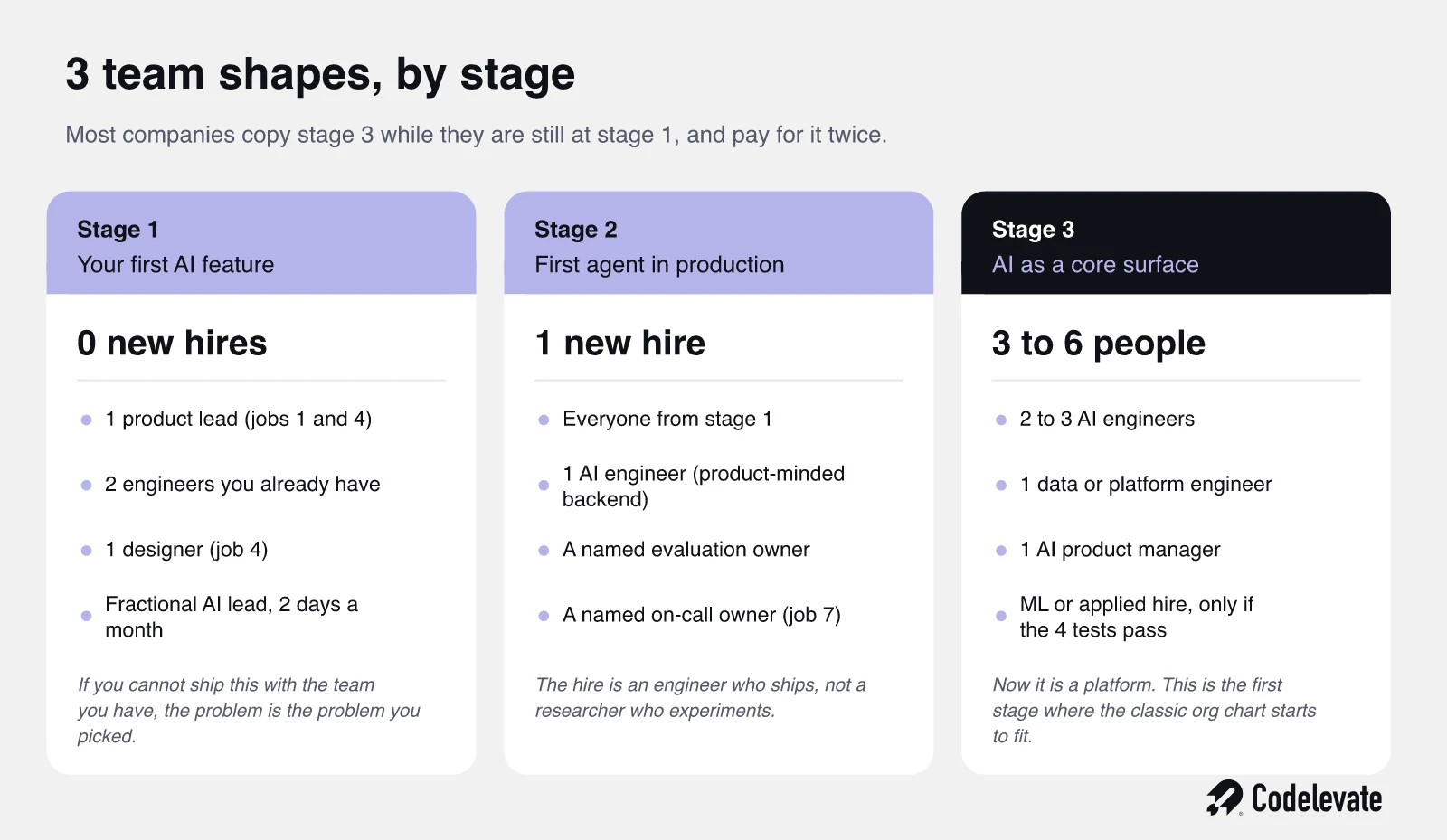
Once the jobs are clear, team shape follows. The mistake we see most often is a company copying the structure of a company two stages ahead of it, then paying for that structure for a year before the first feature ships.
Stage 1: your first AI feature
0 new hires. A product lead who owns problem selection and failure design, two engineers you already have, a designer, and ideally an experienced AI lead for a couple of days a month to stop you making the expensive mistakes early. Many companies use a fractional CTO arrangement for that last part rather than a hire.
The reason to hold the line at 0 hires here is diagnostic. If your first AI feature genuinely cannot be built by the team you have plus occasional senior guidance, that is strong evidence you picked a first problem that is too hard, too broad, or too central. Pick a narrower one. The first feature exists to teach your team how this technology behaves in your product, not to transform the company.
Stage 2: first agent in production
1 new hire. When the feature works and you are moving from a single call to something that takes multiple steps and acts on real systems, the load on jobs 2, 3, and 5 grows past what a part-time owner can carry.
The hire is an AI engineer, and the profile matters more than the title. You want a strong backend engineer with good product instincts who has shipped LLM-backed features to real users. You do not want a researcher. The daily work is integration, retrieval, evaluation, cost control, and debugging strange behaviour, and someone who trained models for a living will find that work unsatisfying. This is also the stage where evaluation and post-launch ownership must have explicit names attached, not implied ones.
Stage 3: AI as a core surface
3 to 6 people. AI is now central to the product rather than a feature inside it: 2 to 3 AI engineers, a data or platform engineer owning pipelines and infrastructure, and an AI product manager. This is the first stage where the standard org chart you found on a recruiting blog starts to describe your actual situation, and it is also the first stage where a machine learning or applied science hire can be justified, if the tests in the next section pass.
When do you actually need a machine learning hire?
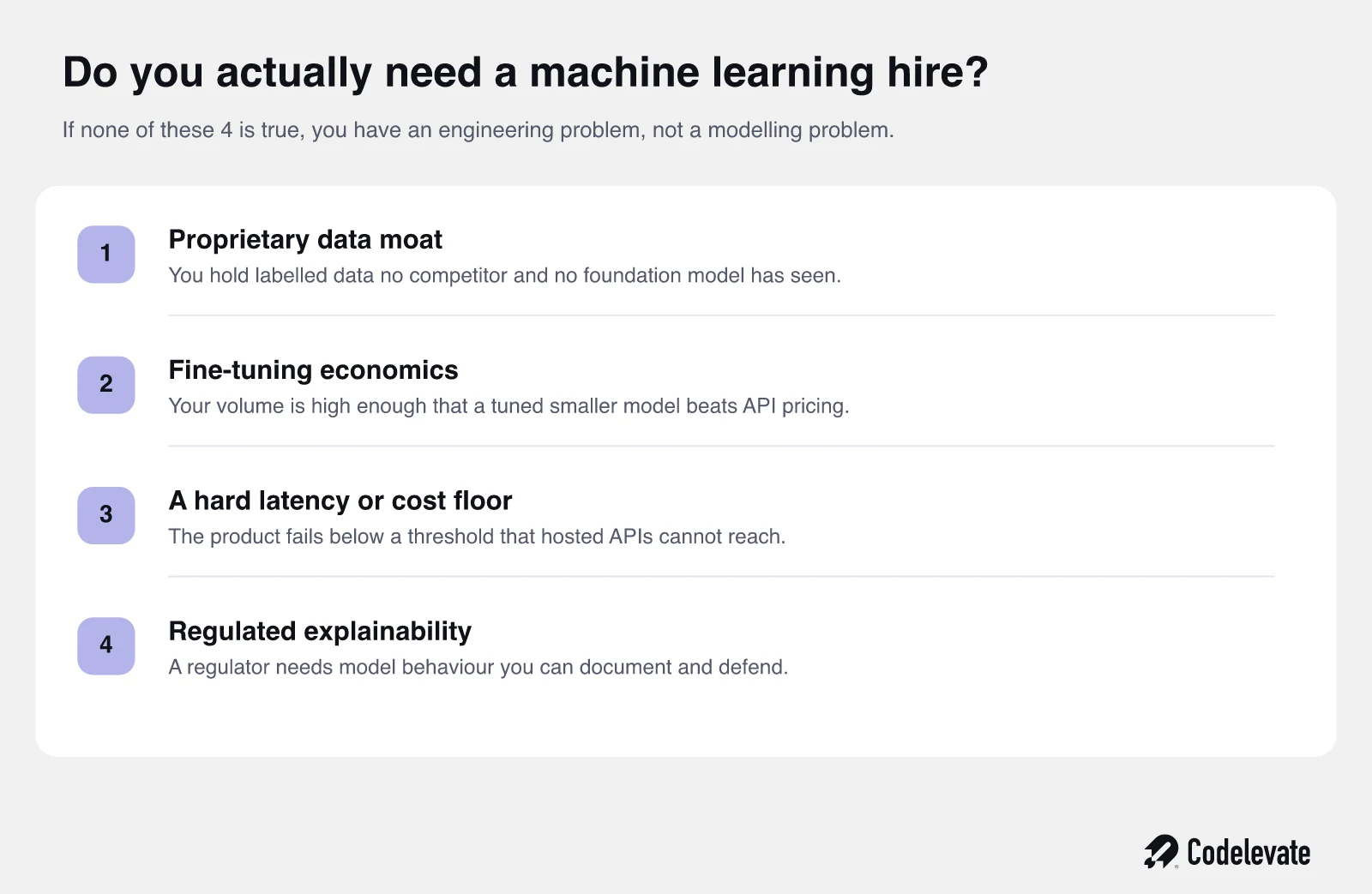
You need a machine learning specialist when at least 1 of these 4 conditions is true. If none of them are, hiring one is expensive, and you will probably lose them within a year to a company that can give them the work they trained for.
• You hold proprietary labelled data that no competitor and no foundation model has seen, and that data is the actual product advantage.
• Your volume is high enough that fine-tuning a smaller model beats hosted API pricing by a margin worth the engineering, which in practice means millions of requests, not thousands.
• The product has a hard latency or cost floor that hosted models cannot reach, so you must run something smaller and self-hosted.
• You are in a regulated setting where a supervisor requires model behaviour you can document, reproduce, and defend, and a vendor API cannot give you that.
Most SaaS companies meet none of these. That is a good position to be in, not a limitation. It means your competitive advantage sits in the workflow, the data access, and the quality of the surrounding system, all of which your existing engineers can build, and none of which requires you to compete for scarce research talent.
The honest version of this advice is one most hiring guides will not print: for the majority of companies putting AI into an existing product in 2026, the model layer is a procurement decision, and the differentiator is engineering discipline.
5 AI hiring mistakes we see most often
These come from working with companies that had already tried once before calling us. They repeat with unusual consistency.
• Hiring a machine learning researcher first. The work turns out to be integration engineering, the hire is underused, and both sides are disappointed. This is the single most common and most expensive error.
• Hiring a prompt specialist as a standalone role. Prompting is now a skill inside engineering and product roles, the way SQL is. It is not a job description, and building a role around it creates a person with no clear career path and no ownership of outcomes.
• Making AI a separate team. An AI group sitting outside the product organisation ends up building things that never integrate, because the people who own the workflow and the people who own the model are in different meetings. AI features belong to the product teams that own the workflows they touch.
• Leaving evaluation unassigned. Covered above, and worth repeating, because it is invisible until it is expensive.
• Outsourcing problem selection. Bringing in a partner to build is reasonable. Letting them decide which problems are worth solving is not, because they do not know which workflows actually hurt, and they carry an incentive toward the ambitious build rather than the useful one. Keep job 1 in-house, always.
In-house, partner, or hybrid?
All three work. The choice depends on how quickly you need to move and whether AI is going to be a permanent capability or a set of features you build once and maintain.
Building fully in-house makes sense when AI is central to your product and you have the time and salary budget to hire ahead of the work. It is the slowest path to a first result and the strongest position after 18 months.
Working with a partner makes sense when you want the first feature in production this quarter rather than next year, and when you would rather learn what the work involves before committing to permanent headcount. The risk is dependency, and it is managed by contract: insist that evaluation sets, prompts, and documentation are yours, and that at least one of your own engineers works alongside the build rather than receiving it at the end.
The hybrid version is what we recommend most often. A partner covers jobs 2, 3, and 5 for the first two features while one of your engineers works alongside them and takes over. You keep problem selection and failure design in-house from day one, because those depend on knowing your business. After two features, your engineer has the intuition that would otherwise have taken a year of trial and error, and you know from evidence whether a permanent AI hire is justified.
How Codelevate approaches this
When a client asks us to help them build an AI capability, the first session is not about architecture. We map the 7 jobs against the people they already have, and we usually find that four or five are already covered by someone who does not know it is now part of their role. The gaps are almost always evaluation and post-launch ownership, sometimes cost engineering.
From there the recommendation is specific rather than generic: which single hire actually unblocks you, which jobs to formally assign to existing people this week, and which parts are worth having an outside team carry while your engineers learn the pattern. Sometimes the answer is that you need an extended engineering team for two quarters. Sometimes it is that you need nobody new and a different first problem. We would rather tell a client the second thing and be right than sell them the first.
The value of running this properly is that you stop guessing. You know which jobs are covered, which are not, and what the next hire is actually for.
Where to start this week
AI team structure in 2026 is not an org chart problem. It is an ownership problem wearing an org chart costume. The companies getting value are not the ones with the most impressive AI titles, they are the ones where all 7 jobs have a name attached and evaluation is not an afterthought.
So before you open a single job posting, do three things. Write the 7 jobs on a page and put a name next to each. Circle the ones with no name, which will almost certainly be evaluation and ownership after launch. Then pick a first problem small enough that your current team can ship it, and use it to find out what you actually need rather than what a recruiting blog told you.
If you want a structured version of that exercise, our SaaS founder's AI blueprint covers scoping, staffing, and sequencing in more detail, and it is free.
And if you would rather work through it with someone who has done it across a few dozen builds, book a free call with our team. We will map the 7 jobs against your team and tell you honestly what the gap is, including when the answer is that you do not need to hire anyone.

.svg)
.svg)


