
Build vs buy AI agents: the layer by layer decision most teams get backwards
Most build vs buy decisions for AI agents are made at the wrong altitude. A room of capable people argues for weeks about whether to license a platform or write their own, as if an agent were a single object you either purchase or produce. It is not. An agent is a stack of 7 distinct layers, and each layer has its own answer.
Get the altitude wrong and a specific, expensive pattern follows. Companies buy the layer that carries their competitive advantage, and build the layer any vendor would have rented them for a few hundred euros a month. They pay twice. Once in licence fees for something generic, once in engineering months for a problem the industry solved years ago.
This article is written for founders, CTOs, and operations leaders at companies that already have real process volume behind the decision, the ones about to sign a platform contract or approve 6 months of engineering. If you want a chatbot on a marketing site, this is far more depth than your problem needs.
Here is what you will get: the 7 layers of an AI agent with a default call for each, the layer swap that quietly costs the most, a 5 step exercise that closes the decision in one afternoon, the costs neither vendors nor engineers put in the quote, and the reversibility test that beats every spreadsheet you could build.
Key takeaways
• Build vs buy is not one decision about the agent. It is 7 decisions, one per layer of the agent stack.
• Buy the model, the runtime, and the interface. These are commodities and owning them wins you nothing.
• Build the context layer, the decision logic, and your evaluation set. These encode what makes you different.
• Integration is the layer that decides your timeline, and it is the one most teams schedule last.
• The most common and most expensive mistake is renting your decision logic while hand building your plumbing.
• Ask what leaving costs in month 18. Reversibility separates a good buy from an expensive trap.
• Waiting is a legitimate third answer when the process itself is not yet stable enough to automate.
Build vs buy AI agents: what the decision actually covers in 2026
Build vs buy for an AI agent is the decision about which parts of the agent your team owns and operates, and which parts you rent from a vendor. It is almost never all of one or all of the other, which is exactly why framing it as a single yes or no produces bad answers.
The confusion comes from the word agent. It sounds like a product, so people shop for it like a product. In practice an agent is an assembly. Something reasons, something remembers, something is allowed to act, something watches it, and something puts it in front of a human. Those are separate concerns built by separate parts of the market, and the boundaries between them are where your leverage lives.
The market has already picked a side at the surface level. In its 2025 enterprise survey of 495 AI decision makers, Menlo Ventures found that 76 percent of enterprise AI solutions are now bought rather than built, up from 53 percent a year earlier. Read quickly, that looks like a verdict. Read carefully, it is a warning. When almost everyone buys the same capability from the same short list of vendors, the capability stops being an advantage. It becomes table stakes, and whatever you kept for yourself is the only thing left that separates you.
The failure rate points the same direction. Gartner predicts that over 40 percent of agentic AI projects will be cancelled by the end of 2027, citing escalating costs, unclear business value, and inadequate risk controls. Those three causes are not model problems. They are scoping and ownership problems, which is another way of saying they are build vs buy problems decided badly.
Why the whole-agent question is the wrong question
When you ask build or buy about the entire agent, you force one answer onto 7 different problems. Three failure patterns follow, and we see all three regularly in the first conversation with a new client.
The moat you wrapped in someone else's product
A logistics company we spoke with had spent months encoding how they triage exceptions. Which delayed shipment gets escalated, which gets rebooked automatically, which needs a human call to the customer before anything moves. That logic was the product of 15 years of operating experience. They then handed it to a platform whose workflow builder could express about 70 percent of it, and quietly dropped the other 30 percent because the tool had no way to represent it. The agent worked. It also made their exception handling look exactly like their competitor's, who used the same platform.
This is the pattern to fear most, because it does not feel like a mistake while it is happening. Everything ships on time. The loss only shows up later, when your differentiation has been sanded down to the shape of a vendor's data model.
The plumbing you paid to rebuild
The opposite error is just as common and easier to spot. A team decides they are building, and building means everything. So they write their own orchestration layer, their own retry and queue handling, their own prompt versioning, their own vector store abstraction. Four to 6 engineering months disappear into problems that a mature open source framework or a hosted runtime would have handled on day one.
Nobody has ever won a customer because of their in-house queue implementation. This is rented infrastructure that behaves like a fixed asset on the balance sheet: expensive to build, expensive to maintain, and worth nothing to anyone outside the company.
The evaluation that never ends
The third pattern is paralysis. When the question is too big, no answer feels safe, so the team keeps evaluating. Six vendor demos become 12. A proof of concept runs for a quarter and proves only that the demo works. Meanwhile the process the agent was meant to fix keeps consuming the same hours it did before.
Splitting the question by layer breaks the deadlock, because most of the layers turn out not to be close calls at all. Once you strip out the obvious ones, you are usually arguing about 2 layers, not the whole system.
The 7 layers of an AI agent, and who should own each
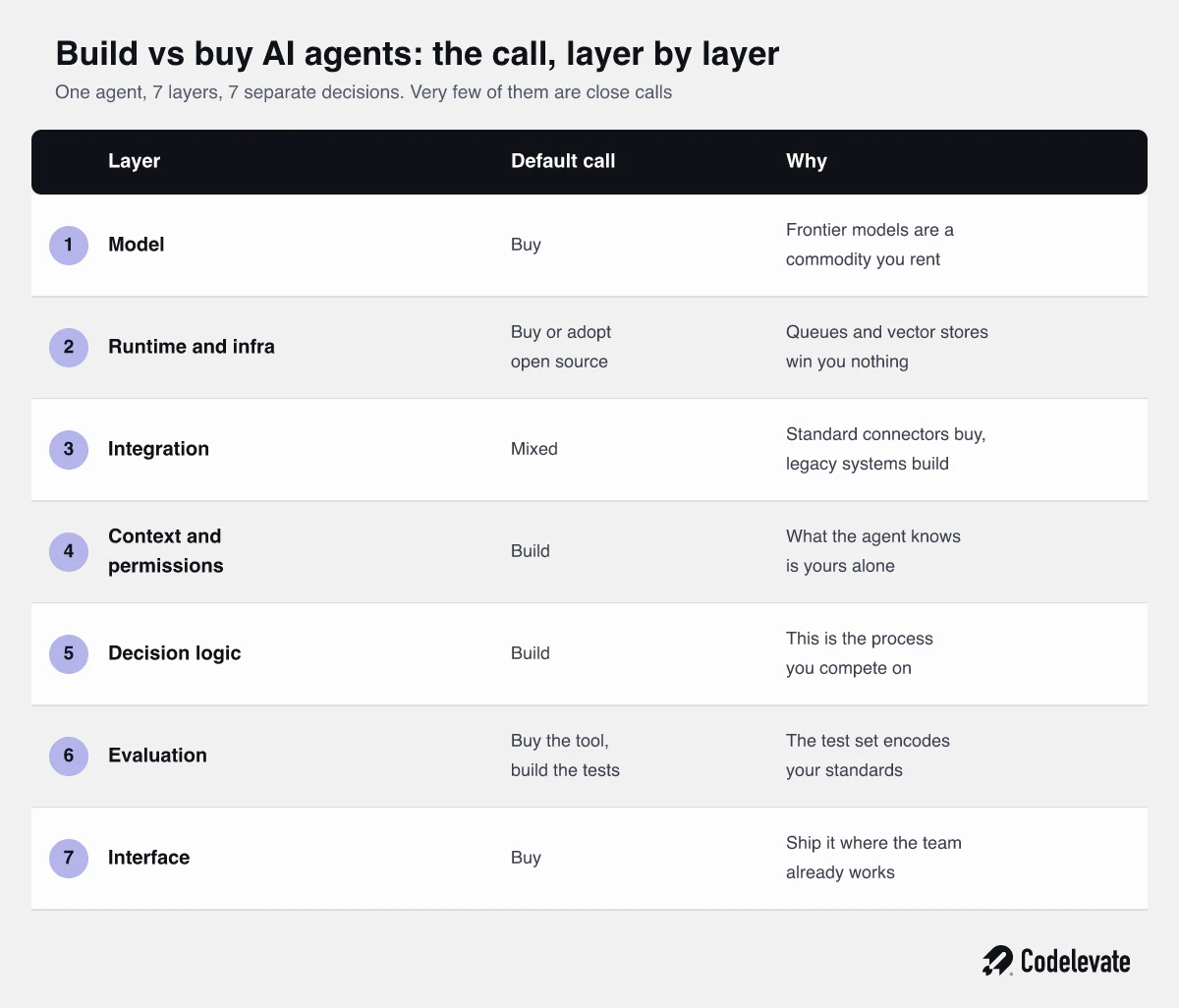
An AI agent is made of 7 layers. Decide each one separately and most of the decisions answer themselves.
The 3 layers to buy without much debate
The model layer is a rental market and should be treated like one. Frontier models from Anthropic, OpenAI, and Google are commodities in the economic sense: substitutable, priced per unit, and improving faster than any internal effort could match. Fine tuning a smaller model for a narrow, high volume task is sometimes worth it on cost grounds, but that is an optimisation you reach for in year 2, not an architecture decision you make in month 1.
The runtime and infrastructure layer covers orchestration, queues, retries, vector storage, and secrets handling. Buy it or adopt a well maintained open source framework. Every hour spent here is an hour not spent on the parts of the agent your customers would notice. The one caveat is data residency: if your sector requires processing inside a specific jurisdiction, that constrains which hosted runtime you can use, and it is worth checking before you fall in love with a vendor.
The interface layer is where people meet the agent. Almost always, that should be a tool your team already has open, whether that is Slack, Teams, your ticketing system, or the internal admin your operations staff live in. Building a new destination for an agent is the surest way to have it ignored. The exception is when the interface itself is your product, in which case it was never a build vs buy question.
The 3 layers to build almost every time
The context and permissions layer is what the agent knows and what it is allowed to see. Which systems it reads, how fresh that data is, which customer records a given user may surface through it, and what happens when a document is stale or contradicts another. No vendor can assemble this for you, because it is a map of your business and your access rules. Teams that shortcut it by dumping documents into a vendor index end up with an agent that is confidently wrong in ways nobody can trace.
The decision logic layer is the sequence of judgements the agent makes: when to act alone, when to ask, when to escalate, what an edge case looks like, and which outcomes are unacceptable. This is your operating process expressed in software. If a competitor could buy the same logic from the same vendor, it was never worth much. Build it, and keep it in a form you can read, version, and change without a support ticket.
Evaluation is a split decision, and the split matters. Buy the tooling, because eval harnesses and tracing platforms are mature and cheap. Build the test set. A few hundred real cases from your own history, labelled with what a good outcome actually looks like in your business, is the single most valuable asset in the whole project. It is what lets you say the agent is ready with a straight face, it survives every model and vendor change underneath it, and no supplier can hand it to you.
The layer that decides your timeline
Integration is the mixed case, and it is the one that determines whether you ship this quarter or next year. Where your systems are mainstream and well documented, buy the connector and move on. Where the system is a 12 year old ERP, an industry specific platform, or a database somebody's predecessor designed, budget real engineering time. This is usually the largest single line item in an agent project and it is almost always the last one anyone plans.
The practical test is simple. Before you commit to any vendor or any architecture, list every system the agent must read from or write to, and mark each one as documented API, undocumented API, or no API. If the third column has entries, your timeline is set by that column and nothing else.
If you are mapping this out for the first time, our free SaaS AI Blueprint walks through how these layers fit together in a real product, including the architecture decisions that are painful to reverse later. It is a useful companion to the exercise below.
The layer swap that quietly costs the most
Across the projects we assess, one pattern shows up more than any other: teams buy what they should own and build what they should rent. It is worth looking at directly, because each half of the swap has a different failure signature.
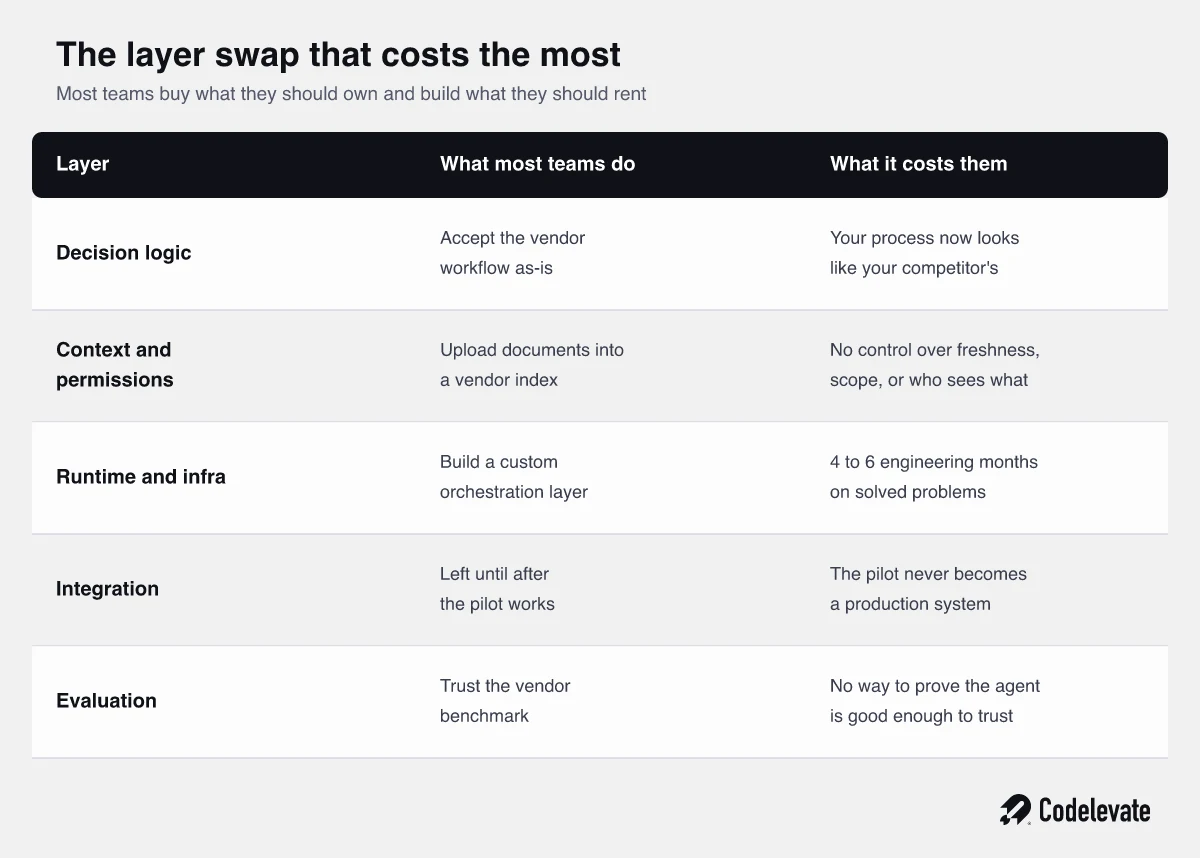
Renting your decision logic fails slowly. Nothing breaks. You just wake up 18 months later unable to change how your own process works without filing a feature request, and unable to explain to a customer why your service is different from the 3 competitors on the same platform.
Hand building your plumbing fails visibly. The project runs long, the team is exhausted before the agent handles a single real case, and the first executive review focuses on the burn rather than the outcome. It is recoverable, but it costs a quarter you did not have.
The uncomfortable part is that both mistakes are made by careful people. Buying the workflow feels responsible because it looks like a shortcut to production. Building the infrastructure feels responsible because it looks like control. The layer view is what separates the responsible move from the merely responsible feeling one.
How to run the build vs buy call in one afternoon
This decision does not need a quarter. It needs 3 hours, the right people, and a whiteboard. Run it with whoever owns the process, whoever owns the systems, and whoever owns the budget, all in one room.
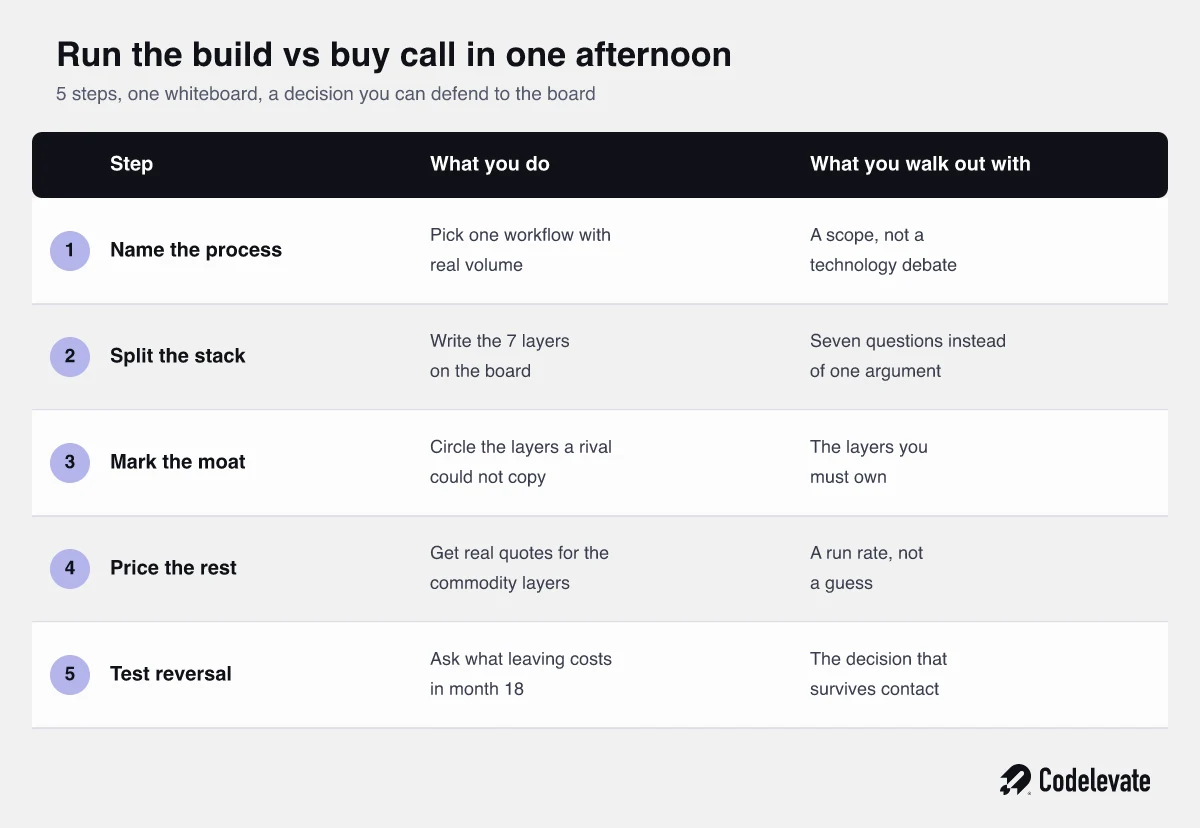
Step 1 is to name the process. Pick one workflow with real volume, not a category. Not customer service, but the first response on refund requests under 200 euros. A named process keeps the room arguing about scope instead of technology, which is the only argument worth having at this stage.
Step 2 is to split the stack. Write the 7 layers on the board. This alone changes the conversation, because people who were disagreeing violently usually turn out to have been answering different questions. The person who wanted to buy meant the runtime. The person who wanted to build meant the logic. Both were right.
Step 3 is to mark the moat. Go layer by layer and ask whether a competitor with the same budget could buy the same thing tomorrow. If yes, it is a commodity and you should rent it. If no, it belongs to you and you should own it outright. In our experience this circles the context layer and the decision logic almost every time, and very little else.
Step 4 is to price the rest. For every layer you marked as commodity, get a real quote rather than an estimate. Ask for pricing at 10 times your current volume, not today's volume, because agent usage is one of the few line items that genuinely scales with success. A per run price that looks trivial in a pilot can become the largest item in your infrastructure budget within a year.
Step 5 is to test reversal, which is important enough to have its own section below.
You walk out with a one page decision: 7 layers, 7 calls, a run rate for the bought parts, and a scoped build for the rest. That page is what you take to a board or an investor, and it holds up under questioning in a way that a vendor comparison sheet never does.
What buying actually costs
Vendor pricing pages describe the licence, not the cost. Four line items reliably land outside the quote.
• The customisation tax. Your process will not match the vendor's model exactly. You will either bend your process or pay for professional services, and both are real costs that appear after signature.
• The integration work you were going to do anyway. Buying a platform does not remove the connector problem for your non standard systems. It only moves it.
• Scaling with success. Per seat, per run, and per token pricing all grow as the agent works. Model the bill at the volume you are hoping for, not the volume you have.
• The exit. Ask directly what you take with you if you leave: your prompts, your workflow definitions, your evaluation history, your logs. If the answer is vague, the answer is nothing.
What building actually costs
Engineers usually estimate the wrong half. The model integration is rarely the expensive part, and it is not the part that runs late.
The money goes into integration with awkward systems, into the context layer and its permission rules, into building the evaluation set, and then into operating the thing once it is live. That last item is the one most often left out entirely. An agent in production needs monitoring, someone who owns the exception queue, a way to roll back a bad change, and a regular review of whether its answers are still good as the underlying business shifts. Budget for the second year, not just the launch.
The upside is that marginal cost falls. Once the integration and context work is done, extending the agent to a second and third workflow is dramatically cheaper than the first, because you are reusing the layers that took the effort. This is why the honest comparison is not build versus buy on one workflow. It is the 3 year cost across the workflows you expect to automate.
The reversibility test
When a decision is genuinely close, stop comparing features and ask one question instead: what does it cost us to reverse this in month 18?
For a bought layer, that means asking what leaving looks like. Can you export your configuration in a usable form? Do you keep your evaluation history? How long would a migration take, and who would do it? A layer you can walk away from in 2 weeks is a low risk purchase even if it is imperfect. A layer that takes 6 months to unwind is a strategic commitment and deserves to be treated as one.
For a built layer, reversal means the opposite question: if a vendor solves this properly next year, can you drop your implementation and adopt theirs without touching everything else? That is an argument for clean boundaries between layers, and it is the practical reason the layer model earns its keep beyond the initial decision.
Reversibility is a better guide than cost, because your cost estimates will be wrong and your ability to change your mind will not be. We go deeper on the specific traps in our guide to AI vendor lock-in for SaaS teams.
5 questions that tell you whether a vendor can carry a layer
If you are buying a layer, these 5 questions separate a capable supplier from a good demo. Ask them in this order.
• Show me a customer in production, not a pilot. How long did it take them to get from the demo to real volume, and what went wrong in between?
• What happens when your model provider changes behaviour? Who tests it, who tells us, and what is the notice period?
• Can I export my prompts, workflow definitions, evaluation history, and logs today, in a format I can use elsewhere?
• Where does the customisation stop? Show me the specific thing your platform cannot express, and be honest about it.
• Who owns an incorrect output that reaches a customer? Walk me through your last one.
The last question is the most revealing. A vendor who has never had an incident either has no production customers or is not telling you the truth. A vendor who describes one clearly, including what they changed afterwards, is a vendor who has actually operated something.
When the right answer is to wait
Waiting is a legitimate answer and it is under-used. Three situations call for it.
• The process is not stable. If the workflow changes every few weeks because the business is still finding its shape, any agent you build encodes a snapshot that is already out of date. Stabilise the process first, on paper, with humans.
• Nobody owns the outcome. If you cannot name the person whose numbers improve when the agent works, the project has no home and will be quietly abandoned regardless of how well it is built.
• The data is not reachable. If the information the agent needs lives in someone's inbox or a spreadsheet on a laptop, the first project is a data project, not an agent project. That is a smaller and more valuable piece of work than the one you were about to fund.
Choosing to wait for one of these reasons is not indecision. It is the same judgement that makes the other 6 layers easy to call.
How we make the call at Codelevate
When a client brings us a workflow, we do not start with technology. We map the layers, mark which ones carry their advantage, and then argue only about those. Usually 5 of the 7 are settled inside an hour, which leaves the real conversation, about context and decision logic, enough room to be had properly.
We then build the layers that belong to the client in a way they can own after we leave: readable logic, a documented context layer, an evaluation set built from their own historical cases, and clean boundaries so any bought layer can be swapped later without a rewrite. On the commodity layers we make a recommendation and get out of the way. That is the whole of our approach to AI development, and it is why our clients can usually take a second workflow live far faster than the first.
The short version
Build vs buy for AI agents is not a decision you make once. It is 7 decisions, and 5 of them are not close. Rent the model, the runtime, and the interface. Own the context layer, the decision logic, and your evaluation set. Plan the integration layer first, because it sets your timeline. Then check every call against what it costs you to change your mind in 18 months.
Teams that decide this way stop paying twice. They ship faster, because most of the stack is bought and the argument is narrow. They also keep the part that makes them worth choosing, which is the whole point of automating a process you are already good at.
If you want the architecture thinking behind this in more depth, the SaaS AI Blueprint is free and covers the decisions that are hardest to undo. And if you would rather have the layer conversation with someone who has run it before, book a free call with our team and bring one workflow. An hour is usually enough to know which layers are actually yours.

.svg)
.svg)


