
AI vendor lock-in: a practical guide for SaaS teams in 2026
Most advice on AI vendor lock-in is written for enterprises with a platform engineering team, a procurement department, and a budget for an AI gateway nobody outside IT has heard of. If you run a 5 to 50 person SaaS company shipping an AI feature this quarter, that advice does not fit your business, and following it too literally will slow down the very feature that is supposed to be your differentiator.
This article is for founders, chief technology officers, and product leaders who are building or have already shipped AI features into a SaaS product and are wondering how much effort to spend protecting themselves from getting stuck with one model provider. If you already run a dedicated AI platform team with a multi model gateway in production, you have probably solved most of what is here. If you are still deciding whether to add an AI feature at all, start with our primer on what actually changes in AI software development in 2026 instead.
In this article you will learn what AI vendor lock-in actually is, why it has become a sharper risk in 2026, the 5 layers where it actually accumulates, why the standard enterprise fix is often the wrong size for a lean team, and a practical way to decide what is worth protecting and what genuinely is not.
Key takeaways
• AI vendor lock-in is the cost and difficulty of switching away from an AI provider once your product, data, and team depend on it.
• A 2026 Zapier survey found 89 percent of enterprise leaders believed they could switch AI vendors within 4 weeks, but only 42 percent who actually tried it called the migration smooth.
• Lock-in accumulates across 5 layers: the model itself, prompt behavior, data and embeddings, orchestration logic, and team knowledge.
• Most early-stage SaaS teams do not need a full model abstraction platform. That is enterprise-shaped advice solving an enterprise-shaped problem.
• The right question is not "how do I avoid lock-in" but "which specific parts of my product would actually hurt to change, and how do I keep those cheap to swap."
• Frontier model release cycles have compressed from 6 to 9 months in 2023 to roughly 4 to 6 weeks by mid 2026, which is exactly why this decision cannot be made once and forgotten.
• Gartner expects 40 percent of enterprise applications to carry task specific AI agents by the end of 2026, up from under 5 percent in 2025, which means the surface area exposed to lock-in is expanding fast, for everyone.
What is AI vendor lock-in?
AI vendor lock-in is the accumulated cost, risk, and difficulty of moving away from an AI provider once your product, your data, and your team have grown dependent on how that specific provider behaves. It is rarely a single contract clause or a single line of code. It is a slow accumulation of small decisions, a prompt tuned to one model's quirks, a fine-tune only that vendor can run, a monitoring dashboard built around that provider's API shape, until switching stops being a technical task and becomes a project with its own budget and timeline.
The confusion most founders run into is treating lock-in as binary, either you are locked in or you are not. It is not binary. It is a spectrum, and different parts of your product sit at different points on it. A simple text summarization call that any competent model can handle sits at one end. A fine-tuned model that encodes years of your best support agent's judgment sits at the other. Treating both the same, either by ignoring lock-in entirely or by over-engineering against it everywhere, is the actual mistake.
Why this is a sharper risk in 2026 than it was two years ago
The honest answer is that AI vendor dependency has grown much faster than most teams' ability to reason about it. A 2026 Zapier survey of enterprise leaders found that 81 percent are concerned about dependency on a specific AI vendor, and 74 percent said losing their primary provider tomorrow would cause day to day disruption or worse. The gap between confidence and reality is the part worth sitting with. 89 percent of respondents believed they could migrate to a different vendor within 4 weeks. Of the 66 percent who actually attempted a migration, only 42 percent called it smooth. The rest hit failures or found it took significantly more effort than expected.
That confidence gap exists because switching an AI provider looks simple from the outside. Change an API key, update a model name string, done. In practice, the API call is the easy 10 percent. The other 90 percent is the prompt tuning built around one model's specific tendencies, the eval suite that only measures what that model tends to get wrong, and the operational muscle memory your team built debugging that one provider's failure modes.
The pace of change is also part of the story. Frontier labs have compressed their release cadence dramatically. OpenAI's median gap between flagship releases fell from around 170 days in 2023 to roughly 50 days by 2026. Anthropic's gap has similarly narrowed toward the 70 day range. What used to be a 6 to 9 month cycle where you could reasonably pick a model and stop thinking about it is now a 4 to 6 week cycle where a materially better or cheaper option ships constantly. That is not a reason to chase every release. It is a reason to make sure switching, when it genuinely pays off, is not blocked by architecture you built in a hurry 18 months ago.
Scale is the third factor. Gartner expects 40 percent of enterprise applications to feature task specific AI agents by the end of 2026, up from under 5 percent in 2025. Every one of those agents is another place where product logic, tool calling formats, and prompt behavior can quietly weld themselves to one vendor's specific implementation. The lock-in surface area is not shrinking. It is expanding, roughly in step with how fast teams are shipping AI features at all.
If you are scoping an AI roadmap right now and want a structured way to think through build decisions like this one before you commit engineering time, our SaaS AI blueprint walks founders through exactly this kind of tradeoff. It is free, and worth reading before the architecture decisions below get made by default rather than on purpose.
The 5 layers where AI vendor lock-in actually accumulates
Lock-in does not live in one place. It builds up across 5 distinct layers, and each one has a different cost to unwind. Treating them as one undifferentiated problem is how teams end up either ignoring real risk or wasting months protecting against risk that was never going to bite.
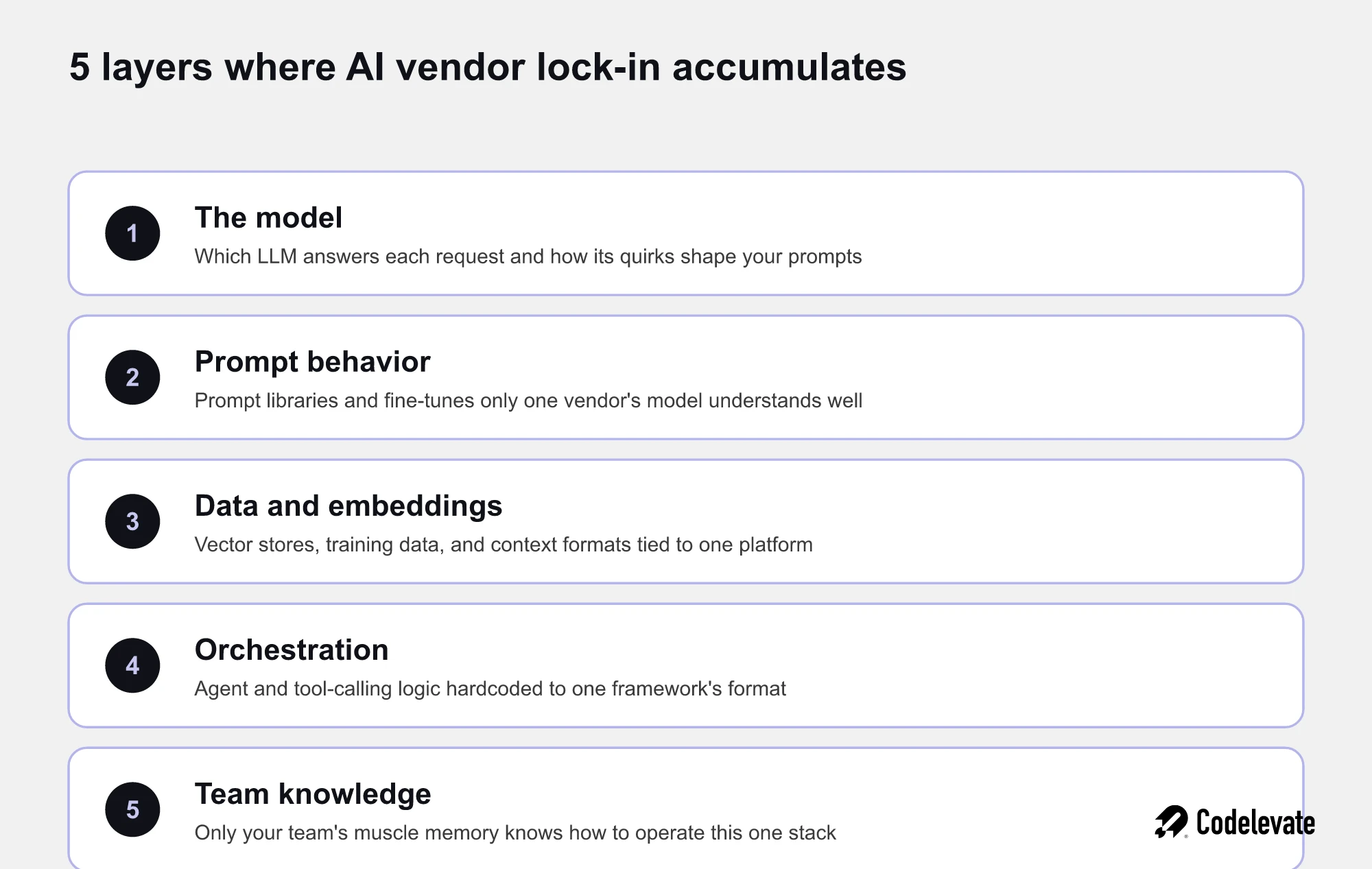
The model layer is the one everyone thinks of first and it is usually the cheapest to change. Swapping which large language model answers a given request is often a configuration change, provided nothing downstream assumes that specific model's exact response format or tone.
The prompt behavior layer is where real cost starts. A prompt tuned over months against one model's specific tendencies, its verbosity, its tool calling syntax, its tendency to hedge or not hedge, does not transfer cleanly to a different model. Neither does a fine-tune. This is not a reason to avoid fine-tuning. It is a reason to know, before you invest in it, that you are choosing a deeper commitment than a stock API call.
The data and embeddings layer holds your vector stores, your retrieval pipelines, and the context formats you built around one provider's embedding model. Embeddings from different models are not interchangeable, so a provider switch on this layer usually means re-embedding your entire corpus, which is a real cost measured in both compute and time.
The orchestration layer is where agent logic, tool definitions, and multi-step workflows get hardcoded to one framework's specific tool calling format. We have written before about how a second AI agent breas assumptions the first one got away with, and the same pattern applies to vendor switches. The more agents you run, the more this layer costs to unwind, because every agent's tool definitions and handoff logic were likely written against one vendor's exact interface.
The team knowledge layer is the one almost nobody accounts for and it is often the most expensive. Your engineers know how to debug this specific model's failure modes, your support playbooks assume this specific provider's latency and error patterns, and your on-call runbook was written for one vendor's outage behavior. None of that transfers automatically, and rebuilding it after a switch is invisible in a budget spreadsheet but very real in the weeks it costs your team.
Why the standard enterprise fix is the wrong size for most SaaS teams
Search for how to avoid AI vendor lock-in and you will find a fairly consistent enterprise playbook: build an abstraction layer between your application and every model provider, adopt an AI gateway, diversify at the model level, keep a tested fallback provider on standby, and govern every agent through a central control plane. None of that is wrong. It is also not built for a team that is trying to ship its first AI feature before the runway gets shorter.
A full abstraction layer for every model call is a real engineering project. It means building and maintaining a routing layer, testing every feature against multiple providers before release, and keeping a second provider integration warm enough to fail over to on short notice. For a company with a dedicated platform team, that is a sound investment. For a 5 to 15 person engineering team, it is often the reason the AI feature slips a full quarter, and the opportunity cost of that delay is usually larger than the switching cost it was built to avoid.
The deeper problem with copying enterprise architecture wholesale is that it treats every model call as equally important, which is precisely the mistake the 5 layers above are meant to help you avoid. A support ticket summarizer and a fine-tuned pricing recommendation engine do not carry the same lock-in risk, so they should not receive the same defensive engineering. Spending 3 weeks building a universal gateway to protect a feature that would cost half a day to rewrite against a different model is not caution. It is the same instinct that gets teams accused of over-engineering everywhere else in the codebase, just wearing an AI costume.
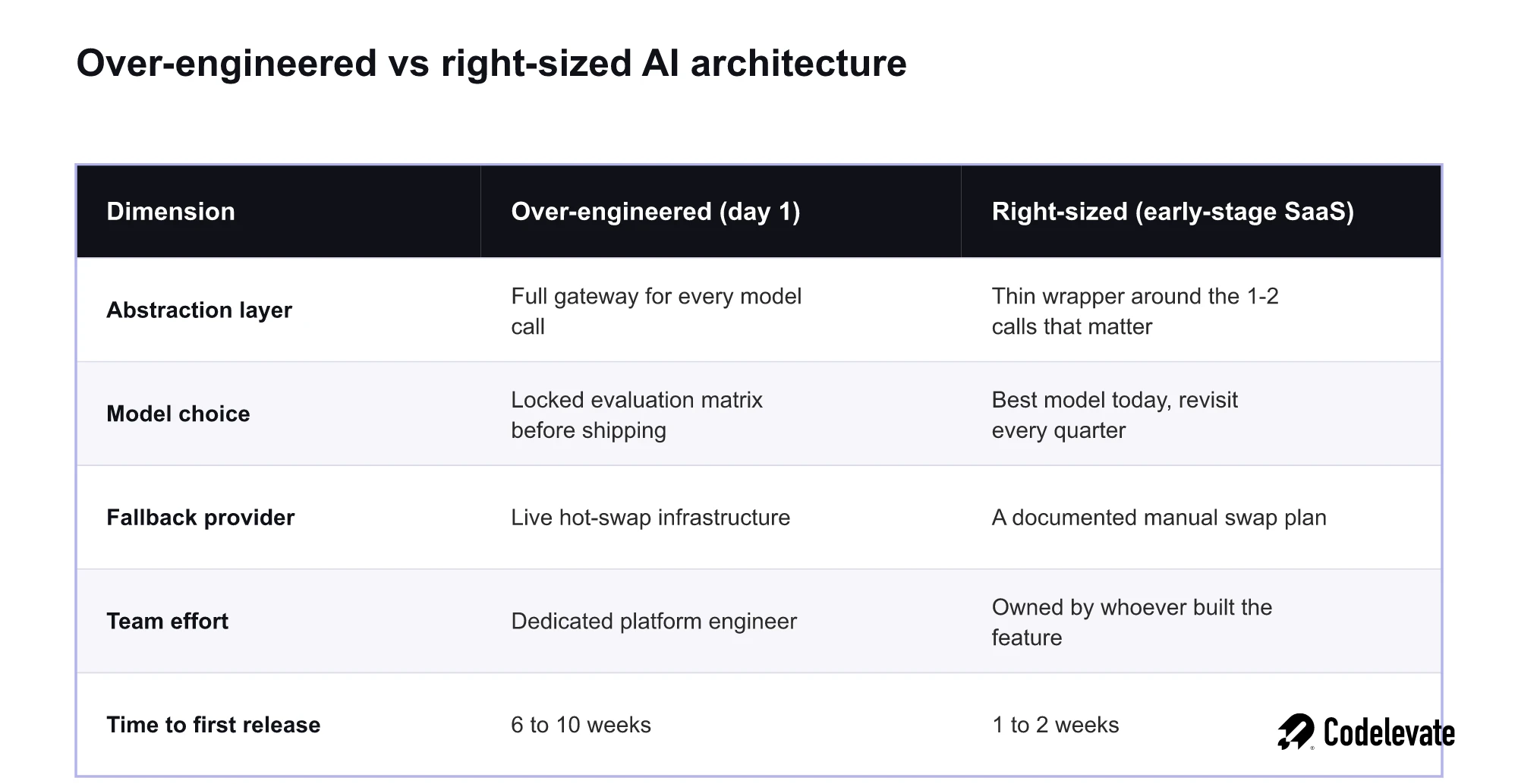
None of this means ignore the risk. The Zapier data above is clear that the risk is real and that most enterprises underestimate the effort a genuine migration takes. The right response for a lean team is not zero protection. It is protection sized to what you actually stand to lose, applied to the specific parts of the product where losing it would hurt.
A right-sized way to decide what is worth protecting
Instead of asking how do we avoid AI vendor lock-in everywhere, ask a narrower and more useful question for each AI feature you ship: if this specific model call became unavailable or doubled in price tomorrow, how much would it actually cost us to replace it, and does that cost justify defending against in advance.
Three questions make that judgment concrete for any given feature.
• How much product-specific behavior lives inside the prompt or fine-tune. A generic summarization or classification call carries little of this. A prompt that encodes months of tuning against one model's specific voice or a fine-tune trained on your proprietary data carries a lot.
• How reversible is the data layer. If the feature depends on embeddings, ask what it would cost to re-embed your corpus against a different model. For a small corpus this is an afternoon. For millions of documents it is a real project worth planning for before you pick a provider, not after.
• How much is this feature actually worth to the business today. A feature driving meaningful revenue or retention justifies real investment in switching readiness. An internal tool used by 2 people on your team almost never does, no matter how technically interesting the lock-in question is.
Score each live or planned AI feature against these 3 questions and a natural split appears. A handful of features, usually the ones closest to your actual competitive edge, deserve a real adapter pattern, a documented fallback provider, and a quarterly review of whether the current model choice still holds up. Everything else can call one provider's API directly, ship fast, and get revisited only if the business reality around it changes. That asymmetry, protecting a few things well instead of everything a little, is the actual skill, and it is the same discipline good engineering teams already apply to every other dependency in their stack.
A worked example: a SaaS writing assistant feature
Picture a mid-market SaaS company adding an AI writing assistant that helps users draft outreach emails inside the product. The team ships it fast, wiring the feature directly to one model provider's API with a prompt tuned over a few weeks of user feedback.
Applying the 3 questions changes what happens next. The raw API client wrapper carries almost no product-specific logic, it just passes text in and gets text back, so there is no reason to build a gateway around it. The prompt, on the other hand, has been tuned against real user complaints for months and genuinely captures voice and tone decisions the team cares about, so it gets version controlled with a small evaluation set that can be re-run against any candidate model before a switch, rather than trusted to look right in an ad hoc test. There is no fine-tune and no embeddings layer here, so 2 of the 5 lock-in layers simply do not apply, and pretending they do would be wasted effort.
The team also writes down, in one page, what a provider switch would actually involve: re-running the eval set against the new model, spot checking 20 real outreach drafts, and updating one config value. That plan lives in a document, not in code, and costs an afternoon to write. Six months later, when a materially cheaper model ships from a competing lab, the switch takes 2 days instead of 3 weeks, not because the team built an elaborate abstraction layer up front, but because they had already done the 20 minutes of thinking that made the real switching cost visible in advance.
A practical starting checklist
If you are shipping an AI feature this quarter and want the right-sized version of vendor lock-in protection rather than the enterprise version, this is the order to work through it in.
• List every AI feature you have shipped or are about to ship, and score each one against the 3 questions above.
• For the few features that score high on product-specific behavior or business value, write a one-page switch plan before you need it, not during an outage.
• Keep a small, versioned evaluation set for anything with a tuned prompt or fine-tune, so a candidate replacement model can be checked against real behavior in hours, not weeks.
• Separate your prompt and configuration from your application code so a provider or model change does not require a full redeploy.
• Revisit your model choice on a fixed quarterly cadence for anything customer facing, rather than only when something breaks.
• Resist the urge to build a universal abstraction layer before you have shipped and validated the feature it would protect.
How Codelevate approaches this
We build AI features into client products on fixed-price budgets, which forces a specific kind of honesty about where engineering effort actually pays off. Over-building a defense against a risk that was never going to materialize is just as costly to a client as under-building one that does. Our AI development company work starts every engagement by mapping which parts of a planned feature carry real vendor-specific risk and which do not, before a line of integration code gets written, so the architecture matches the actual stakes rather than a generic best practice list.
For teams without a full-time technical leader making these calls, this is also one of the recurring questions we get asked through our CTO as a service engagements. Which AI bets are worth defending against a vendor swap, and which are safe to ship fast and revisit later, is exactly the kind of judgment call a fractional CTO earns their keep on, because getting it wrong in either direction is expensive, just in different currencies. Building it too defensively burns runway. Building it too casually on the wrong feature creates a rebuild nobody budgeted for.
Mistakes worth avoiding
• Treating every model call as equally locked in, and either over-protecting all of them or ignoring the risk on all of them.
• Building a full abstraction gateway before shipping the feature it is meant to protect, and losing months of runway to infrastructure nobody has used yet.
• Skipping a written switch plan for the few features that genuinely carry high switching cost, and discovering the real cost only during an outage or a sudden price increase.
• Forgetting the team knowledge layer, and assuming a technical migration is complete once the code compiles against the new provider.
• Picking a model once and never revisiting it, even as release cycles compress and materially better options ship every few weeks.
Conclusion
AI vendor lock-in is real, and the Zapier data above shows most companies underestimate exactly how real until they try to switch and it does not go smoothly. The mistake is not taking the risk seriously. It is responding to it with enterprise-shaped architecture sized for a team and a budget you probably do not have yet. Score your AI features honestly against how much product-specific behavior, data, and business value each one carries, protect the few that deserve it, and ship the rest fast without apology.
If you are still mapping out where AI fits in your product roadmap, our SaaS AI blueprint is a useful next read, free to download and built for exactly this kind of build decision.
If you want a second opinion on which of your AI features actually need switching protection and which are safe to leave as they are, book a free call with our team and we will walk through your specific setup.

.svg)
.svg)


