Automating BPM declarations: the file has to hold up
For years, a BPM declaration for an imported car was mostly about speed. Papers in, value set, declaration filed, licence plate out. Whoever did it fastest won the importers.
In 2026 that changed. In March the Dutch Tax Administration said it would also check the values in price lists (koerslijsten). In July it announced extra checks on every declaration based on a valuation report (taxatierapport). Speed still matters, but it is no longer enough. The file has to hold up.
That also changes what you should ask of AI. Automating BPM declarations no longer means filling in forms faster. It means building every file so it is correct, the evidence is attached, and someone with a name has signed it.
This article is for owners and operations leads of Dutch companies with 10 to 200 people that file BPM declarations for others: import brokers, BPM service providers, importers with their own declarations desk, and tax firms with a BPM practice. You file hundreds to thousands of declarations a year, mostly by hand, and your growth stalls on finding people who know the trade. It is not for you if you import 1 car privately, bring in 20 cars a year, or are a valuer looking for a valuation tool.
In this article you will learn where the hours in a BPM file really go, why the choice between the 3 depreciation methods moves the most money, which part AI should do and which part fixed rules should do, a worked example with 3,000 declarations a year, what not to automate, and what happens after launch.
Key takeaways
• Since 2026 the Tax Administration checks harder: price list values can be recalculated, and declarations with a valuation report get extra checks.
• The work is not in filling in the form. It is in collecting documents, choosing the method and bundling the evidence.
• There are 3 ways to depreciate: the flat rate table, a price list and a valuation report. You may pick the most favourable one, so calculate all 3.
• AI reads the documents. Fixed rules calculate and check. A specialist signs. Never reverse that order.
• The rules for a valuation report are hard and checkable: 1 month before the inspection, a certified valuer, 31% of repair costs. That is exactly the kind of work code is for.
• In the worked example the work drops from about 2,590 to 510 hours a year. That is more than 1.4 full time jobs.
• Leave the valuation itself to the valuer. An AI that estimates damage makes your file weaker, not stronger.
Automating BPM declarations: why speed is no longer the question
Most AI products for this market show the same demo. You drop a registration certificate and an invoice into a window, and the fields fill themselves. That is useful. It only solves the smallest part of the problem.
On its page about depreciation with a price list, valuation report or flat rate table, the Tax Administration says plainly that declarations with a valuation report will get extra checks from now on. A car can be called in, and then it only gets a licence plate after that inspection. With a price list, the tax office can recalculate the trade value itself, and then the BPM can differ from what you declared.
For your client that means 2 things. A car that sits still because the file is wrong costs money. And a correction afterwards costs trust. The importer does not call the Tax Administration then. They call you.
So the question is no longer how to fill in faster. It is how to build every file right the first time, with the evidence attached, without your specialists spending half a day on it.
Where the hours in a BPM file really go
Ask a specialist where the time goes and you rarely hear "filling in". You hear: the foreign invoice that was missing. The German registration certificate with a different variant than the price list knows. The valuer who sends a report without the times of the inspection.
Take a file apart and you see roughly 6 steps:
• Collect the documents: registration certificate, invoice or purchase statement, certificate of conformity, damage report, photos.
• Identify the vehicle: make, model, type, variant, options, first registration date, mileage.
• Choose the method: table, price list or valuation, and check that the conditions are met.
• Calculate: gross BPM, depreciation, any mileage correction, net BPM.
• Bundle the evidence: the full price list report, the valuation report, the purchase invoice.
• File and follow up: declaration, payment, a possible inspection call, the licence plate.
The filling in itself is maybe 10% of the time. The rest sits in steps 1, 2, 3 and 5. Those are exactly the steps that get heavier now that checks are stricter.
We saw this ourselves in a BPM file processor we built. A file there took 4 to 8 hours of manual work. Now it goes through processing in under 5 minutes. The gain was not in the form. It was in collecting, comparing and bundling.
The method choice is where the money is
For a used car from abroad you may reduce the BPM with depreciation. There are 3 methods for this. The Tax Administration states clearly that you may choose whichever is most favourable to you.
In practice many firms pick a fixed route per type of car. Young car without damage, price list. Old car, table. That works most of the time. But most of the time is not every time, and the difference can be hundreds of euros per car.
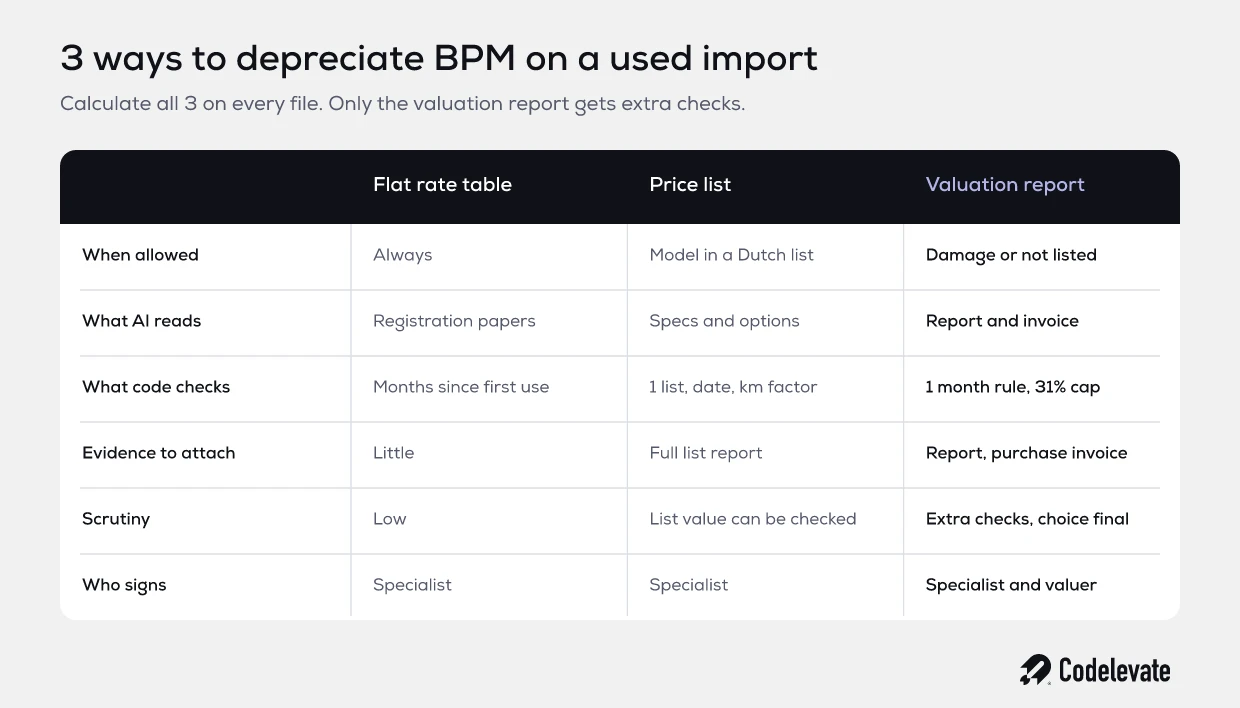
Software can calculate every method for every file and show which one is most favourable, and whether the conditions are met. That takes a computer a fraction of a second. A specialist does it at most when in doubt.
The flat rate table
The depreciation percentage follows from the time since first registration. No price list or valuation is needed. This is the simplest route and the easiest to automate. The main risk is that you pay too much BPM because another method would have been better.
The price list
More rules apply here. You use the most recent Dutch price list, with data from 1 list only. The reference car must match, including all options. The reference date is the day the RDW, the Dutch vehicle authority, finished its inspection. If the list gives a mileage correction, you must apply it. And you always attach the full price list report.
Each of those rules can be checked. Does the variant match? Is the list the most recent one on the reference date? Was the correction applied? Is the report attached? Those are yes or no questions.
The valuation report
This is the route with the most scrutiny. A valuation report is only allowed for more than normal wear and damage, or when the car is not in a price list. The valuer is independent and certified. The inspection happens within 1 month before the RDW inspects the car. The loss of value from damage is in principle 31% of the repair costs. The purchase invoice is attached. The car stays available, unchanged, for up to 6 working days after payment. And once you choose a valuation report, you cannot change that choice later.
According to Accountancy Vanmorgen, the Tax Administration advises importers to check beforehand whether the report meets every requirement. That advice is really a job description. It describes exactly what a checking layer in software does, on every file, without getting tired.
What AI reads, what code checks and what a person signs
The biggest misunderstanding about AI in this work is that the AI files the declaration. It does not, and you should not want it to. A good system has 3 layers, each with its own job.
Layer 1: AI reads
Documents arrive in every shape. A scanned German registration certificate, a Belgian invoice as a phone photo, a valuation report as a PDF, an email from the client with 4 attachments. A language model is good at reading those. It pulls out make, type, variant, first registration date, mileage, price and date, and says how sure it is.
Where it is unsure, it asks. If the purchase invoice is missing, a message goes to the client right away, not 3 days later when a specialist opens the file.
Layer 2: code calculates and checks
The calculation and the conditions do not belong in a language model. They belong in fixed rules you can read and test. Was the inspection within 1 month before the RDW check? Is the loss of value no higher than 31% of the repair costs? Is the valuer on the list of certified valuers you maintain? Was only 1 price list used?
Code gives the same answer for the same input every time. That is exactly what you want when the Tax Administration later asks why you did something. Every rule leaves a trail: which rule, which value, which result.
Layer 3: a specialist signs
The specialist no longer gets a pile of paper but a finished file: the 3 methods side by side, the most favourable one marked, every check green or red, and all attachments bundled. They review it, adjust where needed and sign. The declaration only leaves the building with a name under it.
That is also your answer when a client asks whether the computer now decides the BPM. No. The computer prepares everything. A person who knows the trade decides.
Want to work this out for your own firm in 1 place, with the steps, the rules and the budget? Use the free AI product requirements template. It helps you describe this kind of work so you can compare quotes.
Worked example: 14 people, 3,000 declarations a year
An example, not a client. A BPM service provider with 14 people files 3,000 declarations a year for importers and dealers. 2,100 with the flat rate table, 750 with a price list and 150 with a valuation report.
Before automation, a table file takes 30 minutes on average, a price list file 75 minutes and a valuation file 4 hours. Together that is:
• Table: 2,100 times 30 minutes is 1,050 hours.
• Price list: 750 times 75 minutes is about 940 hours.
• Valuation: 150 times 4 hours is 600 hours.
• Total: about 2,590 hours a year.
After automation, AI reads the documents, code calculates all 3 methods and checks the conditions, and the specialist reviews and signs. A table file then takes 6 minutes, a price list file 15 minutes and a valuation file 45 minutes. Together about 510 hours.
That saves around 2,080 hours a year. At 55 euro an hour in internal cost that is about 114,000 euro. In people: more than 1.4 full time jobs you do not have to recruit.
There is a second gain that is often forgotten. Say that for 4% of the table files the price list turns out better, with an average of 350 euro more depreciation. That is 84 cars and about 29,000 euro less BPM for your clients. That money does not come to you, but it is the best sales argument you can have.
And the cost? In this example: a Blueprint of 7,500 euro, and 2 automations of 55,000 euro together. 1 for reading and bundling, 1 for the calculation and the checks. Then operations at 1,250 euro a month per automation, so 30,000 euro a year. That pays back the build in about 9 months. If you only get half the savings, it takes just over 2 years. So always run the numbers at half as well.
What not to automate
There are 3 things you should leave to people.
First, the valuation itself. An AI that estimates a damage amount from photos sounds clever. But the rules require an independent, certified valuer who inspected the car in person. A model's estimate does not make your file stronger. It gives the inspector something to ask about.
Second, filing without a signature. Even when the software is confident, no declaration goes out until a specialist has looked at it. Not because the software is bad, but because you are responsible.
Third, a small practice. If you file fewer than about 500 declarations a year, mostly with the table, a good checklist, a fixed folder structure and a spreadsheet pay back faster than software. That is no shame. That is arithmetic.
Buy or build
You do not have to build everything. Price lists you buy from a provider. Packages exist for the filing itself. Document reading you can partly rent as a service. Do not rebuild what you can buy.
What you cannot buy is your way of working. Which documents you request from which type of client. Which valuers you trust. How you bundle a file so it survives an inspection. That knowledge sits in the heads of your best people today. That is also the part to build, on your own files, connected to what you already use.
Not sure yet which steps in your process pay off most? Start by mapping the AI opportunities in your workflow. It takes an afternoon and stops you from automating the wrong step.
Who works on it, what happens after launch and what if month 1 disappoints
Codelevate turns Dutch B2B service companies into software companies: we map the expert process you run by hand, automate it so the same team handles the volume, and build the platform your customers pay for, with 2 engineers by name from the blueprint to year 2.
In practice that starts with the Blueprint. In 10 to 20 working days we map your process as it actually runs, with the bottlenecks priced in hours and euros. Depending on the number of processes it costs 2,500 to 10,000 euro. You get a roadmap with fixed prices per step and a first rough prototype in your own repository. It is yours, also if you build on in house afterwards.
Then comes 1 automation per bottleneck, priced fixed between 18,000 and 45,000 euro per major process. A specialist approves wherever a mistake is expensive. After launch, operations begin. A named engineer is on the alert, updates the rules when the Tax Administration changes something, keeps the AI cost per file under a cap, and sends you a 1 page report every month. The response time is set in the Blueprint.
And if the first month disappoints? Exit after month 1: pay for what is delivered, keep everything.
From declaration to product
Once your files run like this, you have something clients want to buy on its own. An importer who uploads documents directly, sees right away which method is most favourable, and follows every car through to the licence plate. You then sell access, not only hours.
That is a step for later. Your own process has to be right first. How to keep an eye on payback for a step like that, you can read in our AI automation payback playbook.
How to start this week
• Take 20 recent files and write down how long each step took.
• Count how many files you do per method, and how many needed documents chased afterwards.
• Put the rules for valuation reports and price lists next to your current checklist. What do you not check today?
• Pick 10 table files and recalculate them with a price list. Was 1 of them better?
With those numbers you know whether this pays off for you, before you talk to anyone. Want to put them in a document you can hand to any builder? Download the free AI product requirements template.
Send us what you have. 1 of the 2 engineers reads it with you in 20 minutes, and you get 1 of 3 answers in writing the same day: do it in house, hire, or the Blueprint.