
AI automation for SMEs: the 2026 playbook
Most SME automation projects work exactly as promised and still show up nowhere in the accounts.The invoices get read, the emails get drafted, the data gets copied, everyone agrees it is impressive and at the end of the quarter the payroll is the same, the backlog is the same, and the lead time is the same. That is not an AI problem. It is a targeting problem.
This playbook is for owners, directors, and operations leaders at companies with roughly 10 to 250 employees who are past the demo stage and want automation that survives contact with a real week. Itis written for the Netherlands and the wider EU market, so the money is in euros, the rules are the onesyou actually fall under, and the examples are the workflows we see in installation, logistics, professional services, wholesale, healthcare admin, and hospitality.
The core argument, up front: automating a task almost never changes your numbers. Automating aseam does. A seam is the place where work waits, changes hands, gets re-entered, or sits blocked on a decision. Tasks are what people do. Seams are where the time actually goes, and seams are what awell-scoped AI automation can remove entirely.
In this playbook you will get a method to find those seams in your own business in about an hour, a scorecard to rank them, honest 2026 build and run costs including the maintenance charge nobody quotes, the 10 SME workflows that reliably pay back, a decision framework for Zapier versus Make versus n8n versus custom, a full worked example with the arithmetic shown, the 7 ways these projects fail, what changes under the EU AI Act on 2 August 2026, and a 90 day plan you can start on Monday.
Key takeaways
- Automation pays back when it removes a queue, a handoff, a re-entry, or a decision delay, not when itmakes an existing task marginally faster.
- Eurostat put AI use at 20% of EU enterprises with 10 or more staffin 2025, but only 17 percentof small companies against 55 percent of large ones, so the gap is now a competitive one.
- A first production automation for one workflow typically lands between 4,000 and 18,000 euros tobuild in the Netherlands, with 60 to 400 euros a month to run.
- Budget 15 to 25% of the build cost per year for maintenance. Every quote that leaves this out isquietly moving the cost to you.
- Score candidates on annual hours, error cost, rule stability, data access, and owner appetite. Thehighest scoring workflow is rarely the most exciting one.
- Use deterministic automation wherever the rules are stable and reserve AI for the judgement steps,because a model in the wrong place is just an expensive if statement.
- From 2 August 2026 the AI Act transparency duties and the penalty regime apply, while the heavy highrisk obligations moved to December 2027 and August 2028.
- Target 90 days from decision to a live automation with a measured before and after number, and stopanything that has not reached real users by week 6.
What AI automation actually means in 2026
AI automation is the use of software to complete a business process end to end, where a language model or another AI component handles only the steps that need interpretation or judgement, and ordinary code handles everything else. That definition matters because the word has been stretched to cover a chatbot on a website, a spreadsheet macro, and an autonomous agent that emails your customers, and those are three completely different risk and cost profiles.
It helps to think in three layers. The bottom layer is plumbing: moving data between systems, triggering on events, writing records, sending files. This is deterministic, cheap, and boring, and it is where most of the reliability lives. The middle layer is interpretation: reading an unstructured email, pulling fields out of a scanned delivery note, classifying a complaint, drafting a reply in your tone of voice. This is where a model earns its keep. The top layer is decision and orchestration: what happens next, who needs to approve it, what to do when confidence is low, when to escalate to a human.
Almost every disappointing SME project we are asked to rescue got the layers wrong. Either they put a model in the plumbing, where it introduces variability into something that should be exact, or they left the top layer undefined, so the automation produces output that nobody owns and nothing happens with it. Getting the layers right is not a technical nicety. It is the difference between a system that runs unattended for a year and one that quietly gets switched off in month 3.
The market has also moved, and so has the gap. Eurostat put AI use at 20 percent of EU enterprises with 10 or more employees in 2025, up from 13.5 percent a year earlier, but the split by size is the number that should worry a mid-sized company: 55 percent of large enterprises against 17 percent of small ones, according to the Eurostat figures on AI use in EU enterprises. Your larger competitors are compounding an advantage while the market is still forgiving about it. In 2024 the interesting question was whether a model could read your documents at all. In 2026 it can, cheaply, in Dutch, including handwriting and photographs of paper. The interesting question now is whether your process, your data access, and your governance are ready to let it. That shift is why the winners this year are not the companies with the best models. They are the companies with the cleanest processes.
Why most SME automations never reach the P&L
Here is the pattern we see almost every time. A team picks a visible, annoying task, automates it, and measures the result as minutes saved per execution. The number looks great. 4 minutes per order, 200 orders a week, 13 hours a week saved. Then nothing changes, because those 4 minutes were distributed across 6 people in slices too small to reclaim. Nobody had a spare 4 minutes. They had a spare zero, and now they have a slightly less annoying day.
Time only converts into money in specific circumstances: when it lets you avoid a hire you were about to make, when it removes overtime you are actually paying, when it lets the same team absorb growth without adding cost, when it shortens a lead time that customers pay for, or when it removes errors that cost real money to fix. If your automation does not do one of those 5 things, it is a quality of life improvement. Those are worth having, but do not put them in a business case.
Seams are where the convertible time hides. Four kinds are worth naming, because once you can name them you start seeing them everywhere in your own company.
- Queues: work that sits in a mailbox, a shared inbox, a folder, or somebody's head until a person gets to it. The processing takes 6 minutes, the waiting takes 2 days.
- Handoffs: work that moves between people or systems and gets re-explained, re-typed, or re-checked on the way. Every handoff is a chance to lose a day.
- Re-entry: the same information typed into a second system because the two do not talk. This is the most common and most under-measured cost in a Dutch SME.
- Decision latency: work blocked because someone has to look at it and that someone is in a van, on a site, or on holiday. The work is not hard, it is just waiting for a judgement.
Notice that none of these are tasks. They are gaps between tasks, which is exactly why they never show up in a job description and rarely show up in a process document. Ask a team what takes them the longest and they will describe tasks. Watch a single order move through your business end to end and you will see seams. A quote that takes 40 minutes of actual work but 4 days of elapsed time has 3 and a half days of seam in it, and that is the part worth attacking.
This is also why the honest first metric is not hours saved. It is elapsed time from trigger to done, measured across a real sample of 20 to 30 cases. If you cut elapsed time by 70% and hold quality, the money follows in ways you can point at: more capacity from the same team, quotes out before a competitor, cash collected sooner, fewer things falling through.
The 60 minute seam audit you can run this week
You do not need a consultant to find your first automation. You need one hour, a whiteboard, and 2 people who actually do the work. Do it in this order, because the order is what stops the conversation drifting into wish lists.
Step 1: pick one flow and follow one unit of work
Choose a flow that starts outside your company and ends in money or delivery. An inbound quote request, a customer order, a supplier invoice, a service call, a new patient intake. Then take one real example from last week and walk it end to end, timestamp by timestamp, using the actual systems. Not how it is supposed to work. How that one went.
Step 2: mark every wait, every retype, and every approval
On the timeline, mark 3 things in different colours: every point where the work waited, every point where a human copied information from one place to another, and every point where something was blocked pending a decision. Write the elapsed time next to each mark. Most teams are genuinely shocked here. It is normal to find that 85 to 95 percent of the elapsed time is waiting, and that the actual work is under an hour.
Step 3: count the volume and the cost of being wrong
For that flow, write down how many times it runs per week and what a mistake costs when it happens. Not the average, the actual bad case: a wrongly priced quote, a double payment, a missed SLA, a rebooked engineer. Volume times time gives you the size of the prize. The cost of error tells you how much human oversight you need to design in.
Step 4: check whether the data is reachable
For every system in that flow, answer one question: can software read and write this without a person clicking? An API, a database, a webhook, a structured export, or at minimum a reliable file drop. If a critical system in the flow is a desktop application with no interface and no export, your automation project just became an integration project, and the cost profile changes completely. Better to find that out in hour 1 than in week 5.
Step 5: name the owner
One person whose numbers improve when this works, who can approve the next step, and who will be in the room when you review the results. If nobody wants that role, the flow is not painful enough to automate yet. Move to the next candidate. This single filter kills more doomed projects than any technical review.
Run this on 3 flows and you will have a shortlist. Now you need a way to rank them that is not just who complained loudest.
The automation scorecard: how to rank candidates honestly
Score every candidate flow from 1 to 5 on 6 dimensions, then multiply by the weight. It takes 10 minutes per flow and it consistently changes the order teams thought they wanted.
• Annual volume, weight 3. How many times a year does this run? 20 times a year is a habit, not a business case.
• Convertible time, weight 3. Does the time saved turn into avoided hiring, avoided overtime, absorbed growth, shorter lead time, or fewer errors? If not, score it 1 regardless of how many hours it looks like.
• Rule stability, weight 2. Have the rules of this flow changed in the last 6 months? A process that is still being argued about is not ready to be encoded.
• Data reachability, weight 2. Can every system in the flow be read and written by software today, without a person in the middle?
• Error tolerance, weight 2. What happens when the automation is wrong? A wrong internal label is cheap. A wrong price to a customer is not. Low tolerance does not disqualify a flow, it just means you are budgeting for review steps.
• Owner appetite, weight 3. Does a named budget holder want this, in writing, this quarter?
Anything scoring above 55 out of a possible 75 is a strong first project. Between 40 and 55, it is a good second or third project once you have credibility. Below 40, leave it alone this year no matter how often it comes up in meetings. The discipline here is worth more than the arithmetic: the scorecard makes the conversation about the business rather than about the technology, and it gives you a defensible answer when somebody senior asks why their pet idea is not first.
One more filter we apply before quoting anything: the 12 minute rule. If a single run of the flow takes a competent person under 12 minutes and runs fewer than 500 times a year, full automation will probably cost more than it returns. Improve it with a template, a form, or a better handoff instead. Saying this out loud costs us work and saves clients money, which is the only reason anyone believes the rest of our numbers.
The 10 SME workflows that reliably pay back
These are the flows that come up again and again in Dutch SMEs and consistently clear the bar. The hours are typical ranges we see at companies between 20 and 150 staff, not a promise, and they assume the flow actually runs at the volume shown.
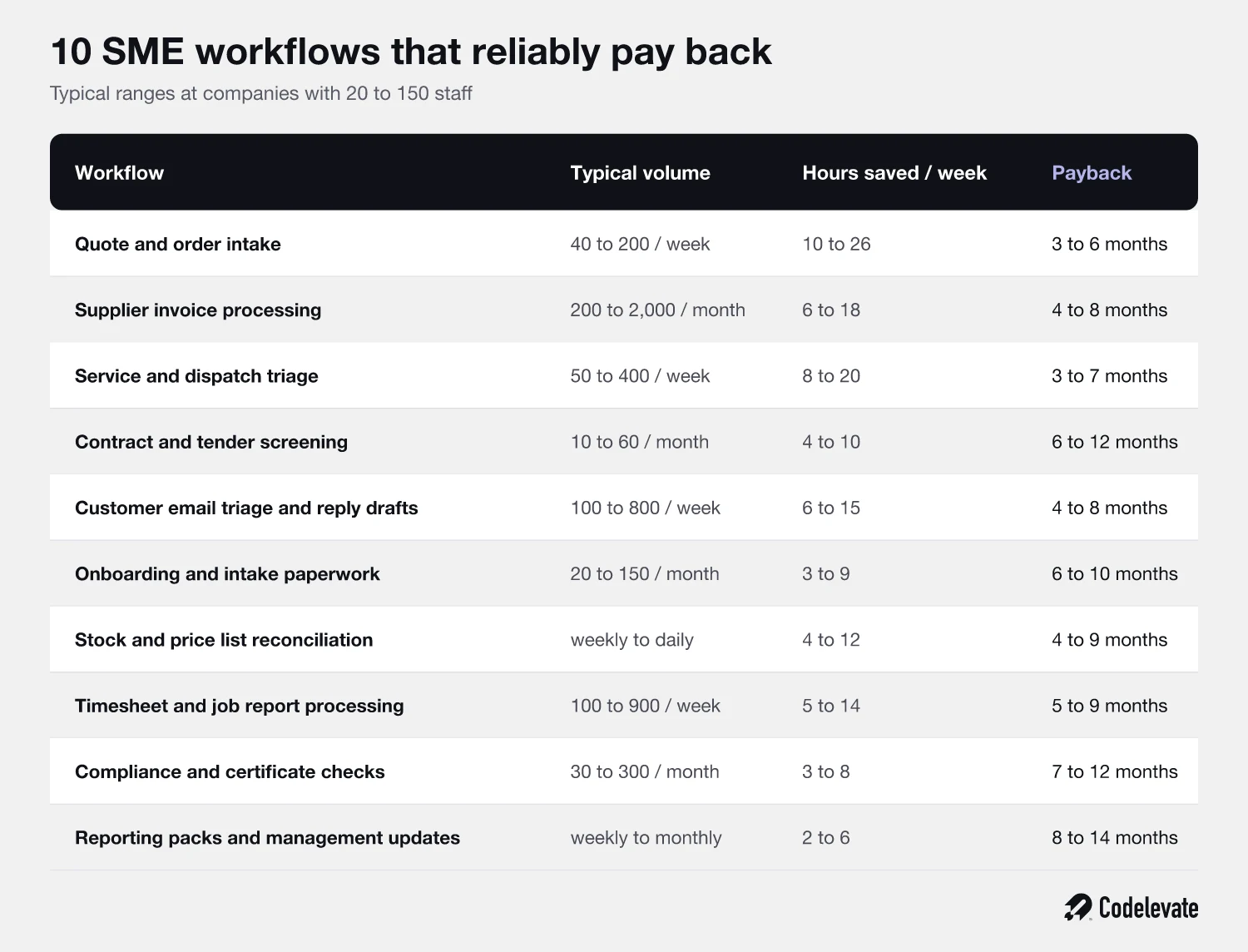
Quote and order intake is the single most common winner. An inbound request arrives as an email, a PDF, a web form, or increasingly a WhatsApp photo of a handwritten list. Today somebody reads it, works out what the customer means, checks stock or availability, prices it, and types it into the system. The interpretation step is a genuine judgement problem, which is exactly what a model is good at, and the rest is plumbing. Companies that fix this flow usually see quote turnaround drop from days to hours, and quote-to-order conversion moves with it because the first credible quote often wins.
Supplier invoice processing is the most reliable payback and the least glamorous. Read the document, match it to a purchase order or a project, code it correctly, route the exceptions to a human. The technology has been good enough for 2 years. What holds companies back is that the exceptions are where all the work is, so the automation has to be designed around the 15 percent of invoices that do not match, not the 85 percent that do.
Service and dispatch triage deserves attention in installation, maintenance, and facilities businesses. Incoming issues get read, classified by urgency and skill needed, matched against the schedule, and either booked or escalated. The gain is rarely the classification itself. It is that the customer gets an answer in 10 minutes instead of the next morning, and the engineer arrives with the right part.
The ones that disappoint are worth naming too. Fully automated outbound sales messaging tends to produce volume and damage. Automated content generation without an editor produces material nobody wants to publish. Chatbots on low traffic websites answer 12 questions a month and cost more in maintenance than the answers are worth. And anything that requires a person to check every single output has not been automated, it has been relocated.
What AI automation actually costs in 2026
Prices in this market are opaque, so here are real ranges for the Netherlands and Belgium, based on what we and comparable partners quote in 2026. Three numbers matter: what it costs to build, what it costs to run, and what it costs to keep working. The third one is the one that gets left out.
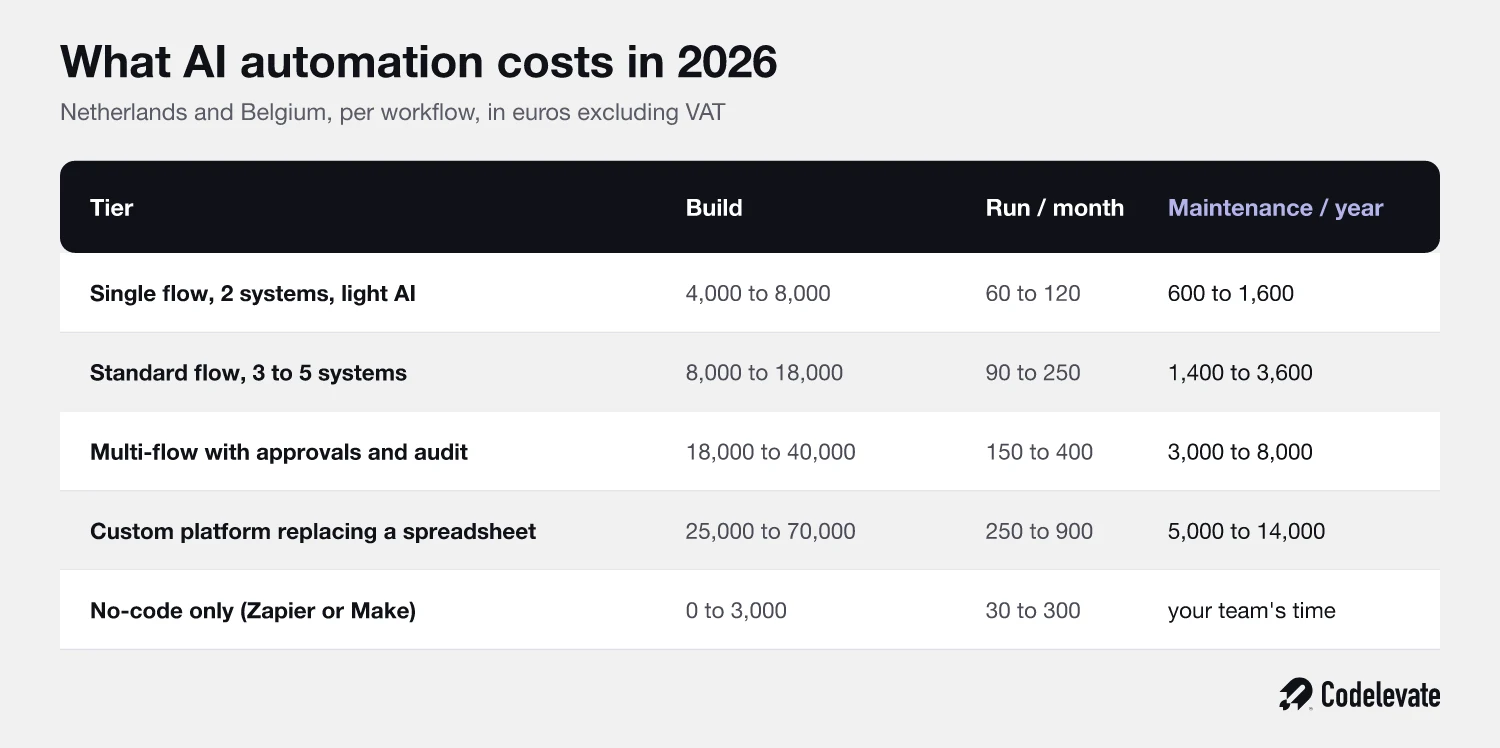
The build number covers discovery, integration work, the AI logic, evaluation, error handling, and getting it live on real data. A simple 2 system flow with light interpretation sits at the bottom of that range. A flow touching 4 or 5 systems with a real approval path and audit requirements sits at the top. A platform that replaces a spreadsheet a department runs on is a different category and is priced as software, not as automation.
The run number is smaller than most people fear. Model usage for a typical SME flow processing a few thousand documents a month costs between 10 and 120 euros, because the models that do this work well are now cheap and you should not be using a frontier model to extract 6 fields from an invoice. Hosting is 20 to 80 euros. Monitoring is included in a decent build. What you are really paying for over time is attention, not compute.
The maintenance charge is where honesty separates partners. Budget 15 to 25 percent of the build cost per year. That covers the supplier who changes their invoice layout, the API version that gets deprecated, the model provider that retires an endpoint, the new product line that does not fit the old rules, and the quarterly review of what the system is getting wrong. Nobody escapes this. You either pay it deliberately or you pay it as an emergency in month 14 when the flow breaks and nobody remembers how it works.
Two costs are usually invisible in quotes and belong in your own planning. The first is your team's time: expect 15 to 30 hours from the people who own the process during a first build, mostly in weeks 1 and 2 and again at go-live. The second is the cost of the decisions you have been avoiding. Automation forces you to write down rules that have lived in someone's head for 11 years, and that conversation is frequently the most valuable output of the whole project.
Take the scorecard and the cost model with you
If you want the frameworks in this playbook in a form you can bring to a planning session, our SaaS founder's AI Blueprint covers how to scope a first AI workflow, what to measure, and where budgets leak. It is free, it takes about 20 minutes to read, and it pairs directly with the audit above.
Zapier, Make, n8n, or custom
This is the question every SME asks, and it is usually answered badly because it gets framed as cheap versus expensive. The real frame is different. You are choosing how much of your process logic lives inside somebody else's product, and how expensive it will be to change your mind.
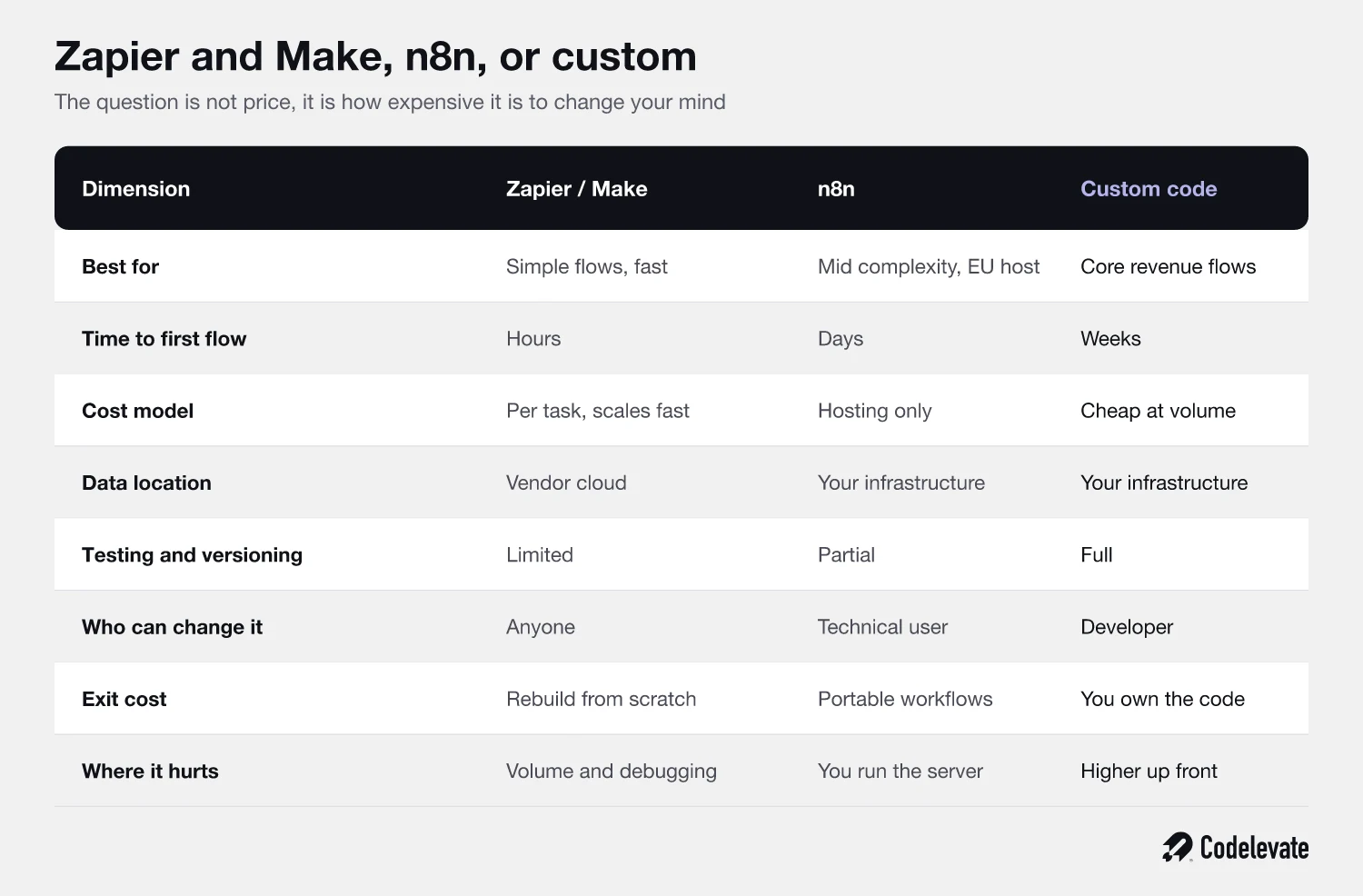
No-code platforms are excellent and genuinely underused. If your flow is a handful of steps between mainstream systems, Zapier or Make will have it running this week, and paying 40 euros a month for something that works is a better outcome than a 12,000 euro project. Use them without shame for flows with light logic, low volume, and low consequence.
The trouble starts at scale and at complexity. Per-task pricing is fine at 2,000 runs a month and painful at 200,000. Debugging a 40 step scenario in a visual editor is genuinely harder than reading 200 lines of code. Version control, testing, and staging environments are limited, so a change that breaks production is hard to catch and hard to roll back. And your logic is not portable, which is the part that matters most: rebuilding it elsewhere means starting over.
n8n sits in the middle and is the pragmatic default for a lot of Dutch SMEs in 2026. It is visual like the others, you can self-host it inside the EU on infrastructure you control, and per-execution costs disappear. The trade is that somebody has to own the instance, the upgrades, and the backups, which is real work even if it is not much work.
Custom code earns its place when the flow is core to how you make money, when volume makes per-task pricing absurd, when you need proper testing and audit trails, or when the logic is genuinely yours and you do not want it living in a vendor account. It costs more up front and less over 3 years at any serious volume, and you own it outright.
A test we use to cut through the debate: imagine your automation platform triples its price or shuts down your plan next year. How many days would it take to be running again somewhere else? Under 2 days is fine for anything. Two to 3 weeks is acceptable for a supporting flow. If the honest answer is months, and the flow is central to your revenue, you have built a dependency rather than an asset, and you should be building that one properly.
The most common good answer is a mix. Run the long tail of small integrations on a no-code platform where speed matters and the stakes are low, and build the 1 or 2 flows that carry real volume or real risk as owned software. Pretending you must pick one philosophy for the whole company is how organisations end up either fragile or slow.
When you need an AI agent, and when you really do not
An AI agent is a system that decides its own next steps toward a goal, calling tools as it goes, rather than following a path you defined. Agents are useful when the path genuinely cannot be predicted in advance: research across many sources, multi-step troubleshooting, complex triage where the next question depends on the last answer. For most SME processes the path can be predicted, and a defined flow with model steps inside it will be cheaper, faster, and far easier to debug.
The practical rule: use deterministic logic wherever the rule is stable, use a model where the input is unstructured or the judgement is genuinely fuzzy, and use an agent only when you cannot enumerate the steps. Most disappointment in 2026 came from teams reaching for the most autonomous option available rather than the simplest one that solved the problem.
Wherever you do use a model, design the confidence routing before you build. Every output should land in one of 3 buckets: confident and low risk, so it proceeds automatically; uncertain or high value, so a person reviews it in a queue built for 10 second decisions; or clearly out of scope, so it escalates with the original document attached. Companies that skip this end up with either blanket human review, which destroys the payback, or blind automation, which eventually destroys trust.
A worked example
A 45 person technical installation company in Noord-Brabant. Around 90 quote requests a week arrive by email, web form, and increasingly photographs of handwritten site notes. Two people in the back office handle them alongside other duties. Actual work per quote is roughly 22 minutes. Elapsed time from request to quote sent is 2 to 4 working days, and in busy weeks the backlog reaches 5 days.
The seam audit found the shape immediately. Of the 22 minutes, about 9 were spent reading the request and working out what was actually being asked for, 6 were retyping details into the ERP, 4 were looking up pricing and availability, and 3 were writing the covering email. Elapsed time was dominated by the request sitting in a shared inbox waiting for someone to be free, and by quotes waiting for a manager to sign off anything above 5,000 euros while they were on site.
What was built: an intake automation that reads every incoming request in any format, extracts customer, location, requested items, quantities, and deadline, matches items against the product catalogue with a confidence score per line, pulls current pricing and stock, drafts the quote inside the ERP, and drafts the covering email in the company's tone. Anything under 5,000 euros with all lines above the confidence threshold goes to a back office reviewer as a finished draft. Anything above 5,000 euros or with any uncertain line goes to a mobile approval queue where the manager sees the original request, the drafted quote, and the flagged lines, and approves or edits in under a minute.
The numbers, using conservative assumptions. Human handling time per quote fell from 22 minutes to about 6, which is the review rather than the creation. That is 16 minutes saved on 90 quotes a week, so 24 hours a week, which at a loaded cost of 45 euros an hour is around 1,080 euros a week or 47,500 euros a year of capacity. The company did not fire anyone. They stopped a planned hire and absorbed a 20 percent volume increase with the same team, which is how the saving actually converted.
The second effect was larger and less expected. Elapsed time fell from 2 to 4 days to under 4 hours for standard quotes. Quote-to-order conversion rose from 31 percent to 38 percent over the following 2 quarters. On an average order value of 3,400 euros and 90 quotes a week, those 7 points are worth considerably more than the labour saving, and they are the reason the project got a second phase rather than a pat on the back.
The costs, for completeness. Build was 14,500 euros over 9 weeks, including the ERP integration, which was the hard part. Running costs are 95 euros a month: 45 in model usage at roughly 390 quotes a month, 35 in hosting, 15 in monitoring. Maintenance is 2,600 euros a year, which has so far been spent on catalogue changes and 2 new request formats. Payback on the labour saving alone landed in month 5. Including the conversion effect it landed in month 3.
Three details in that build are worth copying. The confidence threshold per line item, rather than per document, meant a single unusual product did not send an entire quote to manual handling. The mobile approval queue attacked decision latency directly, which was the largest seam and the one nobody had thought of as automatable. And the original request stayed attached to everything downstream, so when the system got something wrong the reviewer could see why in 2 seconds instead of hunting through a mailbox.
The 7 ways SME automation projects fail
Every one of these is recoverable if you spot it early, and expensive if you spot it in month 8. We have walked into all 7.
1. Automating the task instead of the seam
You speed up the 6 minutes of work and leave the 2 days of waiting untouched. The fix is to measure elapsed time from trigger to done before you build, and to make that number the target rather than minutes per execution.
2. Building on an export instead of the live system
The pilot runs on a clean extract and behaves beautifully. Production data has duplicates, three naming conventions from two acquisitions, and photographs of paper. Connect to the real source in week 1, accept that quality will be worse, and let the mess shape the design.
3. No answer for when it is wrong
Every AI step is wrong sometimes. If nobody has decided who sees the output before it takes effect, what confidence level triggers review, and where uncertainty escalates, the system will eventually make an expensive mistake and get switched off. Design the 3 buckets before you write code.
4. The owner is an enthusiast, not a budget holder
Projects sponsored by whoever is most interested in AI stall at exactly the moment they need real money or real process change, because nobody's numbers improve when it ships. One named operational owner with budget authority, or do not start.
5. Rules that were never actually agreed
Halfway through the build you discover that 3 people apply 3 different pricing rules and all of them believe theirs is the standard. This is not a delay, it is the project finding a real problem. Budget for it, resolve it in a room with the owner, and write the decision down.
6. Scope that grows sideways
The moment the first flow works, everyone wants their variant added. Widening before the first flow has 4 clean weeks of production data is the most reliable way to end up with something fragile that serves nobody well. Finish, measure, then widen.
7. Nobody owns it after launch
The build partner leaves, the internal champion changes role, and 6 months later the flow half works and no one knows why. Name the person who reviews the monitoring monthly, and make sure the prompts, the evaluation set, the logs, and the code sit in your own accounts and repositories, not the supplier's.
Data, GDPR, and what actually changes
Two separate rulebooks apply to an SME running AI automations in the EU, and confusing them causes both unnecessary panic and genuine exposure. GDPR governs what you do with personal data and has applied since 2018. The AI Act governs how AI systems are built, sold, and used, and it is phasing in now.
The GDPR side, in practical terms
Most SME automation flows handle ordinary business personal data: names, work addresses, order histories, correspondence. That is entirely workable. Four things need to be true. You have a lawful basis and a purpose that covers processing it this way. You have a data processing agreement with every provider in the chain, including the model provider, and you know their sub-processors. You are not sending special category data, meaning health, biometrics, or anything similarly sensitive, into a general purpose consumer tool. And your retention is defined, so documents and logs are not accumulating in a bucket forever because nobody decided otherwise.
Use enterprise or API tiers rather than consumer products. On the API and business tiers from the major providers, your content is not used to train their models and retention is contractually limited, which is exactly the assurance a consumer subscription does not give you. Where data cannot leave the country or the union at all, EU-region hosting from the large providers or a self-hosted open model on your own infrastructure both work. The self-hosted option is genuinely viable in 2026 for extraction and classification tasks, and it is more work to run than most vendors admit.
The AI Act side, and the dates that actually matter
The timeline changed in 2026 and a lot of published advice is now wrong. The prohibitions on unacceptable practices have applied since February 2025. Obligations for general purpose AI models have applied since August 2025. The heavy obligations for high risk systems, which is the part most SMEs were worried about, were postponed under the omnibus agreement: standalone Annex III systems such as recruitment screening and credit scoring move to 2 December 2027, and AI embedded in regulated products moves to 2 August 2028.
What did not move is the part that touches ordinary businesses. From 2 August 2026 the Article 50 transparency duties apply, along with enforcement powers over general purpose AI and the penalty regime. Content that is synthetically generated has to be machine readable as such, with a grace period until 2 December 2026 for systems already on the market. And people have to be told when they are interacting with an AI system rather than a person. The details of the delay only bind formally once published in the Official Journal, which is expected before the deadline, so treat the transparency duties as live and the high risk regime as scheduled work rather than an emergency. You can read a clear account of the changes in this summary of the AI Act omnibus agreement.
What an SME should actually do about it
• Keep a one page inventory of every AI system in use, what it does, what data it touches, and who owns it. This is 30 minutes of work and it is the foundation of every other obligation.
• Disclose AI interaction wherever a customer could reasonably think they are talking to a person, in plain language, at the start of the interaction.
• Mark AI generated content where you publish or send it, and check that whatever tool you use supports the machine readable marking.
• Keep logs of what the system did, for how long your policy says, so you can answer what happened in a specific case 8 months later.
• Keep a human in the loop on anything that affects a person's money, employment, health, or legal position, and document that the human can genuinely override the system.
• Check whether any flow you are planning touches an Annex III use, particularly recruitment, worker evaluation, credit, or access to essential services, because those carry the heavier regime even with the later date.
For the overwhelming majority of SME automations, invoice processing, quote drafting, dispatch triage, stock reconciliation, document classification, none of this is burdensome. It is an afternoon of documentation and a few design decisions taken deliberately rather than by accident. The companies that will struggle are the ones with 14 undocumented AI tools spread across departments and no idea what data any of them touch.
Your first 90 days
This is the plan we run with clients, compressed to what you could execute yourself. The dates matter more than the detail: if you are not in front of real users by week 6, something is wrong that more building will not fix.
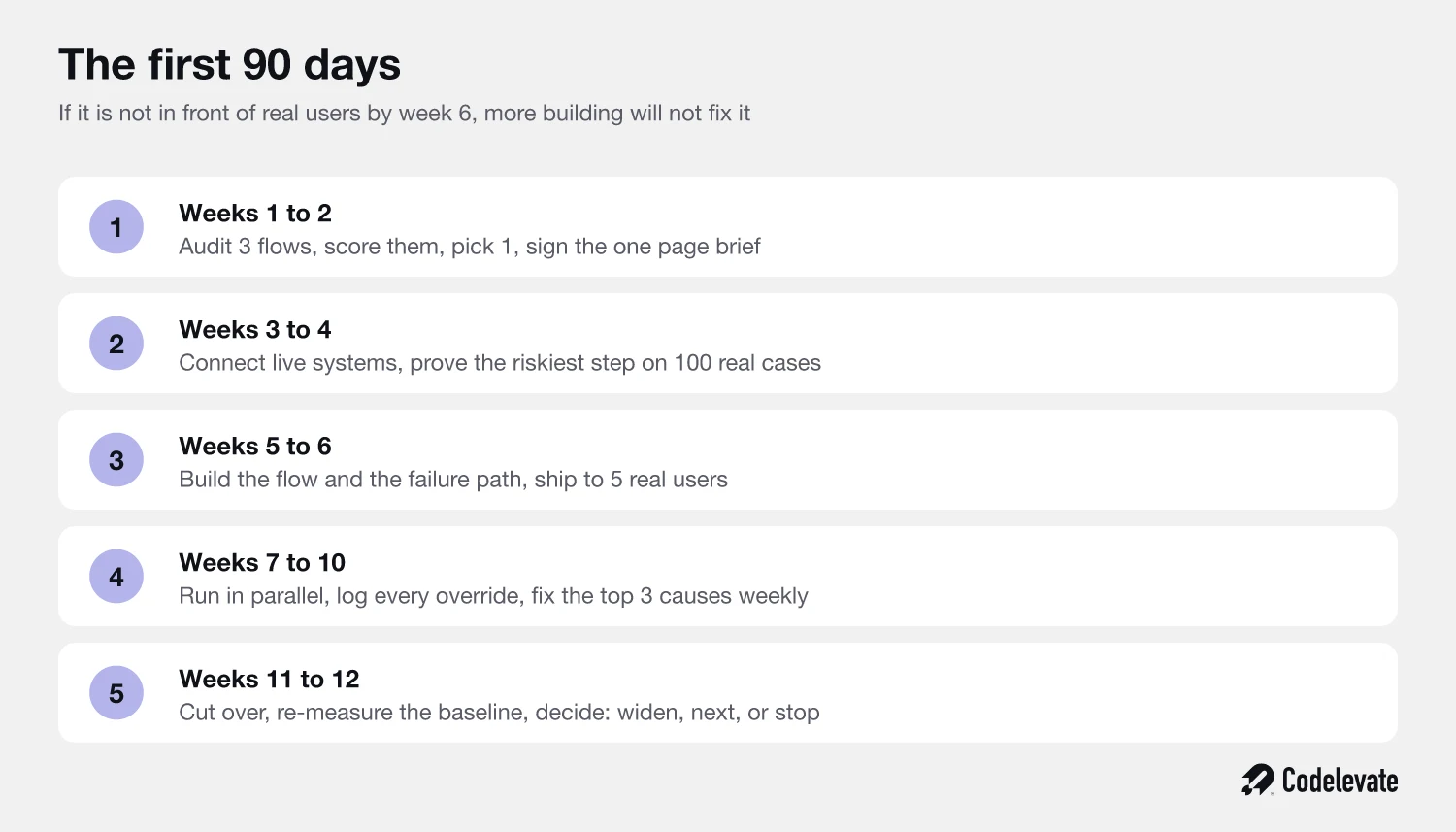
Weeks 1 and 2
Run the seam audit on 3 flows. Score them. Pick 1. Write a single page that states the flow, the owner, the baseline number measured on 20 real cases, the target, the date you will decide, and the result that would make you stop. Get the owner to sign it. This page is the whole governance layer for a first project and it prevents every argument you would otherwise have in month 3.
Weeks 3 and 4
Get read access to the real systems and build the riskiest piece first, which is almost always the integration or the messiest document type. Run the extraction over 100 real historical cases and measure accuracy against what actually happened. If it cannot handle the real data, you want to know now, on a small budget, not after the whole flow is built around it.
Weeks 5 and 6
Assemble the flow end to end, with the 3 confidence buckets, the review queue, the escalation, and the logging. Build the review interface for speed, because a reviewer who needs 4 clicks and 2 tabs will quietly stop using it. Then put it in front of 5 real users on live work.
Weeks 7 to 10
Both systems run: the automation drafts, the humans keep the old path as a safety net, and every override is logged with a reason. Those override reasons are the most valuable data you will get all quarter. Fix the top 3 causes weekly. Accuracy typically climbs fast in this window, because you are finally fixing real failures rather than imagined ones.
Weeks 11 and 12
Switch the default path to the automation with the old route still available. Re-measure the same 20 case baseline. Present the before and after to the owner with the honest error rate and the real running cost. Then make one of 3 decisions: widen this flow to more cases, start the next flow on the shortlist, or stop and write down what you learned. All 3 are acceptable outcomes. Drifting is not.
The 4 numbers to review every month
Automation without measurement becomes folklore within a quarter. Everyone believes it helps, nobody can say by how much, and it survives or dies on politics. Four numbers keep that honest, and they take 20 minutes a month to produce if you instrumented the build properly.
• Elapsed time from trigger to done, median and 90th percentile, compared to the baseline you measured before you started.
• Automation rate: the share of cases that completed without a human touching them, split by case type so you can see where it struggles.
• Override rate and reasons: how often a reviewer changed the output and why. A rising override rate is the earliest warning that something upstream has changed.
• Cost per completed case, including model usage, hosting, and the human review minutes, compared to what the manual process cost.
Review these with the owner monthly for the first 6 months, then quarterly. The moment they stop being reviewed, budget for the flow to decay. That is not pessimism, it is just what happens to any system with no attention: suppliers change formats, product lines change, and a system that was right in March is quietly wrong by November.
Who runs this after launch
The honest answer for a company under about 150 staff is that you do not need an AI team, and hiring one is usually a mistake at this size. What you need is one internal owner who understands the process and can read a dashboard, plus a partner or an internal developer who can make changes when the world moves. Somewhere around 4 or 5 live flows, that part-time arrangement starts to strain and it becomes worth having a dedicated person, often the operations analyst you already have, spending half their week on it.
What matters far more than headcount is where the knowledge lives. Insist that the integration code, the prompts, the evaluation set, the logs, and the infrastructure configuration sit in accounts and repositories your company owns. If a supplier keeps those, you have not bought an asset, you have rented one, and the renewal conversation will reflect that. This single contractual point is worth more over 3 years than any discount you can negotiate on the build.
For most SMEs the sensible model is a build partner for the first 2 flows, an explicit handover with documentation and a working local setup, then internal ownership with the partner on a small retainer for changes and quarterly reviews. That keeps the expertise available without paying for it full time, and it keeps you free to leave.
How we approach this at Codelevate
We start with the seam audit rather than a tool recommendation, because the tool question is answerable in 20 minutes once the flow is understood and unanswerable before. The first delivery is deliberately narrow: one flow, real data, real users, live in weeks rather than quarters. We build the failure path before the happy path, because that is what decides whether a business will actually run the thing.
We also insist the client owns the result, for the reasons above, and we say no to flows that do not clear the 12 minute rule. If you want to see how that works as an engagement, including the scoping session, the team shape, and how we price a first workflow, our AI automation agency page walks through it. For the broader picture of where AI fits across an SME, our complete 2026 guide to AI automation for SMEs covers the strategic view alongside this playbook.
The short version
Find the seams, not the tasks. Score candidates on volume, convertible time, rule stability, data access, error tolerance, and whether a budget holder genuinely wants it. Expect 4,000 to 18,000 euros to build a first real flow, under 150 euros a month to run it, and 15 to 25 percent of the build each year to keep it working. Use no-code where the stakes are low, own the flows that carry your revenue, and keep a human on anything that touches a person's money or position. Then measure elapsed time, automation rate, override rate, and cost per case, monthly, out loud.
Do that and AI automation stops being a project you have to defend and becomes infrastructure, in the same way your accounting software is infrastructure. Nobody asks for the ROI of that anymore either.
If you want a structured starting point for your own plan, take the SaaS founder's AI Blueprint into your next management meeting and use it to scope the first flow properly.

And if you would rather have someone run the audit with you, we do this every week. Book a free call with our team and we will map your seams, score the top 3 candidates, and tell you honestly which ones are worth building and which ones are not.

.svg)
.svg)


