
AI pilot to production: why most AI projects stall and how to design one that ships
Your AI pilot probably did not fail because the model was not good enough. It failed because it was built to be shown, not to be used. That difference is the whole game, and almost nobody designs for it on day 1.
This article is for founders, CTOs, and operations leaders who ran an AI pilot in 2025 or 2026, got a room full of nodding heads, then watched it quietly die in a Slack channel. You will get the 5 patterns that kill pilots, the 6 decisions that separate a demo from a system, what changes technically at go-live, what it costs, and how to tell whether your pilot deserves to graduate or be stopped this month.
The reframe worth taking away before anything else: a pilot is not a smaller experiment on the way to a real project. A good pilot is the production system with the scope turned down. Same data, same failure handling, same owner, just pointed at one narrow workflow. Teams who build it that way ship. Teams who build a demo first pay twice and usually never get the second budget.
Key takeaways
• Most AI pilots stall for organisational reasons, not model quality, so buying a better model does not fix it.
• Gartner predicted at least 30 percent of generative AI projects would be abandoned after proof of concept by the end of 2025.
• MIT's 2025 research found roughly 95 percent of generative AI pilots produced no measurable impact on profit and loss.
• A demo-shaped pilot uses curated data, an internal audience, and no failure path. A production-shaped pilot uses live data, real operators, and a defined escalation route.
• Name an owner who holds a budget before you write code. Pilots without a budget holder almost never graduate.
• Agree the number and the kill date on day 1, so the pilot can be judged instead of debated.
• Budget 30 to 50 percent of the build for evaluation, monitoring, permissions, and rollback. That work is what makes it production.
• If a pilot has not reached real users within 12 weeks, it is usually stuck for reasons more code will not solve.
What pilot to production actually means
Pilot to production is the process of taking an AI system that worked in a controlled test and making it run continuously against real data, real users, and real consequences. It is not a deployment step at the end. It is a set of decisions about ownership, data, failure handling, and measurement that either exist from the start or have to be retrofitted at three times the cost.
The word pilot hides an enormous range. In practice we see three very different things called by the same name. A prototype answers "can the model do this at all" and lives on a laptop. A proof of concept answers "would this be valuable" and usually runs on a curated dataset in front of an audience. A pilot, properly defined, answers "does this hold up when reality touches it" and runs against production data with a small group of real users for a fixed period.
Most teams believe they are running the third one. Almost always they are running the second. That is the gap where projects die, because a proof of concept optimises for a yes in a meeting, while production optimises for surviving a bad Tuesday. Those two goals pull the design in opposite directions from the very first commit.
The honest version of the question is not "when do we move this to production." It is "what did we deliberately leave out, and who is going to pay to put it back." Answer that in week 1 and the path is short. Answer it in month 6 and you are rebuilding.
Why AI pilots stall: 5 patterns we see over and over
When a company comes to us with a stalled pilot, we do not start with the model. We start with the conditions the pilot was built under, because that is where the cause almost always sits. Five patterns cover the overwhelming majority of cases, and only one of them is technical.
This matches what the research keeps finding. MIT's 2025 study of enterprise generative AI, reported in Forbes coverage of the MIT pilot failure research, put the share of pilots with no measurable impact on profit and loss at about 95 percent, and pointed at integration and learning inside the organisation rather than at model capability. In other words, the thing that stalls is rarely the AI.
1. It was designed to impress, not to run
The first version gets built for a demo date. The dataset is cleaned by hand, the prompts are tuned against the examples that will be shown, and the awkward edge cases are quietly excluded because there is no time. The demo goes well. Everyone is impressed. Then someone asks to try it on their own work, feeds it a real document with a scanned page and a missing field, and the illusion breaks in 30 seconds.
Nothing dishonest happened. The team optimised for the goal it was given. But the second impression is the one people remember, and once a business audience has watched the system fail on their own input, a second budget becomes a political problem rather than a technical one.
2. Nobody with a budget owns it
The most reliable predictor of whether a pilot graduates is not accuracy. It is whether a named person with profit and loss responsibility considers it theirs. Pilots run by an innovation team, an internal AI guild, or an enthusiastic engineer without cost ownership tend to stall at exactly the moment they need real money, because there is nobody whose numbers improve when it ships.
This is what Gartner pointed at when it predicted that at least 30 percent of generative AI projects would be abandoned after proof of concept by the end of 2025, citing unclear business value and escalating costs among the reasons. Read the failure list closely and it is mostly a list of decisions nobody was accountable for. You can find the full prediction in the Gartner press release on abandoned generative AI projects.
3. The data only behaves in the demo
AI pilots are usually built on an export. Someone pulls a few thousand clean records, and the system is tuned against that snapshot. Production data is different in ways that are boring and fatal: duplicates, half-filled fields, three naming conventions from three acquisitions, PDFs that are photographs of paper, and a stream that changes shape whenever an upstream team ships a release.
The fix is not a data warehouse project before you are allowed to touch AI. That is how organisations spend 2 years preparing and never build anything. The fix is to point the pilot at the live source from week 1, accept that quality will be worse, and let the mess shape the design. If your pilot cannot handle the data you actually have, it is not a pilot, it is a wish.
4. There is no answer to what happens when it is wrong
Every AI system is wrong sometimes. The question that decides whether it can go live is what happens next. In a demo, a wrong answer is a laugh in the room. In production, a wrong answer becomes an invoice paid twice, a customer told the wrong thing, or a compliance issue somebody has to explain later.
Production-shaped pilots answer this before they are built. Who sees the output before it takes effect, and for which categories of decision. What confidence signal triggers a human review. Where the escalation goes when the system is unsure. How a bad output gets corrected, logged, and fed back. This is unglamorous work and it is precisely the work that separates a system a business will run from a toy it will admire.
5. Success was never defined as a number
Ask a stalled team what the pilot needed to prove and you usually get an adjective. It needed to be accurate, useful, promising. Adjectives cannot be argued to a conclusion, so the review meeting becomes a debate about impressions, and the decision gets postponed. Postponed twice is dead.
A number ends the debate. Handling time on this queue drops from 14 minutes to under 6. First-response accuracy on the top 20 intents stays above 90 percent with a human reviewing anything below the threshold. Cost per processed document under 40 cents including model spend. You do not need certainty about the number, you need agreement about it before anyone is emotionally invested. If you want the mechanics of choosing that number, our guide on how to measure the ROI of an AI agent works through it in detail.

The reframe: build the production system with the scope turned down
Here is the shift that changes outcomes. Stop treating the pilot as a cheaper, looser version of the real thing. Treat it as the real thing, aimed at one narrow slice of work.
Narrow the scope aggressively. One workflow, one team, one document type, one language, one queue. Then refuse to narrow anything else. Real data, real users, real permissions, real logging, real failure path. The scope is the only dial you are allowed to turn down.
Teams resist this because it feels slower in week 1. It is slower in week 1. It is dramatically faster by week 10, because there is no rebuild between the pilot and the rollout. Widening from one queue to five queues is configuration and change management. Converting a demo into a production system is a new project with a new budget, and that second budget is exactly the one that never arrives.
There is a commercial argument too. A production-shaped pilot produces evidence finance accepts: real throughput, real error rates, real cost per transaction over 6 weeks of live use. A demo produces enthusiasm, which depreciates fast.
6 decisions to make before you write any code
These are the decisions we insist on before any build starts. They take a few hours of conversation and they are the single highest-return part of the whole project.
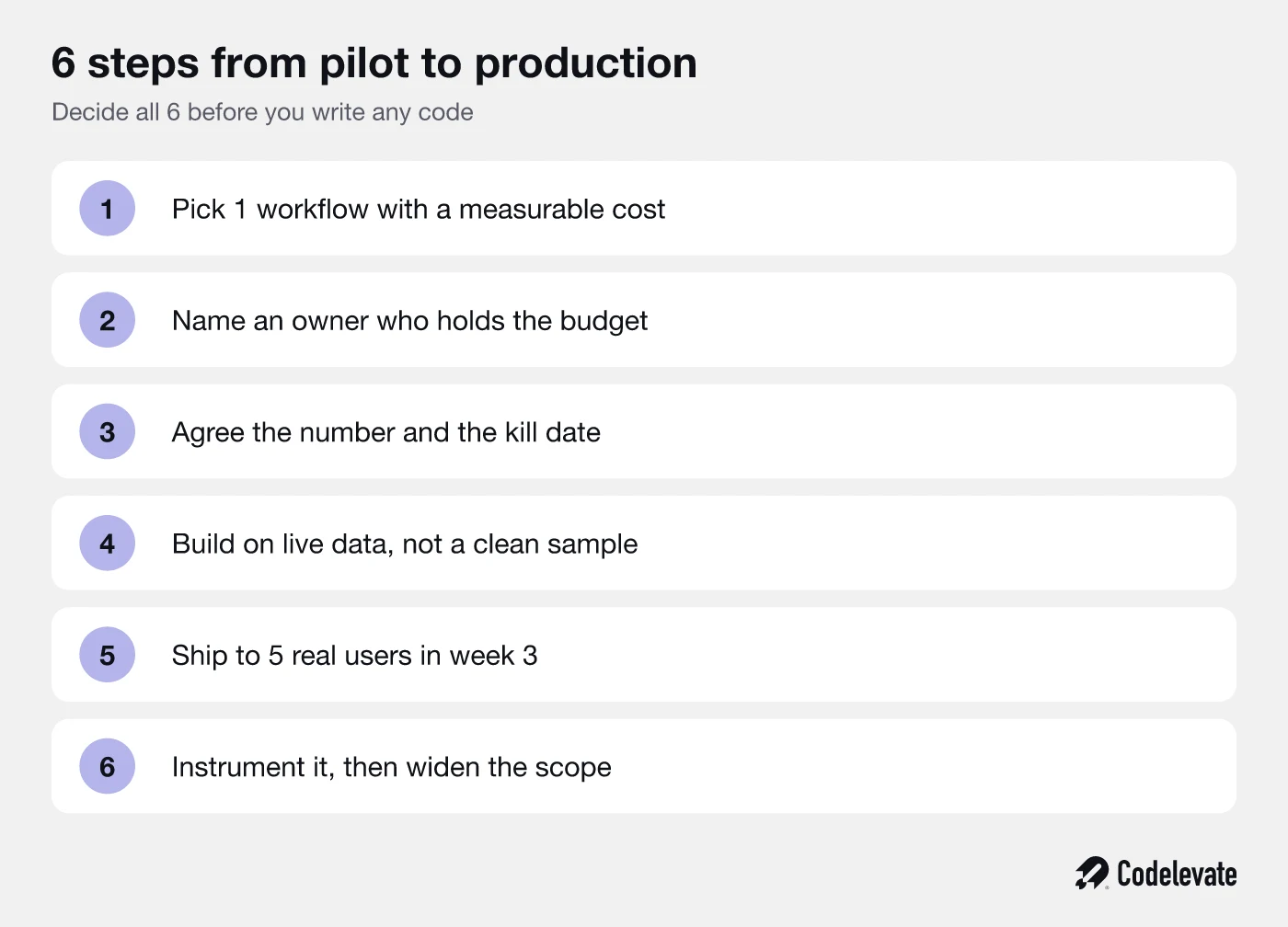
Pick 1 workflow with a cost you can already measure
Choose work that is repetitive, high volume, and currently expensive in hours or errors. If you cannot state today what the workflow costs, you will not be able to prove the AI improved it. Avoid the most exciting workflow and pick the most measurable one. Excitement tends to track novelty, and novelty tends to track unclear success conditions.
Name an owner who holds the budget
Not a sponsor, not a steering group. 1 operational leader whose numbers move when this works, who can approve the next phase without a committee, and who sits in the room when results are reviewed. If nobody like that wants it, that tells you something important about the use case, and it is cheaper to learn it now.
Agree the number and the kill date
Write down the metric, the current baseline, the target, and the date you will decide. Also write down what result would make you stop. Teams find the kill criterion uncomfortable and it is the most valuable line in the document, because it makes a no cheap. Cheap nos are what let an organisation try 6 things a year instead of dragging 1 thing for 18 months.
Build on live data from week 1
Connect to the real source, with real permissions, even if the volume is small at first. Read-only where you can, sandboxed where you must, but real. Every week you spend on an export is a week of learning you will have to repeat later, and the failure modes that matter only appear in the mess.
Put it in front of 5 real users by week 3
Not the project team. The people who do the work, inside their normal day, on their normal caseload. They surface what no test set contains: the step they always skip, the exception that happens twice a week, the reason they quietly stop using it if the output arrives 4 minutes too late. 5 users for 3 weeks tells you more than 5 months of internal testing.
Instrument it before you widen it
You need to see what the system did, what it cost, how often a human overrode it, and where it was unsure. Without that, scaling is guessing. With it, the expansion case writes itself, because you can show finance the per-transaction economics of something that already ran.
Get the AI blueprint we use for this
If you are working through these decisions now, our SaaS founder's AI Blueprint covers the same ground in a format you can take into a planning session: how to scope a first AI workflow, what to measure, and where teams overspend. It is free and takes about 20 minutes to read.
What actually changes between a demo and production
When people ask what the extra work is, the honest answer is that the model part barely changes. What changes is everything around it. In our projects this surrounding layer is typically 30 to 50 percent of the build effort, and it is the part that gets cut when a pilot is scoped as a demo.
Evaluation instead of vibes
A demo is judged by watching it. Production needs a test set of real cases with known correct answers, run automatically on every change, so you can tell whether last week's prompt improvement quietly broke 3 categories of input. Start with 50 to 100 labelled examples from the real workflow.
Observability and cost ceilings
Every call needs to be logged with its inputs, outputs, latency, and cost. Model spend scales with usage in a way that surprises finance the first time a workflow gets popular. Set a hard ceiling per day and per workflow, alert before it is hit, and decide in advance what degrades: a cheaper model, a queue, or a stop.
Human in the loop, placed deliberately
Blanket human review defeats the point, and no review at all is usually unacceptable. Route by risk and confidence instead: low-risk, high-confidence outputs pass automatically, everything else goes to a person with enough context to decide in seconds. Then move the threshold as evidence accumulates.
Permissions, data boundaries, and the EU rules
The pilot ran under someone's personal access. Production needs its own identity, scoped to exactly the data it should see, with an audit trail of what it read and did. For European companies this is where the AI Act and GDPR become concrete, particularly around logging, human oversight, and disclosure.
Rollback and graceful failure
Ask what happens during a provider outage, when a model version is deprecated, or when quality drops after an upgrade. The answer should be a switch someone can flip to return the workflow to the previous way of working without data loss. Systems that cannot be turned off do not get turned on.
What it costs and who does the work
A production-shaped pilot on one workflow typically runs 6 to 12 weeks. The team is smaller than people expect: 1 engineer who can build and integrate, 1 person who knows the workflow intimately, and part-time input from whoever owns the data and the security review.
The cost split is the part worth planning for. Roughly a third goes to integration with the systems you already have, a third to the AI logic itself, and a third to evaluation, monitoring, permissions, and the failure path. When a proposal shows almost all the budget on the AI logic, you are looking at a quote for a demo.
Running costs are the line most teams forget: model spend, monitoring, and somebody's time to review evaluation results and adjust thresholds. An AI workflow is not a project that finishes, it is a system that needs an owner, in the same way your billing integration has one.
How to tell your pilot is ready to graduate
Run this list against the pilot you have now. It is deliberately blunt, and the answers are usually obvious once someone asks the questions out loud.
• It has run on live production data for at least 4 consecutive weeks.
• At least 5 real users outside the build team used it in their normal work.
• You can state the before and after number, not an impression.
• You know the error rate and what happens when the system is wrong.
• One named person with a budget wants it, in writing.
• You know the monthly running cost including model spend.
• Security and data access were reviewed against the production setup, not the test one.
Fewer than 5 of these and the pilot is not ready, and no amount of extra model work changes that. The blockers sit in the missing rows. Fix those and the decision usually becomes straightforward within a couple of weeks.
The harder discipline is stopping. If the kill date passed without the number moving, stop and write down what you learned about the workflow. That is not a failed project, it is a cheap answer to an expensive question, and it is why some organisations get to try 6 things a year.
How we approach this at Codelevate
We do not run demo phases. When a client asks us for an AI pilot, the first sessions are about scope, ownership, the number, and the failure path, and the build starts against live data. Our first delivery is usually narrow enough that people are slightly disappointed by the scope and quite surprised that it is already running against their real systems in week 3.
The second thing we insist on is that the client owns the result. The evaluation set, the logs, the prompts, and the integration code sit in their repository. AI work concentrates knowledge fast, and a partner who keeps that knowledge is a partner you cannot leave. If you want to see how this looks as an engagement, our AI automation agency page walks through the process, the team shape, and the way we scope a first workflow.
The pattern across these projects is unromantic. The clients who get value are not the ones with the most advanced models. They picked a boring workflow, named an owner, agreed a number, and let real users break the first version early enough to fix it.
The short version
Most AI pilots stall because they were built to be shown rather than used, and that gap is not model quality. It is ownership, data, failure handling, and measurement. Build the production system with the scope turned down, decide the 6 things above before any code exists, and put it in front of real users inside 3 weeks.
If you want a structured starting point, take the SaaS founder's AI Blueprint into your next planning session and use it to scope the first workflow properly.

And if you already have a pilot that stalled, that is a solvable problem and usually a faster one than starting over. Book a free call with our team and we will look at where it is stuck and what it would take to get it running in production.

.svg)
.svg)


