
AI agent services in 2026: what to expect from a partner
Most teams shopping for AI agent services are really shopping for a bot. That is the expensive mistake. A bot is a thing you buy. An AI agent service is something you commission, because the value is not the model, it is the outcome: a real process inside your business that now runs itself.
This article is for founders and operations leaders deciding whether to bring in an AI agent partner, and what to expect when they do. You will learn what AI agent services actually include, how to tell a real partner from the growing crowd of agent washing, what the engagement looks like end to end, and how it connects to cost and results.
Get the framing right and an AI agent service buys you a transformation. Your team stops doing repetitive work and starts doing the work only they can do. Get it wrong and you have paid for a demo that never reached production.
What AI agent services actually are
An AI agent service is the end to end work of putting an AI agent into production inside your business, not a piece of software you license. The model is the easy part and the cheapest part. The service is everything around it that makes the agent reliable, integrated, governed, and worth running.
Put simply, you are not buying intelligence. You are buying the engineering, integration, and oversight that turn intelligence into a process that holds up on a Monday morning, with real data and real stakes.
What is included end to end
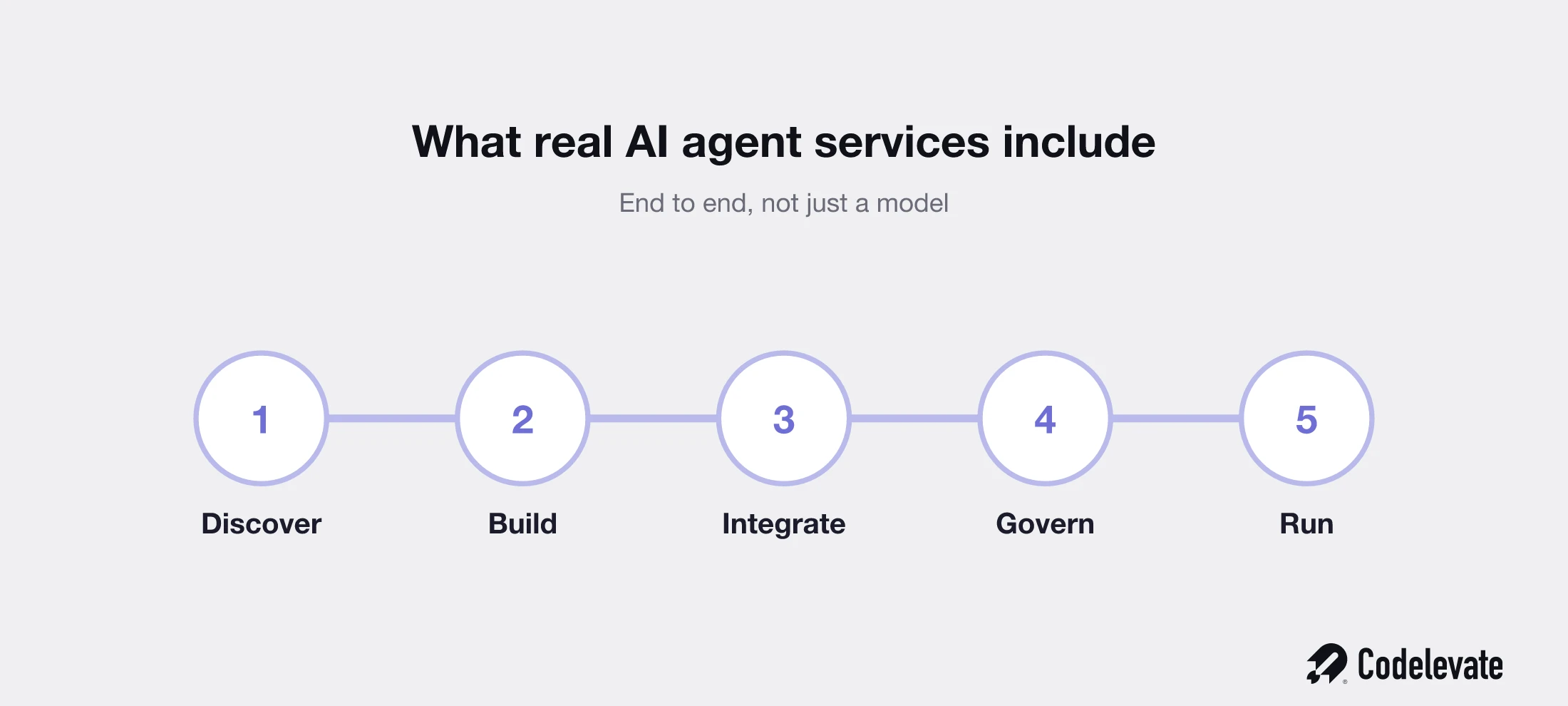
A real AI agent service covers 5 stages. If a provider only talks about 1 or 2 of them, that is your first warning sign.
- Discover. Map the process, the systems it touches, the risk of a mistake, and the metric that defines success. A good partner will tell you which ideas are not worth automating yet.
- Build. The agent itself: the reasoning, the tools it can use, the prompts, and the guardrails that keep it inside the lines.
- Integrate. Connect the agent to your CRM, database, and internal tools so it can actually do the work, not just talk about it. This is usually the largest part of the effort.
- Govern. Human in the loop checkpoints, security, data handling, and an audit trail, so the agent is safe to trust and easy to oversee.
- Run. Monitor performance, control model costs, retrain as your data and tools change, and keep proving the value with real numbers.
The pattern to notice: most of the work, and most of the cost, sits in integration, governance, and running, not in the model. A service that stops at the build hands you a clever prototype and leaves the hard 80% to you.
If you want a structured way to decide where an agent fits in your product before you hire anyone, our free SaaS AI Blueprint walks founders through exactly that.
How to tell a real partner from agent washing
The market is young and noisy. Gartner describes a wave of agent washing, where vendors rebrand a basic chatbot or a rule based tool as an agent and price it like one. A few questions separate a real partner from the rest:
- Do they start with your process and your success metric, or with their tool?
- Can they name exactly which systems the agent will integrate with?
- Do they talk about governance, testing, and running costs without being asked?
- Will they pilot on real data before asking you to commit to the full build?
- Can the agent actually take actions on its own, or does it only answer questions?
A partner who leads with the model and glosses over integration and oversight is selling you the easy 20 percent. The right partner is comfortable being judged on whether the process actually improved.
What AI agent services cost, and how engagements work
Pricing varies as much as the work. You will see fixed project pricing, time and materials, monthly managed retainers, and usage based models. Most custom builds land between 40,000 and 150,000$, plus a monthly cost to run the agent in production. We break the numbers down in our guide on how much it costs to build an AI agent.
The engagement that tends to work best is staged: a small, paid discovery and pilot first, then the full build only once the value is proven on real data. It keeps your risk low and your budget tied to results, not optimism.
Build, buy, or partner
Buying an off the shelf agent is fastest for common, standardized tasks. Building in house makes sense when AI is core to your business and you already have the engineers. An AI agent service sits in between: you get a custom agent built and run for you, without hiring a full team, and you keep ownership of the result. For the deeper version of this decision, see our guide on how to choose the right AI agent for your process automation.
How Codelevate delivers AI agent services
We start with your process and your numbers, not a tool. Our AI automation agency maps where agents create real value, then our AI development team builds, integrates, governs, and runs them, so they hold up in production rather than in a demo. The work is staged, so you prove value on a small budget before committing to the full build.
The takeaway
AI agent services are not a product you buy off a shelf. They are the end to end work of turning a model into a process that runs itself, safely, inside your real systems. Judge a partner on the whole journey, from discovery to running, not on a polished demo, and insist on proving the value before you scale.
Two ways to start: grab the free SaaS AI Blueprint to map where AI fits in your product, or book a free call and we will help you find the one process worth automating first.


.svg)
.svg)


