
AI agent adoption: why your team ignores the agent you built
The agent works. It reads the inbound ticket, drafts the reply, updates the record, and it gets it right about 9 times out of 10. You demoed it and everyone in the room nodded. Six weeks later, 4 people have used it, and 3 of them built it.
This is the most common AI agent adoption story in 2026, and it rarely gets described honestly. When it does, the blame lands in the same three places every time: not enough training, weak change management, staff who quietly fear for their jobs. Those things are real. They are also downstream of the actual cause.
Here is the position we have arrived at after putting agents into real teams: when people ignore an agent that works, the agent was built wrong. Not coded wrong, built wrong. Somebody made 4 quiet design decisions early on, about where the agent lives, what it is allowed to decide, how a person takes control back, and how it explains itself. Those decisions set the adoption ceiling before anyone was trained. No amount of enablement raises that ceiling afterwards.
This article is for founders, CTOs, and operations leaders who already have an agent or an automation running inside a real team and are watching usage sit flat. If you are still deciding whether AI is worth trying at all, start somewhere easier. Everything below assumes you have shipped something and it is not landing.
You will get the 6 structural reasons working agents get ignored, the 4 build decisions that determine adoption, the same process designed two ways, 5 metrics that tell you the truth about usage, and a 30 day plan for rescuing an agent that has already stalled.
Key takeaways
• AI agent adoption is the share of eligible work a team actually routes through the agent, not the number of people who have access to it.
• Access is growing far faster than integration. Deloitte's 2026 enterprise survey found worker access to approved AI tools climbed from under 40% to around 60% in a single year, while the organisational changes lagged well behind.
• Agents get ignored for structural reasons: the wrong surface, the hard part left to the human, no way to undo, false confidence, unowned exceptions, and scorecards that punish the person who uses it.
• Adoption is set by 4 build decisions: which surface the agent appears on, how much it decides alone, what reversal looks like, and how it shows its work.
• Training closes a knowledge gap. Most stalled agents have a trust gap or a workflow gap, and training does nothing for either one.
• Measure repeat use at week 6, override rate and its direction, time to reverse, and the age of the exception queue. Launch week logins tell you nothing.
• A stalled agent is usually recoverable in about 30 days, and the move is almost always to narrow its scope rather than relaunch it wider.
What is AI agent adoption?
AI agent adoption is the share of eligible work that a team routes through the agent, sustained over time. It is a usage measure, not an access measure.
That distinction does more work than it looks like it should. Most companies report adoption as seats provisioned, or as the count of people who logged in during launch week. Both numbers spike on day 1 and tell you nothing about month 3. An agent with 100% access and 6% of eligible work flowing through it has not been adopted. It has been installed.
The useful version of the question is narrower. Of all the invoices, tickets, applications, or reconciliations this agent was built to handle, what proportion did it actually handle last week, and did that proportion hold when nobody was watching it? That is the only number that predicts whether the investment pays back.
There is a second, harder layer underneath. An agent can be used and still not adopted, if every output gets rewritten before it ships. Usage without trust is a tax: the team is now doing their old job plus the job of supervising a machine. Real adoption means the agent's output is treated as the default and the human intervenes by exception, not by habit.
Access is not adoption, and the gap is getting wider
The macro data makes the point better than any anecdote. Deloitte's 2026 State of AI in the Enterprise, built on responses from 3,235 leaders across 24 countries, describes enterprise AI adoption as broadening faster than enterprise AI integration. Access to approved tools rose from under 40% of workers to roughly 60% in a year. The organisational redesign needed to turn that access into value did not move anywhere near as fast.
Microsoft's 2026 Work Trend Index, published in May 2026, adds the agent-specific numbers. Active agents inside Microsoft 365 grew 15 times year over year. At the same time, only 13% of AI users say they are rewarded for redesigning their work around AI regardless of how the results land, and organisational factors account for roughly 67% of AI impact against 32% for individual factors.
Put those two findings next to each other and the story stops being about reluctant employees. Two thirds of the outcome is decided by how the organisation set the thing up. Companies shipped capability at speed and left the surrounding work design almost entirely alone, then expressed surprise when the capability sat unused.
This is good news, in a blunt way. Structural causes are fixable by whoever controls the build. Cultural causes are not, at least not on a quarterly timeline.
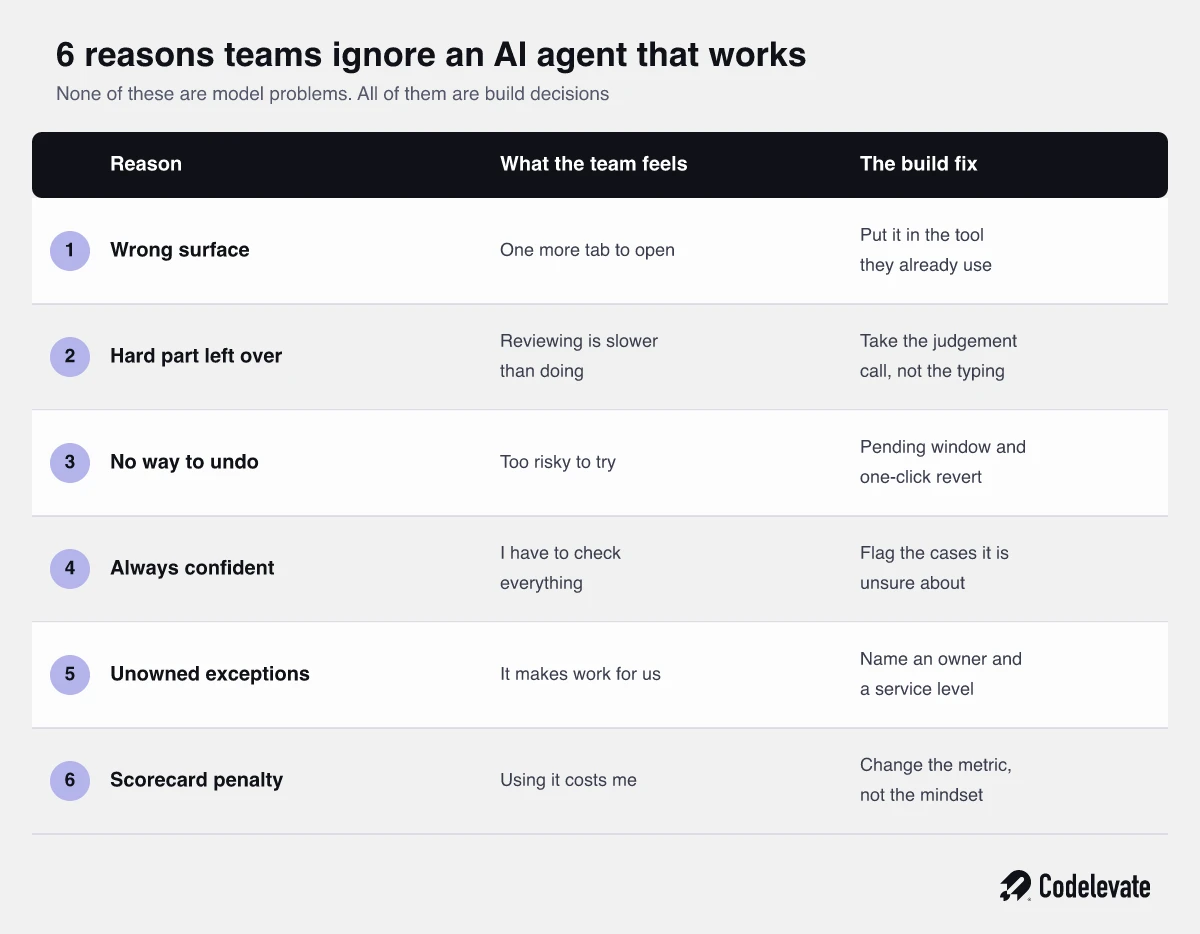
6 reasons your team ignores an agent that works
These are the failure modes we see most often when we are called in to look at an agent that technically performs and commercially does nothing. None of them are model problems.
1. It lives somewhere the work does not happen
Your support team lives in Zendesk. Your finance team lives in Exact or in a spreadsheet that has outlived 3 CFOs. Your ops team lives in a shared mailbox. The agent lives in a separate web app, behind a second login, on a tab nobody has open.
Every context switch is a tax the agent has to earn back before it produces any net value, and it almost never does for small tasks. A person deciding whether to open another tool is making a fast, mostly unconscious cost calculation, and for a 90 second task the answer is always no. This is the single most common reason a good agent goes unused, and it is a placement decision, not a capability one.
2. It leaves the hard part to the human
An agent that produces something 80% right and hands it over sounds obviously helpful. In practice it often costs more than it saves. Reviewing and repairing someone else's near-miss is slower than doing the work from scratch when you already know the answer, and it carries a worse cognitive load because you have to reconstruct the reasoning before you can correct it.
The test is not whether the agent produced output. It is whether the human's remaining task is genuinely smaller than the original task. Drafting the easy 3 paragraphs of a reply and leaving the judgement call unaddressed fails that test. Handling the judgement call and asking a person to confirm one specific thing passes it.
3. There is no way to undo it
People do not adopt tools they cannot back out of. If reversing an agent action means raising a ticket with engineering, the rational behaviour for a careful employee is to never let the agent act in the first place. They are not being obstructive. They are protecting themselves from an error they would own and could not fix.
Reversibility is a feature with a cost, which is why it gets cut. It usually means keeping a shadow record of the prior state, or holding actions in a pending state for a short window. Teams skip it to ship faster and then spend 6 months wondering why nobody trusts the thing.
4. It sounds equally confident about everything
An agent that returns identical tone for a case it has seen 4,000 times and a case it has never seen before teaches people to check everything it produces. Once a team is checking everything, the agent has become overhead with extra steps.
What earns trust is calibration, not accuracy. An agent that is right 90% of the time and reliably flags the 10% it is unsure about is far more usable than one that is right 96% of the time with no signal at all. The first lets a person spend attention where it matters. The second forces uniform vigilance, which is exhausting and gets abandoned.
5. Nobody owns the exceptions
Every agent produces a residue: the cases it could not handle, the ones it flagged, the ones that failed validation. If that queue has no named owner and no service level, it grows. Within a couple of months the team's mental model flips from "the agent does work for us" to "the agent makes work for us," and that impression is close to impossible to reverse.
The exception path deserves as much design attention as the happy path, and it almost never gets it. Who picks these up, how fast, and what happens to the customer or the record in the meantime are questions to answer before launch, not after the queue hits 300.
6. Using it makes someone look worse on their own scorecard
This one is uncomfortable and it explains more stalled rollouts than the other 5 combined. If a support rep is measured on tickets closed per hour and every agent draft needs a careful read, the agent costs them. If an analyst is measured on accuracy and the agent introduces a small error they now personally own, the agent costs them. If a manager's headcount is their standing, an agent that reduces workload is a threat rather than a win.
Nobody in this picture is resisting AI. They are responding correctly to the incentives you gave them. This is exactly what Microsoft's finding about only 13% being rewarded for redesigning their work points at, and it is why adoption work that never touches the measurement system tends to fail politely and permanently.
If you are working through this list against your own build, our free SaaS founder's AI blueprint covers the same design decisions in a format you can take into a planning session with your team. It is the shortest route from reading this to changing something.
Adoption is designed in, not trained in
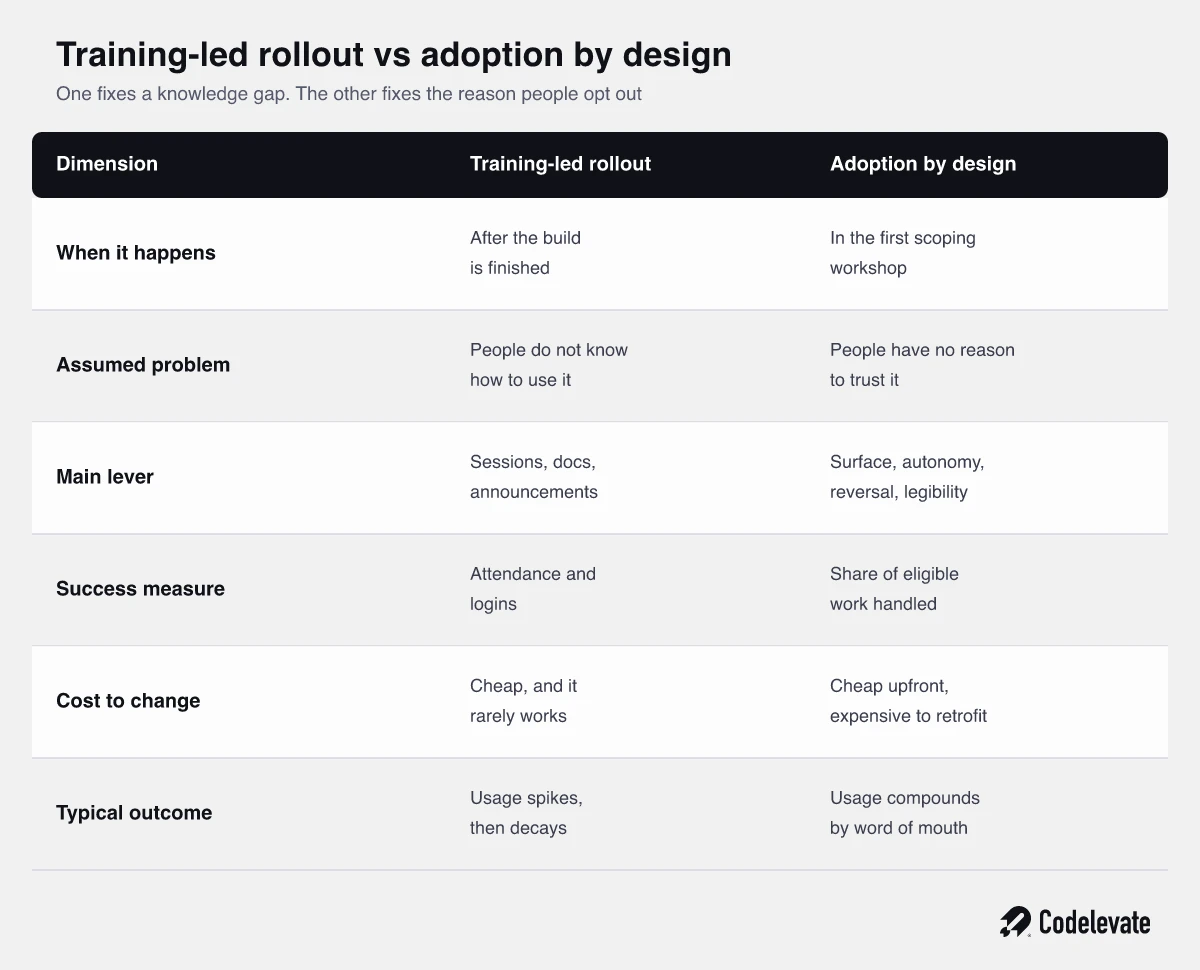
Here is the reframe worth taking away. Every rollout plan has a training budget and almost none of them have an adoption design phase. That is backwards, because training only fixes one kind of gap.
If someone does not know the agent exists or does not know how to invoke it, that is a knowledge gap, and training genuinely fixes it. If someone knows exactly how it works and still does not use it, they have a trust gap or a workflow gap, and no session will touch either. Most stalled agents are in the second category, which is why the standard response of running more enablement produces nothing but calendar invitations.
The decisions that actually move the number get made before any code is written. There are 4 of them.
Decision 1: which surface the agent appears on
Pick the tool the work already happens in and put the agent inside it, even when that is technically harder and less impressive to demo. An agent that appears as a draft reply in the shared mailbox, a suggested field value in the CRM, or a comment on the ticket beats a dedicated interface almost every time.
The rule we use: if adopting the agent requires a person to change where they spend their day, the project has taken on a change management problem it did not need. Build to the existing habit. The habit will not move for you.
Decision 2: how much the agent decides on its own
Autonomy is the setting people over-tune in both directions. Too little and the agent is a suggestion box that adds a click. Too much and one bad action in month 2 gets it switched off permanently, because the blast radius was never bounded.
The practical approach is to set autonomy per action rather than per agent. Reading, summarising, classifying, and drafting can run freely. Anything that touches money, a customer, or a legal record starts gated and earns its way to automatic once the override rate stays low for a meaningful sample. We wrote about where to draw that line in detail in how much autonomy should your AI agent have.
Decision 3: what reversal looks like
Decide the undo story before the happy path. For every action the agent can take, answer 3 questions: can a person reverse it, how long does that take, and does reversing it require anyone technical. If the answer to the third question is yes, adoption will stall and the reason will never appear in a survey.
Cheap reversal mechanisms work fine. A short pending window before an action commits, a one-click revert that restores the prior state, and a visible log of what the agent changed will carry most use cases. The point is not elegance. The point is that a nervous person can try the agent on real work without gambling their week.
Decision 4: how the agent shows its work
The agent should make its confidence and its reasoning legible in a form the specific reader can check in seconds. For a support agent that might be the 2 prior tickets it drew from. For a finance agent it might be the exact invoice lines it matched and the tolerance it applied.
This is not about explainability as a compliance box. It is about giving a skilled human a fast way to agree or disagree. When a person can validate an output in 5 seconds instead of 3 minutes, the agent stops being a risk and becomes leverage, and usage follows without anyone being asked.
The same process, built 2 ways
Consider a mid-size insurance intermediary handling inbound claim notifications. Customers email a shared mailbox. A team of 6 reads each message, classifies it, opens a case in the policy system, requests whatever is missing, and replies. It is high volume, moderately skilled, and genuinely tedious.
The first build is the one most teams produce. A web app where a handler pastes or uploads the email, the agent extracts the fields and proposes a classification, and the handler copies the result into the policy system. It demos beautifully. In practice a handler has to leave their mailbox, move content into a second tool, wait, then move the result into a third. For a message they could have processed in 2 minutes, they now have a 3 tool dance. Usage settles on the small share of unusually complex claims where the extraction is genuinely worth the detour, and then decays as people forget it exists.
The second build changes almost nothing about the model and everything about the placement. The agent watches the mailbox. When a claim arrives it drafts the reply in the thread as an unsent message, pre-fills the case in the policy system as a draft record, and adds a single line showing what it matched the policy on and how sure it is. The handler reads, and either sends or edits. Anything the agent is unsure about lands in a labelled folder that one named person clears twice a day.
Same model. Same accuracy. The difference is that the second version costs a handler nothing to try, gives them a 5 second check instead of a review, and has an obvious owner for the messy remainder. That version becomes the default path within weeks, and it does so without a single training session.
The lesson generalises past claims handling. When adoption is poor, the fix is rarely a better model. It is usually moving the agent closer to where the work already sits and lowering the cost of trusting it.
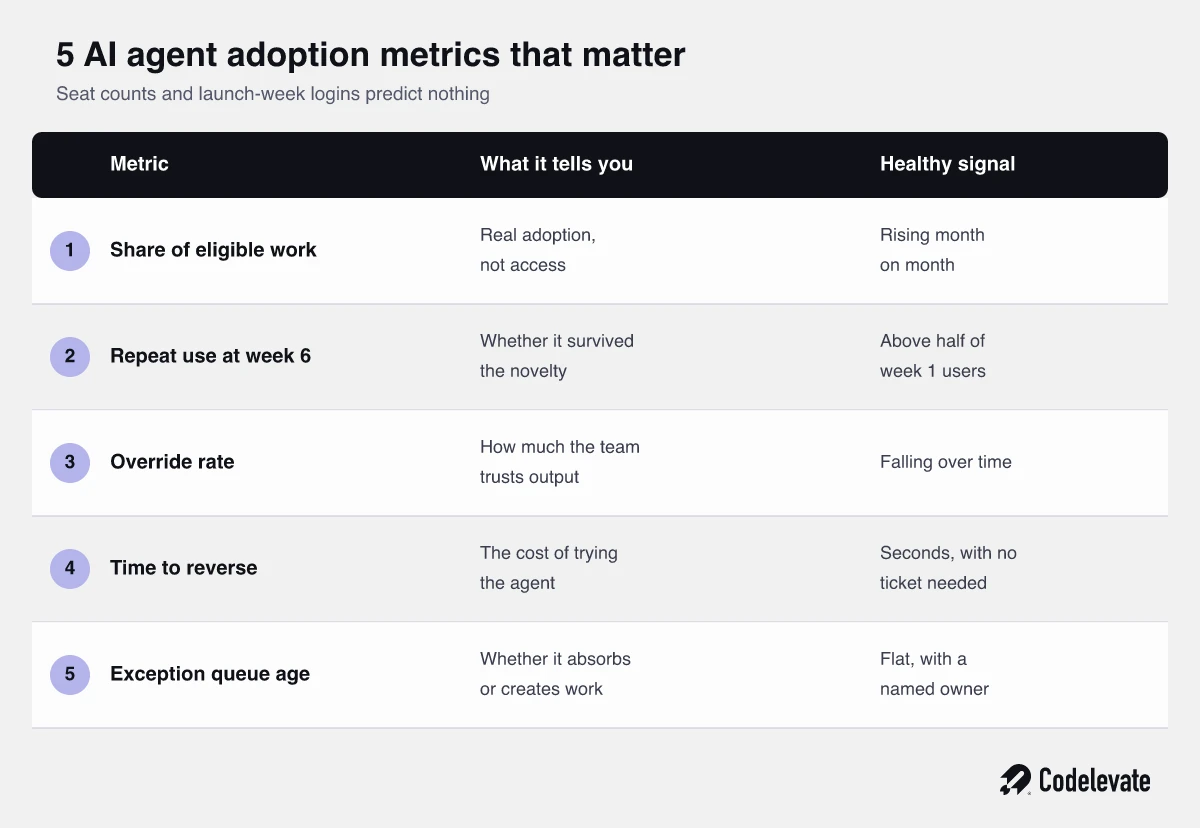
How to measure AI agent adoption: 5 numbers that matter
Most adoption dashboards measure the things that are easy to instrument rather than the things that predict payback. These 5 are harder to collect and worth the effort.
• Share of eligible work: of the cases the agent was built to handle, what proportion actually went through it last week. This is the headline number and the one most teams never calculate, because it requires knowing the denominator.
• Repeat use at week 6: the proportion of people who used it in week 1 and are still using it in week 6. Launch curiosity flatters every early report. Week 6 is where the truth is.
• Override rate and direction: how often a human changes the agent's output, and whether that rate is falling. A steady 30% override that is trending down is healthy. A steady 8% override that is trending up means something in the data or the process has drifted.
• Time to reverse: how long it takes a non-technical user to undo an agent action, measured in seconds. Anything that requires a ticket is effectively infinite and should be treated as a blocker.
• Exception queue age: the median age of items the agent could not handle. A queue that grows is the clearest early signal that the agent is generating work rather than absorbing it.
Track these monthly and the conversation with your team changes character. You stop asking why people are not using it and start seeing which specific step is costing them.
Your agent has already stalled. A 30 day recovery plan
Most stalled agents are recoverable, and the instinct that kills them is relaunching wider with a bigger announcement. Go narrower instead.
Days 1 to 7: find the real blocker
Sit with 3 people who were supposed to use it and watch them work for an hour each. Do not ask what they think of the agent, because you will get politeness. Watch where their hands go, count the context switches, and note the exact moment they decide not to use it. In most sessions the blocker is visible within 20 minutes and it is one of the 6 above.
At the same time, calculate the share of eligible work honestly. Teams are often shocked to find the real number is 4% when the dashboard has been reporting 70% of users active.
Days 8 to 14: cut the scope hard
Pick the single highest volume, lowest risk case the agent handles and make it excellent there. Turn off everything else. A narrow agent that is trusted for one task will spread on its own reputation. A broad agent that is trusted for nothing will not, no matter how much of the surface area it covers.
This is also the moment to fix placement. Moving the agent into the tool the team already uses is usually 1 to 2 weeks of integration work and it routinely does more for adoption than a quarter of prompt tuning.
Days 15 to 30: rebuild trust with reversibility and a named owner
Ship the undo path, ship the confidence signal, and give the exception queue an owner with a service level. Then tell the team exactly what changed and what they are allowed to blame you for. That last part matters more than it sounds. People try things again when the cost of being wrong has visibly moved off their desk.
Set one adoption target for the narrow use case and review it at day 30. If share of eligible work has moved, expand to the next case using the same pattern. If it has not, the blocker was not the one you fixed, and you now know that in a month rather than a year.
How we approach this at Codelevate
When we scope an agent, the surface, the autonomy boundary, the reversal path, and the exception owner are decided in the first workshop, alongside the model choice and the integration list. They go in the specification as named requirements, not as things to sort out during rollout, because retrofitting any of the 4 after launch is expensive and rarely convincing.
We also insist on a denominator. Before the build we agree what counts as eligible work and how it will be counted, so that adoption can be measured against reality rather than against seat licences. It is a small piece of upfront discipline that changes what everyone argues about 3 months later.
If that sounds like the missing half of your current project, that is the work our AI development team does day to day: agents built to be used, not just to pass a demo.
The bottom line
An agent that works and goes unused is not a people problem waiting for better training. It is a build that ran out of design attention before it reached the human on the other end. The 4 decisions that decide adoption, surface, autonomy, reversal, and legibility, are all cheap while the agent is on a whiteboard and expensive once it is live.
The teams getting value from agents in 2026 are not the ones with better models. They are the ones who treated adoption as an engineering requirement and measured it against the work, not against the seat count.
If you want a structured way to make these calls on your own roadmap, take the free SaaS founder's AI blueprint and run your current agent through it before you spend anything else on enablement.
And if you would rather have someone look at the build with you, book a free call with our team. Bring the agent that is not being used and we will tell you which of the 6 reasons is holding it back.


.svg)
.svg)


