
What is an AI automation agency? What they do, cost, and how to choose
An AI automation agency is a specialist partner that designs, builds, and runs AI-powered systems to take repetitive, manual work off your team, from lead intake and data entry to multi-step agents that handle a whole process end to end. In plain terms, you describe the work that eats your team's hours, and the agency builds software that does it, then keeps it running as your tools and data change.
This guide is written by a team that builds these systems, not one selling you a directory listing. We will cover what an AI automation agency actually does, what it costs in 2026, how it differs from hiring in-house or a freelancer, how to choose one without getting burned, and the honest cases where you should not hire one at all. The goal is to give you the clarity you would normally only get on a paid scoping call.
It is written for founders, operations leaders, and CTOs who have real manual work to remove and want to know whether an agency is the right way to do it.
Key takeaways
The short version, before we earn it:
• An AI automation agency designs, builds, integrates, and maintains AI systems that replace manual work. The maintenance is not optional, it is half the job.
• The strongest agencies start with a discovery or audit to find the processes worth automating, not with a tool.
• In 2026, a pilot automation typically runs 5,000 to 15,000 euros, a mid-market build 20,000 to 100,000, and an ongoing retainer 2,500 to 15,000 a month.
• An agency beats hiring in-house when you need results in weeks, not a year, and do not yet have a team to maintain AI systems.
• The automation-as-a-service market is projected to more than triple this decade, so agency quality varies wildly. Choosing well matters more than choosing fast.
• You do not always need one. For a single simple workflow, a no-code tool and an afternoon can be enough.
• The real value is judgment: knowing which work to automate, which to leave alone, and how to keep it reliable once it is live.
What is an AI automation agency?
An AI automation agency is a company that builds and operates AI systems to automate business processes on your behalf. It sits at the intersection of two things: understanding how a business actually runs, and building AI and software that can take over the parts that do not need a human. The output is not a slide deck or a strategy document, it is working software that does a job your team used to do by hand.
It helps to separate this from adjacent things it is often confused with. A traditional software agency builds applications and websites; an AI automation agency builds systems that run operations. A management consultancy tells you what to do; an automation agency does it. A single freelancer can build one workflow; an agency builds, connects, and maintains many, and stays responsible when they break. The distinction that matters is ownership of the outcome: a real automation partner is on the hook for the process working next month, not just for shipping something once.
The work ranges from simple to genuinely advanced. At the simple end, it is connecting your tools so data flows automatically instead of being copied by hand. At the advanced end, it is building autonomous agents that read a request, decide what to do, take the action across several systems, and escalate to a human only when they should. Most companies start at the simple end and grow into the rest, which is exactly the right order.
What an AI automation agency actually does
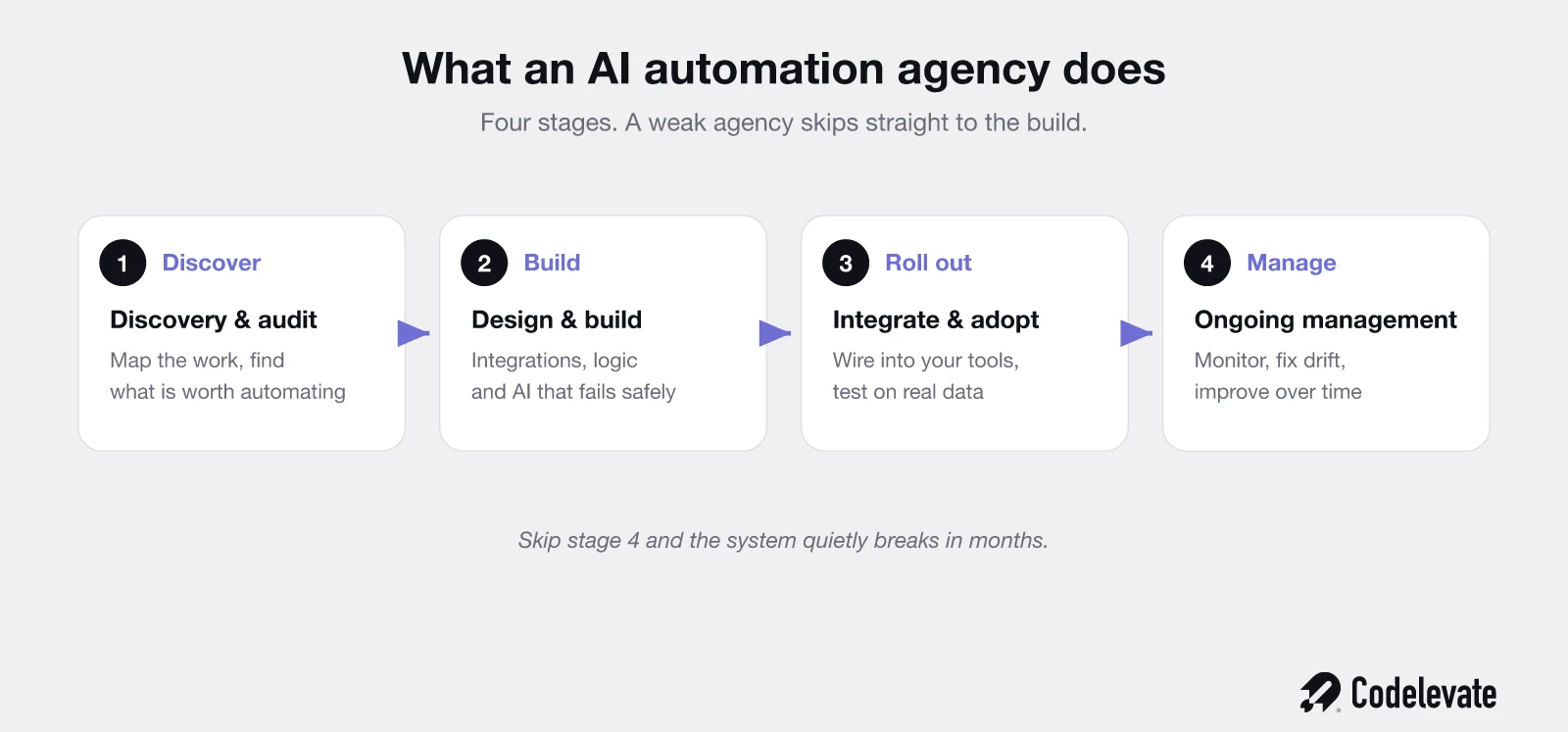
Behind the buzzword, the work breaks into four concrete stages. A good agency does all four; a weak one skips straight to building.
The first stage is discovery and audit. Before anything is built, a serious agency maps your workflows, tools, and data to find where automation actually pays off. This is the step that separates a useful engagement from an expensive toy, because the biggest wins are usually not the processes you first think of. The deliverable is a prioritised roadmap: which processes to automate, in what order, and what each is worth. It is the cheapest part of the engagement and the one that determines whether the rest succeeds.
The second stage is the build. This is designing and building the automation itself: the integrations between your systems, the logic that makes decisions, and, where it fits, the AI models or agents that handle judgment-based steps. Good builds are boring in the best way. They handle the messy edge cases, they fail safely, and they tell someone when something goes wrong rather than silently dropping work.
The third stage is integration and rollout. An automation that works in a demo is not the same as one your team trusts. This stage wires the system into the tools you already use, tests it against real data, and rolls it out with the humans who will rely on it, so it becomes part of how work happens rather than a science experiment nobody touches.
The fourth stage is ongoing management, and it is the one cheap providers quietly skip. AI models drift, APIs change, and workflows break silently over time. Someone has to monitor the system, fix it when a dependency shifts, and improve it as your process evolves. If an agency does not talk about maintenance, that is not a lower price, it is a system that will quietly stop working in a few months and take a business process down with it.
What AI automation agencies actually build
The stages above are the how. Here is the what, the kinds of systems these engagements typically produce, so the idea stops being abstract:
• Lead and customer intake that captures, enriches, routes, and replies without a person copying details between forms and a CRM.
• Document and data processing that reads invoices, contracts, or applications, extracts what matters, and files it correctly.
• Internal operations glue that moves data between the tools you already pay for, so nobody is a human integration anymore.
• Customer support agents that handle the common questions accurately and hand the hard ones to a person with full context.
• Reporting and monitoring that pulls numbers from everywhere and turns them into a plain answer, on schedule, without a manual export.
• Multi-step AI agents that own a whole process, deciding and acting across systems, with a human approving the moments that matter.
The pattern across all of them is the same: take work that is repetitive, rule-heavy, or high-volume, and let software carry it, so your people spend their time on the parts that need a human. The best first project is usually the most boring one, the task everyone hates and nobody questions.
What does an AI automation agency cost in 2026?
Pricing is where buyers most want a straight answer and most rarely get one, so here are the real ranges. Published 2026 agency pricing guides and our own engagements land in the same bands, and they follow three models.
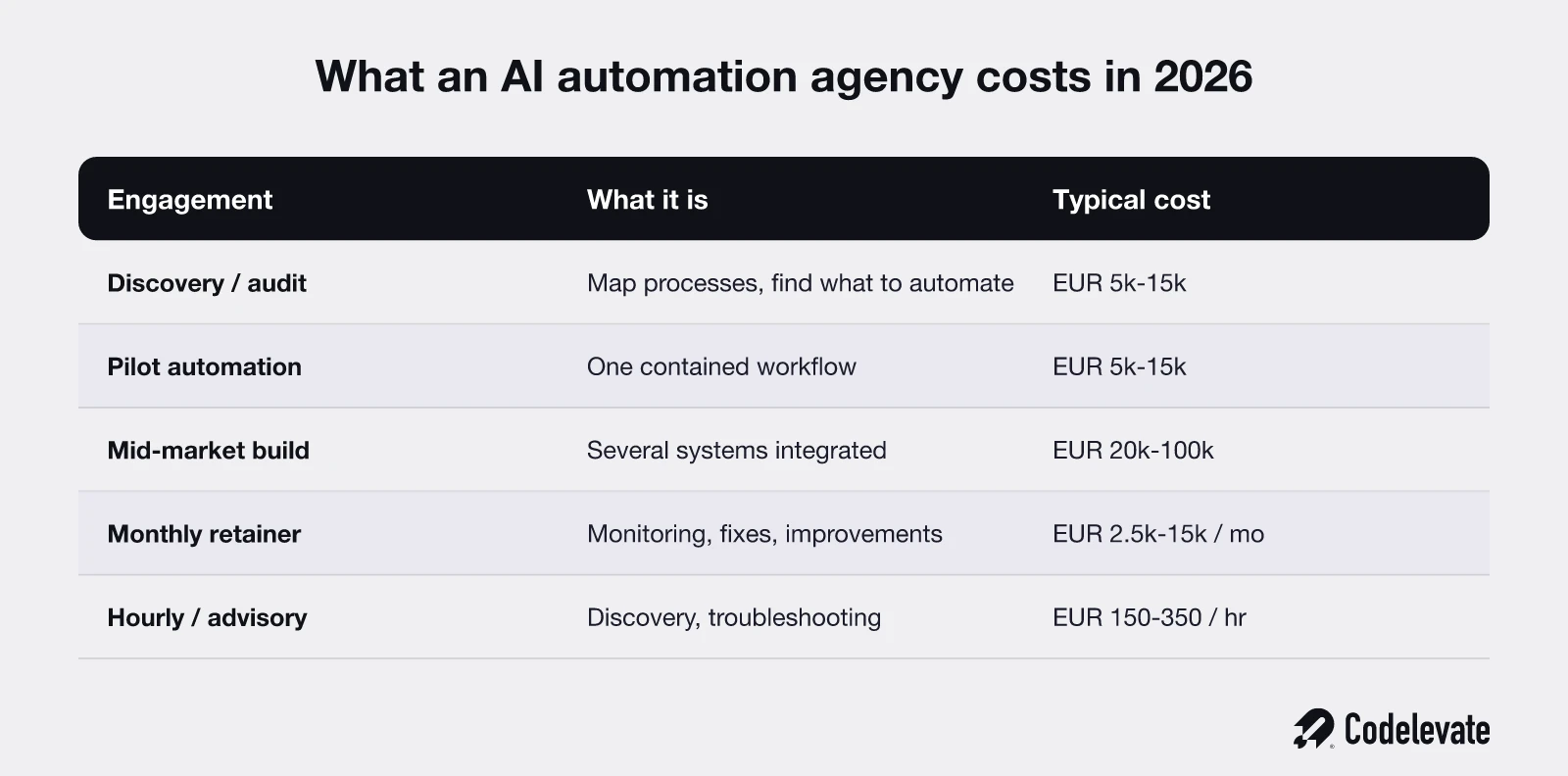
Project-based pricing is the most common. A discovery or AI readiness audit is usually 5,000 to 15,000 euros for a two-to-four-week engagement, and it is the smartest money you can spend because it tells you what is worth building. A pilot automation, one contained workflow, typically runs 5,000 to 15,000. A mid-market build that integrates several systems runs 20,000 to 100,000 depending on complexity. The range is wide because "an automation" can mean a two-day connector or a three-month agent platform, which is exactly why the audit comes first.
Retainers cover the ongoing management that keeps everything alive. These usually run 2,500 to 15,000 euros a month and cover monitoring, model tuning, fixing what breaks when an API changes, and improving the system as your process evolves. For anything that a real business process depends on, this is not optional, and an agency that does not offer it is selling you a liability.
Hourly pricing, usually 150 to 350 euros an hour, shows up for discovery, specialised troubleshooting, or small pieces of work that do not justify a project. It is fine for advisory and dangerous for open-ended builds, because nobody can predict the total. For a defined build, always prefer a fixed scope.
The honest framing on cost is this: the price of the build is small next to the price of building the wrong thing, or of a system that silently fails and nobody notices until a month of leads went nowhere. Judge an agency on whether it protects you from those two outcomes, not on the day rate.
AI automation agency vs the alternatives
An agency is one of four ways to get automation done, and it is not always the right one. The honest comparison is about speed, cost, and who owns the thing when it breaks.
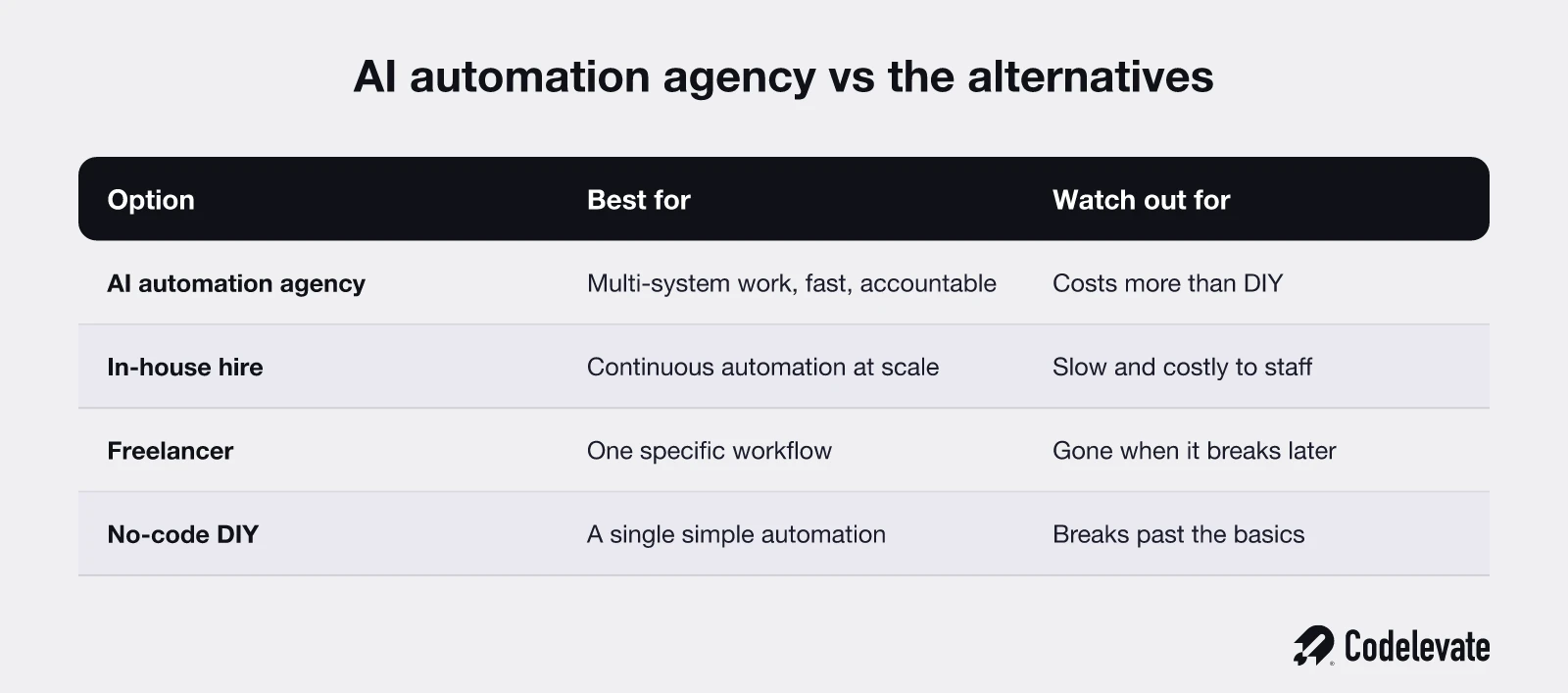
Hiring in-house gives you the most control and the deepest long-term knowledge, and it is the right end state for a company that will automate continuously. The catch is time and cost: a capable AI engineer is expensive and slow to hire, and one person cannot cover discovery, building, and maintenance across a whole company. In-house makes sense once you have enough ongoing work to keep a team busy and enough process maturity to manage them.
A freelancer is the cheapest way to build one specific workflow, and for exactly that, it can be perfect. The risk is continuity and breadth: a freelancer builds what you ask, moves on, and is rarely there when the integration breaks six months later. Freelancers are great for a contained, well-specified task and risky for anything a business depends on long term.
A no-code DIY approach, one person and a tool like a workflow builder, is genuinely the right answer for simple, single automations. If the task is "when a form comes in, add it to a sheet and send a Slack message," you do not need an agency, you need an afternoon. Agencies earn their fee when the work spans many systems, needs real judgment, has messy edge cases, or has to be reliable enough to trust with revenue.
An AI automation agency wins in the middle and upper range: when you want results in weeks rather than a year, when the work crosses several systems and needs someone accountable for it working, and when you do not yet have an in-house team to build and maintain it. That is most growing companies, most of the time, which is why the model exists.
If you want to size the opportunity before you talk to anyone, our free SaaS founder's AI blueprint walks through where AI actually pays off in a business and how to prioritise it, so you arrive at any conversation knowing what you are looking for.
How to choose an AI automation agency
The market is growing fast, which means quality varies wildly and confident marketing is everywhere. Use a short, hard checklist rather than a vibe. The agencies worth hiring will pass it easily.
• They start with discovery, not a tool. If the first conversation is about their favourite platform rather than your processes, they are selling a hammer and calling everything a nail.
• They are honest about maintenance. A partner who explains how they will keep the system alive is telling you they have done this before. One who does not is quoting you a system that will break.
• They show real work, not just logos. Ask what they have actually built, for whom, and what it now does day to day. Specifics separate builders from resellers.
• They will tell you not to automate something. The best sign of a good agency is that it kills bad ideas, including ones that would earn it money. If everything you suggest is a great fit, be careful.
• They own the outcome, not just the deliverable. The contract should make them responsible for the process working, not merely for shipping a workflow once.
• They fit your context. A local partner who understands your market, language, and regulations, for a European company that often means GDPR and Dutch or EU specifics, is worth more than a cheaper team on another continent that cannot sit in the room.
Run those six questions and most of the field disqualifies itself. What remains is a small set of partners who actually build and stand behind reliable systems, which is the only kind worth paying for.
When you should not hire an AI automation agency
This is the section most agency pages will never write, which is exactly why it builds trust. There are real cases where hiring one is the wrong move.
If you have a single, simple, well-defined automation, a no-code tool and a couple of hours will beat a project. If your processes are still changing every week, automate later, because you will pay to automate something that no longer exists by the time it ships. If you do not yet know which work is worth automating, buy a small discovery engagement first rather than a big build, and let the findings decide. And if the real problem is a broken process rather than a slow one, fix the process first; automating a bad workflow just makes the mess happen faster.
The through-line is simple. Automation multiplies whatever it is pointed at. Point it at a clear, valuable, stable process and it pays for itself. Point it at a vague or broken one and you have bought an expensive way to do the wrong thing quickly. A good agency will tell you which situation you are in before it takes your money.
How Codelevate approaches AI automation
Because we build these systems, it is only fair to show how we work rather than describe it in the abstract. We start with a short discovery to find the processes actually worth automating and to rule out the ones that are not, because the wrong target is the most expensive mistake in this work. Then we build, integrate, and roll the system out into the tools your team already uses, and we stay responsible for keeping it reliable as your stack changes.
The part that decides the outcome is judgment, not tooling. Knowing which work to automate, which to leave to people, where a human must stay in the loop, and how to make a system fail safely is what separates automation that compounds from automation that quietly rots. As an AI automation agency, that judgment, plus staying on the hook for the result, is most of what we bring. Where a project needs custom software rather than connected tools, our AI development team builds that too, so the boundary between "automate it" and "build it" is a decision we make with you, not a wall you hit.
The promise we make is the one this whole guide argues for: we will tell you what is worth automating, what is not, and what it will realistically cost and save, before you commit to a build.
The bottom line
An AI automation agency is worth hiring when you have real, repetitive work to remove, want it done in weeks rather than a year, and need someone accountable for it still working next quarter. Expect a good one to start with discovery, to be honest about maintenance, to charge in the ranges above, and to tell you when not to automate. Skip the agency when the task is a single simple workflow or your process is not stable yet. Choose on judgment and accountability, not on the day rate, because the cost of building the wrong thing dwarfs the cost of the build. Get that decision right and automation stops being a buzzword and becomes the quietest, most reliable member of your team.
Free download: our SaaS founder's AI blueprint helps you find where AI and automation actually pay off in your business. And if you want a straight answer on what is worth automating in your operation, and what it would cost and save, you can book a free call with our team and we will map it out with you, with no obligation to build.

.svg)
.svg)


