
Webflow Conf 2026 keynote: every announcement and what it means for your team
Webflow Conf 2026 opened on 2 September with the biggest platform announcement in the company's history, and a recap that lists 8 new things is going to be everywhere by tomorrow morning. This is not that. You will get the full list, accurately, and then the part the recaps skip: which of these you can actually use this month, which are demos with a date attached, and what a team running a Webflow site today should do about any of it.
The short version. CEO Linda Tong opened the keynote with an argument about who counts as a builder now. Webflow's position is that the definition has widened from designers, developers, and agencies to include marketers, and now agents. Everything announced follows from that: new surfaces for marketers, deeper access for agents, and a new platform called Source built for both.
This article is for founders, marketing leaders, and technical teams who run a Webflow site as real business infrastructure and have to decide what to adopt, what to pilot, and what to ignore for 6 months. If you are looking for a feature list to skim, the table below covers it and you can stop there without hard feelings.
Key takeaways
• Webflow announced 8 things in the opening keynote on 2 September 2026, plus more in a separate Builder keynote the same afternoon.
• Source by Webflow is the headline: a new platform where your codebase, CMS, hosting, and marketing tools sit in one environment for people and agents.
• Source is in a limited research preview. It is not something you can buy or migrate to today.
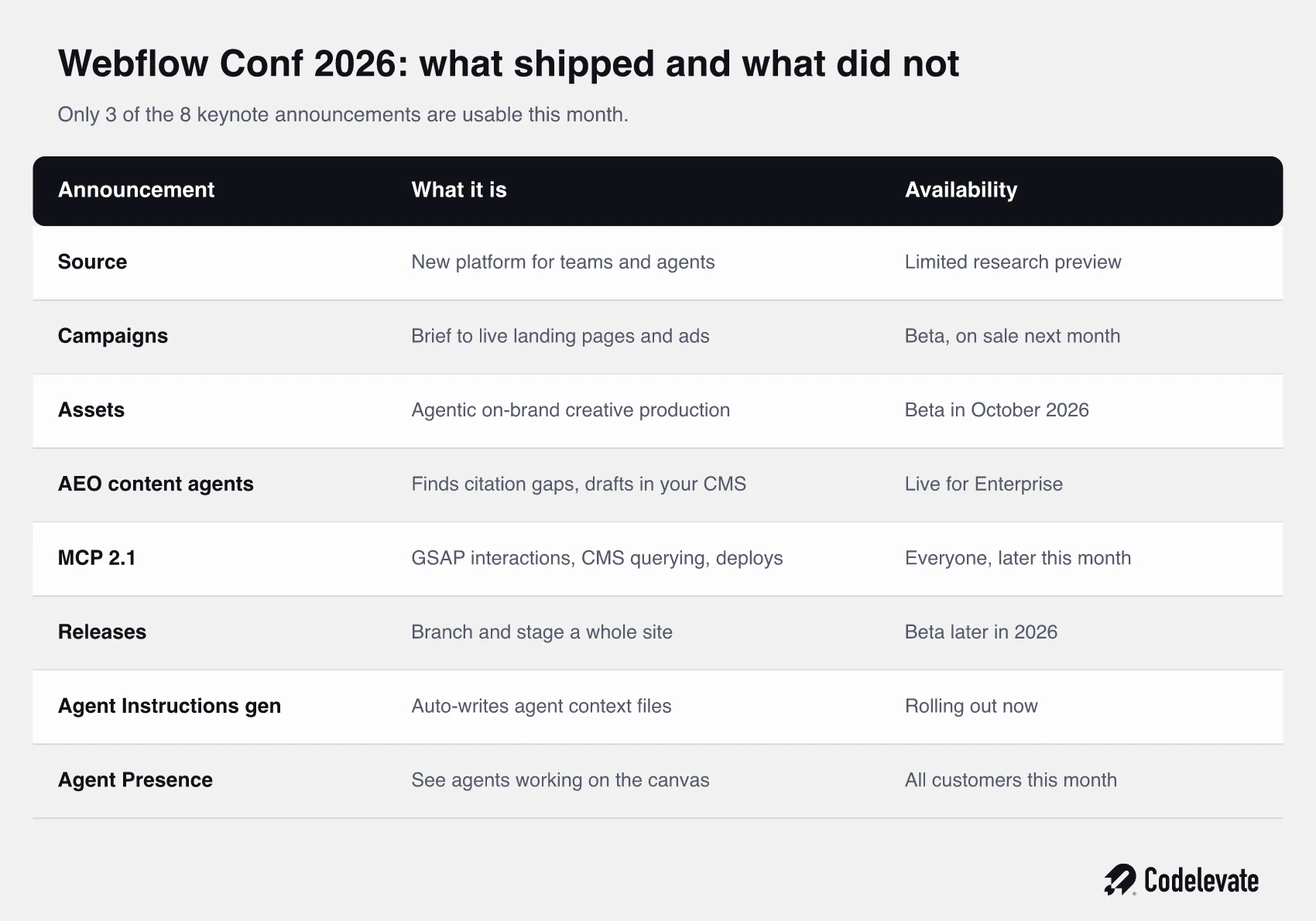
• Campaigns takes a brief to live landing pages, audience variants, and matched ad creative. Beta now, on sale next month.
• Assets is agentic creative production built on technology from Vidoso, which Webflow acquired earlier this year. Beta in October.
• MCP 2.1 adds GSAP interactions, much better CMS querying, and Webflow Cloud deploy logs for agents. It reaches everyone later this month.
• Webflow says the median company appears in 16 percent of the AI answers it would want to be part of, and is cited in only 6 percent.
• Only 3 of the 8 announcements are usable within the next few weeks. Plan accordingly rather than rebuilding your roadmap around a preview.
Watch the Webflow Conf 2026 keynote
The full opening keynote runs about 80 minutes. The presentation itself starts at 15:46 if you want to skip the pre-show, and the Campaigns demo begins around 44:20.
Source: Webflow Conf Keynote 2026 on YouTube
Everything announced at the Webflow Conf 2026 keynote
Here is the complete list from the opening keynote, with the availability Webflow stated for each. The distinction between shipping and announced matters more than usual this year, because the two biggest items are the two furthest from your hands.
Source by Webflow: the announcement that matters most
Source is a new platform for marketing teams and their AI agents, announced by Chief Product Officer Ben Haefele. In Webflow's words, it connects "your codebase and martech stack," bringing agentic and visual development into one shared environment where every marketer, designer, and developer gets a workspace shaped around the outcomes they own.
Three things about it are worth understanding properly, because they explain why this is a new platform rather than a feature release.
Code is the foundation, not an abstraction
This is the real shift. Classic Webflow gives you a visual canvas that produces code you mostly do not touch. Source inverts that: the code that ships is the source of truth, and the visual canvas writes into it. Webflow's reasoning is that code is the native language of AI, so an agent working directly on shipped code can take on larger and more complex changes, and evaluate its own work, without hitting the ceiling of an abstraction layer.
For anyone who has watched an AI tool build something beautiful and then fail to modify it sensibly, this is the right diagnosis. It also has a consequence Webflow is upfront about: this is a fundamental departure from how Webflow has historically worked.
Views: workspaces shaped per role
Views are a new primitive. Rather than one interface everybody learns, teams build dedicated surfaces for visual site building, campaigns, content, or optimization, and can create custom ones for any workflow. A growth marketer opens a Source Inbox with AEO fixes an agent has already drafted. A developer configures the guardrails deciding what ships automatically and what needs sign-off. Each workspace carries brand systems, role-based access, approval paths, and audit trails from day one.
For agencies this is the commercially interesting part. Webflow is explicit that a View built around how a client's team works can be published once, installed on every project, and sold as differentiated work.
Composable by default
Source connects to a codebase, CMS, hosting, and marketing tools you already run, including sites already built in Webflow, with no migration or rebuild required. That is a notable strategic move: Webflow is no longer requiring you to be on Webflow CMS to sell you the layer above it.
Source is in a limited research preview, with select agency partners and customers enrolled in phases over the coming months. You can apply through the form on Webflow's Source page. Read the full detail in Webflow's own Source by Webflow announcement.
New tools for marketers: Campaigns and Assets
Campaigns
Campaigns is built for performance marketers to go from a strategic spark to a live campaign in hours instead of weeks. The flow Webflow demonstrated runs like this: you give it a URL to your live site and an agent pulls your colours, fonts, and UI elements into a brand system, whether or not the site runs on Webflow. You submit a brief and an agent helps refine audience, message, and channel. It then generates a primary landing page plus variants per audience, account, or keyword, generates matching ad creative, and pushes pages and ads into channels like Google Ads. Once live, it tracks conversions, connects to HubSpot or Salesforce for pipeline, and recommends iterative page changes.
Campaigns is in beta and goes on sale next month. Of everything announced, this is the one most likely to change a marketing team's week within this quarter.
Assets
Assets is an agentic way to produce and adapt on-brand creative inside Webflow, built on technology from Vidoso, a company Webflow acquired earlier this year. Its agents find and adapt approved assets across channels, including cutting a full-length video down, trimming filler words, and adding captions for social. The point Webflow makes is about context: generic AI tools produce assets that drift from your brand because they do not know your design system, brand variables, asset library, or what has performed. Assets enters beta in October.
Get the Webflow launch checklist we use
If any of this makes you want to rebuild or relaunch, our free Webflow launch checklist is the 70-point process we run before a client site goes live, covering SEO, performance, accessibility, CMS structure, and the things teams forget until the week after launch. Free, no strings.
Webflow AEO
The most quotable statistic of the keynote came from Webflow's own research. It analysed the websites of 2,000 companies and found the median company appeared in 16 percent of the AI answers it would want to be part of, and was cited in those answers only 6 percent of the time. If you have been treating answer engine optimization as next year's problem, that is the gap you are carrying.
Webflow AEO pulls data from ChatGPT, Claude, Gemini, and Perplexity so you can see where you are mentioned, where you are cited, and who is getting cited instead of you. Because hosting and analytics sit in Webflow, it also shows what AI bots find interesting on your site, how many visitors the models refer, and how well those visitors convert. Agents then queue prioritised recommendations your team reviews, approves, edits, or rejects.
New at Conf: content creation agents that find topics where competitors get cited and you do not, then write the brief and draft original content directly in your CMS. Agents that refresh existing content are coming in the following months, and external agents will eventually reach AEO data through the Webflow MCP. AEO agents are on by default for Enterprise customers.
Webflow also states that AEO customers get 70 percent more mentions and 120 percent more citations than non-Webflow brands. Read that one carefully. Webflow's own footnote calls it a directional finding from internal data covering 158 customers who accepted recommendations against 187 who did not, measured between 19 May and 13 July 2026, and says it does not isolate AEO recommendations from other traffic drivers. It is a real signal, not a controlled result. If you want the mechanics behind why this works at all, our complete guide to answer engine optimization goes deeper than a product page can.
Building with agents: MCP 2.1, Releases, Instructions, and Presence
This group got less stage time and will matter more to most teams over the next 90 days, because it is the part that actually ships.
MCP 2.1
Webflow MCP 2.0 shipped over the summer and gave agents in Claude, ChatGPT, and Slack access to design systems, component props and variants, and Webflow Analyze data. MCP 2.1 adds three things. Interactions with GSAP means you can prompt an animation and your agent builds it, including complex timeline-based work, while keeping the visual controls for timing. CMS querying gets substantially better: agents can now sort and filter on custom fields, search across reference fields, and page through results, which turns multi-step content audits into single requests and cuts token burn. And Webflow Cloud deploy errors now surface to agents, so Claude Code, Codex, or Cursor can work the issue and redeploy rather than sending a developer back and forth to the dashboard.
MCP 2.1 reaches everyone later this month, with expanded access to AEO Analytics and Webflow Optimize planned before year end.
Releases
Releases lets large teams branch an entire site, including pages, CMS content, components, assets, and locales, then stage the work before it goes to production. A Release Manager tracks what has been updated, who is working on it, and where it stands, and shipped releases can be pulled into open branches to keep things in sync. Agents can contribute inside a release and are subject to the same roles and permissions as teammates at merge time. Beta later this year.
If you have ever staged a site-wide rebrand across a live Webflow site, you already know why this exists.
Agent Instructions generation
Agent Instructions launched over the summer and let teams write context files covering design system documentation, SEO guidelines, form governance, and more. The problem was that writing good context is slow. Webflow can now generate those instructions for you, with templates for brand guidelines, design system, asset guidelines, and CMS content, pulled from what Webflow already knows about your site. The generated markdown is editable and regenerable as the site changes. This started rolling out on keynote day.
Agent Presence
Agent Presence shows where an agent is working live on the canvas, the same way you see a teammate, so you stop colliding mid-edit or publishing over unfinished agent work. Available to all customers later this month.
What this actually means if you run a Webflow site today
Strip out the keynote framing and 3 practical conclusions hold up.
First, nothing breaks and nothing is urgent. Webflow was direct that the existing platform is not going anywhere and that investment continues, including agentic features. If you migrate to Source later, Webflow says there will be a supported path. Nobody needs an emergency roadmap meeting about this.
Second, the centre of gravity has moved to code and agents. That is a genuine strategic signal even if you never touch Source. A platform betting its next decade on code as the source of truth is telling you where component quality, clean CMS structure, and written conventions are going to pay off. Teams whose Webflow build is a tangle of one-off classes and undocumented decisions will get less out of every agent feature on this list, because agents inherit the mess.
Third, the AEO number is the one to act on this quarter. Appearing in 16 percent of relevant AI answers and being cited in 6 percent is not a niche problem, and unlike Source it is measurable and addressable now.
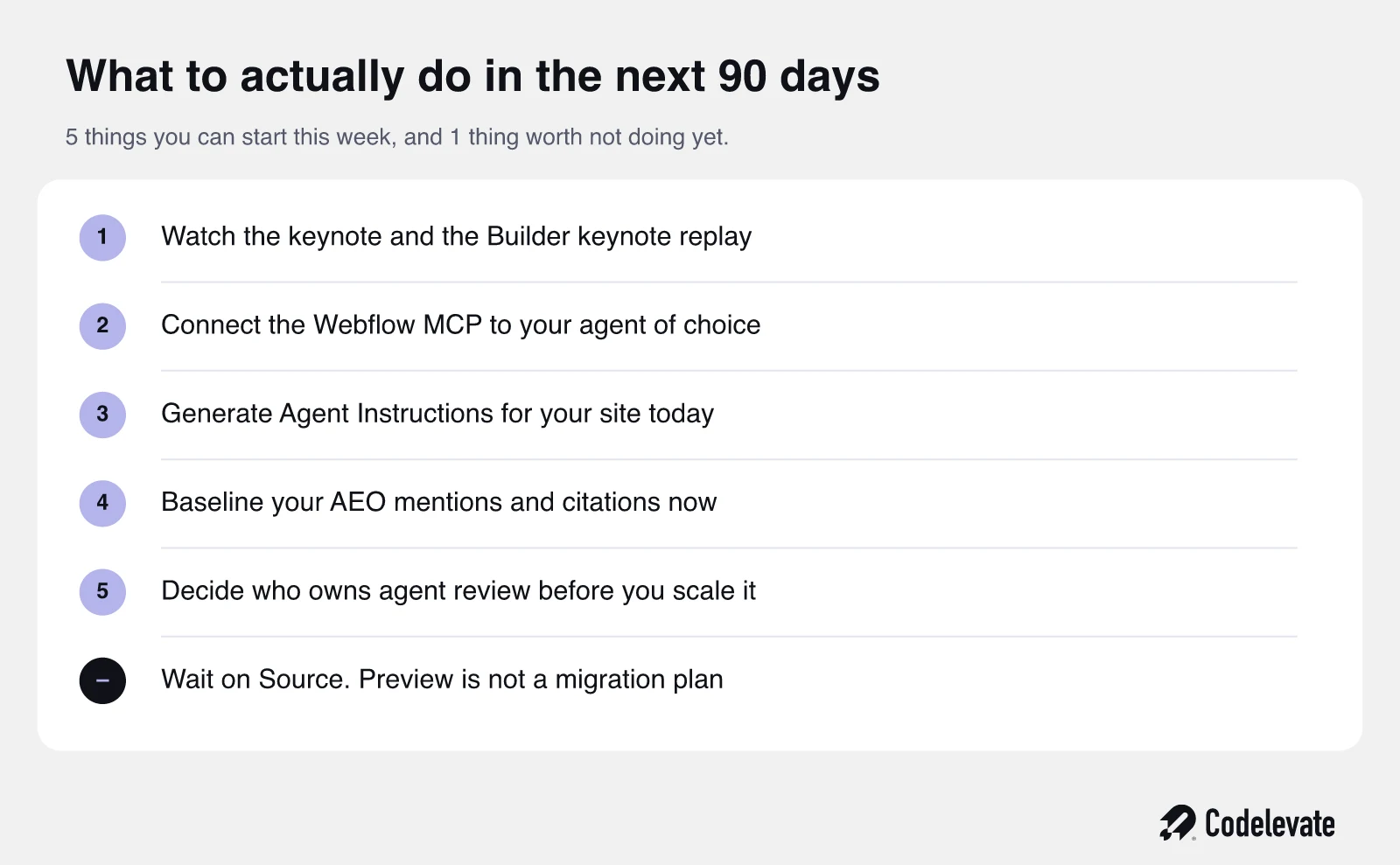
What we would do in the next 90 days
Concretely, in the order we would do it.
• Connect the Webflow MCP to whichever agent your team already uses, and give it a real job such as a CMS audit. The 2.1 querying improvements make this genuinely useful rather than a demo.
• Generate Agent Instructions for your site this week. It is available now, it takes an afternoon, and every agent feature Webflow ships from here reads that context. This is the highest-return item on the list.
• Baseline your AEO position before you change anything. You cannot tell whether any of this worked without a starting number for mentions and citations.
• Decide who reviews agent work before you scale it. Agent Presence and Releases both assume somebody owns the review. If that person does not exist, the tooling will not save you.
• If you run paid campaigns at volume, put Campaigns on the list to trial when it goes on sale next month, on 1 campaign, against your current process, with an honest comparison of quality not just speed.
• Do not restructure anything around Source yet. A limited research preview is not a migration plan, and the sensible move is to register interest and keep building.
How we read this at Codelevate
We are a Webflow Certified Professional Partner and we already build with the Webflow MCP connected to Claude, so this keynote landed close to how we work. Our honest read is that Webflow has correctly identified the problem. Getting to a first version fast stopped being hard about a year ago. What is still hard is everything after: governance, review, brand consistency at volume, and knowing which change actually moved a number. Source is a serious attempt at that, and the decision to build on real code rather than an abstraction is the right call even though it makes migration a genuine question later.
The risk is the usual one with platform announcements. Teams hear a vision, pause current work, and wait for a preview that reaches them in stages over months. The teams that get value from this year will be the ones that adopt the boring available things now, MCP 2.1, Agent Instructions, AEO measurement, and keep shipping while Source matures.
If you want a second opinion on your specific setup, our Webflow development team looks at builds like yours every week.
Webflow Conf 2026 is not over
The opening keynote was the first act. Webflow held its first Builder keynote the same afternoon with announcements aimed at designers, developers, and content creators that did not fit the main stage, plus a Source deep dive, a session with Webflow CPO Ben Haefele and Anthropic's Head of Applied AI Alon Krifcher on enterprises getting real value from AI, a marketing leadership panel, and a fireside chat with Wharton professor Ethan Mollick. Webflow says all sessions will be available on demand early next week, and we will update this article as more ships.
The short version
Webflow Conf 2026 announced 8 things, and the honest split is that 3 of them touch your work this month while the 2 biggest are previews. Source is a credible rethink of how marketing teams and agents build together, and it is worth understanding now and adopting later. Meanwhile MCP 2.1, Agent Instructions, and AEO measurement are sitting there available, and they are where the return is between now and the end of the year.
If you are planning a build or relaunch off the back of this, take the free Webflow launch checklist into your planning session so the fundamentals are covered before you add agents on top.

And if you want to work out which of these features are worth adopting on your site, and which are noise for your stage, book a free call with our team. Full details of every announcement are in Webflow's own Conf 2026 recap.


.svg)
.svg)


