
CTO survey: Main pain points and issues in 2026
In 2026, Chief Technology Officers (CTOs) face a rapidly evolving technology landscape. As leaders of technological innovation and implementation within organizations, CTOs are tasked with balancing strategic vision with operational demands. According to recent surveys and research from organizations like Deloitte and McKinsey, there are several key pain points and issues that CTOs are grappling with today. From navigating complex cybersecurity challenges to managing talent shortages, CTOs are under increasing pressure to deliver cutting-edge solutions while maintaining efficiency and security.
This article delves into the critical pain points CTOs are facing in 2026, backed by data from recent surveys and industry research. We will discuss the top concerns, their impact on businesses, and how CTOs can address them to ensure the successful growth of their organizations.
1. Talent shortages and skill gaps
According to a 2025 Deloitte Global CIO Survey, 63% of CTOs report that talent shortages are a significant challenge. As technology continues to evolve at a rapid pace, finding skilled professionals to meet the growing demand for emerging technologies such as AI, cloud computing, and cybersecurity has become increasingly difficult. This shortage is particularly acute in areas like AI and data science, where specialized knowledge is required.
The demand for tech talent is not only high but also highly competitive. Companies are vying for the same talent, leading to increased wages and difficulties in retaining employees. Many CTOs are now facing the dual challenge of hiring new talent while retaining existing staff, particularly in an environment where remote work and flexible work arrangements have become the norm.
How CTOs can address this:
- Upskilling current employees: Encouraging continuous learning and offering professional development programs can help bridge the skill gap. Platforms like Coursera and Udacity can provide training in critical areas like AI and cloud computing.
- Outsourcing and partnerships: Many CTOs are turning to outsourcing as a way to access specialized talent without the burden of recruitment. Outsourcing development to trusted partners can help meet project demands without the need for a full in-house team.
2. Cybersecurity risks and data privacy
As businesses increasingly rely on digital infrastructure, cybersecurity has emerged as one of the top concerns for CTOs. A 2026 report by McKinsey found that 74% of CTOs believe cybersecurity threats are growing in sophistication and frequency. Cyberattacks, data breaches, and ransomware attacks are more prevalent than ever, making it essential for CTOs to have robust security protocols in place.
Data privacy regulations, such as the General Data Protection Regulation (GDPR) in Europe and the California Consumer Privacy Act (CCPA), have added another layer of complexity. Ensuring compliance with these regulations while maintaining the security of sensitive customer data is a challenge that requires constant vigilance.
How CTOs can address this:
- Implementing multi-layered security systems: Using tools like Okta for identity management and CrowdStrike for endpoint protection can help secure company networks.
- Employee training and awareness: Educating employees about the risks of phishing and social engineering attacks can reduce human error, which is often the weakest link in security.
- Regular security audits: Regular audits and vulnerability testing are essential to identify weaknesses before they can be exploited by cybercriminals.
3. Managing technological change and innovation
The speed of technological change continues to accelerate, and CTOs are under pressure to adopt new technologies to stay competitive. A 2025 Gartner survey revealed that 68% of CTOs believe staying ahead of technological advancements is one of their biggest challenges. Emerging technologies such as AI, machine learning, blockchain, and quantum computing are rapidly changing the business landscape, and CTOs are tasked with understanding their potential applications and integration into existing systems.
However, the adoption of new technologies comes with its own set of challenges. From high implementation costs to the complexity of integrating with legacy systems, CTOs need to carefully evaluate each new technology and decide if it aligns with their business goals.
How CTOs can address this:
- Strategic planning and pilot testing: Before fully committing to a new technology, CTOs should invest in pilot programs and proofs of concept to assess feasibility and ROI.
- Collaboration with vendors and consultants: Partnering with tech vendors who specialize in emerging technologies can provide valuable insights and reduce the risks associated with adoption.
- Fostering a culture of innovation: Encouraging experimentation and a willingness to embrace new ideas can help CTOs stay ahead of the curve in terms of innovation.
4. Cloud migration and infrastructure management
Cloud migration continues to be a significant focus for many organizations. According to the 2026 report by McKinsey, 55% of CTOs consider cloud adoption to be a top priority for their businesses. While the benefits of cloud infrastructure—such as cost savings, scalability, and flexibility—are well-documented, the process of migrating from on-premise systems to the cloud is not without challenges.
Data migration, integration with existing systems, and the management of cloud security and compliance all require significant resources and expertise. Moreover, managing hybrid cloud environments, where some workloads are still on-premise while others are in the cloud, can create additional complexity.
How CTOs can address this:
- Choosing the right cloud provider: Working with trusted providers like AWS, Google Cloud, and Microsoft Azure can simplify the migration process and ensure a seamless transition.
- Cloud cost optimization: Tools like CloudHealth help monitor cloud usage and optimize costs.
- Hybrid cloud management: Adopting a hybrid cloud strategy with integrated management platforms can ensure smooth operations across different environments.
5. Budget constraints and financial pressure
With increasing pressure to deliver results and achieve business objectives, CTOs must often work within tight budget constraints. A 2026 KPMG survey found that 49% of CTOs are concerned with balancing innovation and technology investments while keeping costs under control. As technology budgets are scrutinized, CTOs need to find ways to maximize ROI and ensure that investments align with the organization's long-term strategic goals.
Additionally, with rising costs of talent and technology, it’s becoming more challenging for CTOs to maintain or increase budgets for innovation and infrastructure.
How CTOs can address this:
- Prioritize high-impact initiatives: Focusing on projects that drive significant business value or operational efficiency can help justify tech spend.
- Leveraging open-source tools: Open-source technologies can provide robust solutions at a lower cost, allowing CTOs to save resources while maintaining high-quality infrastructure.
- Agile budgeting: Implementing agile budgeting practices, where budgets are allocated based on iterative progress, allows for flexibility and adaptation to changing business needs.
6. Business-IT alignment
Ensuring that the IT strategy aligns with the broader business strategy is another challenge that many CTOs face. According to McKinsey’s 2025 IT Alignment Report, 62% of CTOs reported that aligning IT initiatives with business goals was a significant pain point. CTOs need to work closely with other C-level executives to ensure that technology investments are in sync with the overall vision and goals of the organization.
This alignment is crucial for ensuring that technology is seen as a business enabler rather than just a cost center. CTOs must demonstrate the value of technology to the bottom line and ensure that technology projects support the company’s mission.
How CTOs can address this:
- Collaborate with business leaders: Regular communication with other executives, including the CEO, CFO, and COO, ensures that the technology strategy is aligned with the company’s goals.
- Measure business impact: Tracking and reporting on the business outcomes of technology initiatives can demonstrate the value of IT investments to the organization.
- Cross-functional teams: Building cross-functional teams that include both IT and business leaders can help foster collaboration and ensure alignment across departments.
Common CTO personas
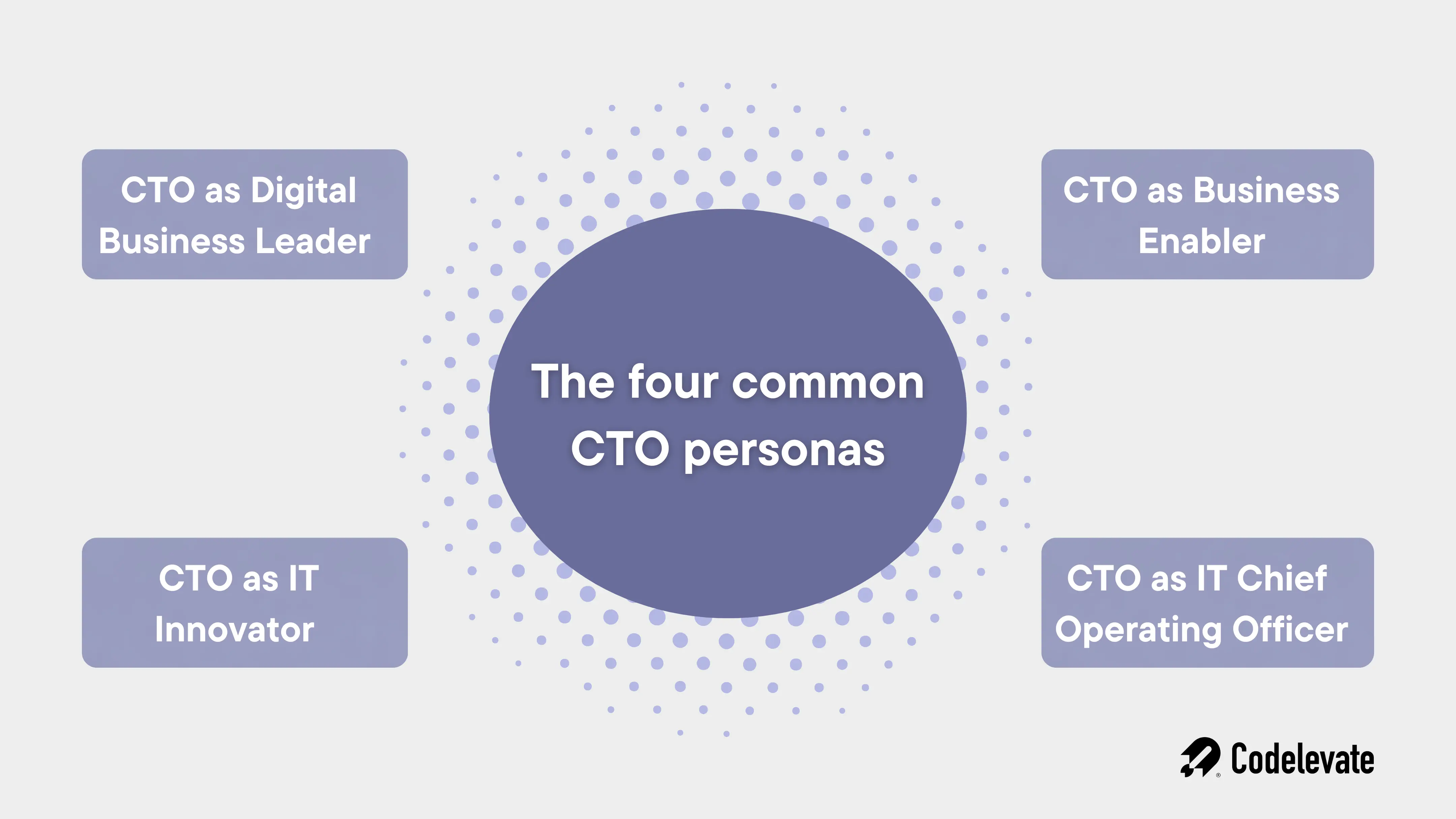
In most organizations, the CTO plays a dual role: part visionary strategist, part operational leader. They evaluate how emerging technologies can be applied to drive new ways of working, open revenue opportunities, and strengthen competitive advantage. Beyond identifying innovation paths, the CTO is also responsible for translating these ideas into execution. This often means overseeing implementation, managing technical operations, and ensuring new systems integrate smoothly with existing infrastructure. Because of this broad mandate, effective CTOs combine deep technical expertise with strong industry knowledge. They understand the practical realities of the business, can design the technological foundation to support strategic goals, and are able to communicate the value of innovation across the organization. Their responsibilities typically span managing current tech stacks, representing the company externally on technology matters, staying ahead of emerging trends, and collaborating with the executive team on budgets, priorities, and long-term direction. Ultimately, the CTO shapes how technology influences key business decisions and future growth.
Why CTOs choose to outsource software development
As technology accelerates and solutions like AI, machine learning, and cloud platforms become central to business strategy, CTOs increasingly face pressure to deliver more with limited internal capacity. Implementing modern architectures, scaling products, and maintaining operational stability often requires skills that are difficult to hire quickly, especially in competitive talent markets. Outsourcing becomes a practical response to these realities. Common drivers include limited local talent availability, the need to optimize development costs, and the desire to reduce operational load so internal teams can focus on higher-level strategic initiatives. For many organizations, partnering with external specialists offers the flexibility, expertise, and speed needed to adopt new technologies without overextending internal resources.
Conclusion
The role of a CTO in 2026 is more challenging than ever, with issues like talent shortages, cloud migration, cybersecurity risks, and budget constraints. By addressing these head-on, CTOs can drive innovation and ensure long-term success. Staying proactive, embracing new technologies, and aligning IT with business goals is key to overcoming these challenges and thriving in a fast-paced tech landscape.





.svg)
.svg)


