
How to integrate AI into your business in 2026
The world of business is rapidly evolving, and the key to staying ahead of the competition in 2026 lies in the smart and strategic integration of AI into your operations. Whether you run a small startup or an established enterprise, AI is no longer a futuristic tool – it’s a present-day necessity. The good news is that AI isn’t just for big corporations with massive budgets. With the right approach, businesses of all sizes can unlock AI’s potential to improve efficiency, make data-driven decisions, personalize customer experiences, and reduce costs.
However, integrating AI into your business isn't as simple as purchasing a tool and turning it on. To truly harness the power of AI, companies need a well-thought-out strategy that focuses on clear business outcomes, the right technology stack, and the ability to scale. This guide will walk you through the essential steps to integrate AI into your business in 2026, highlighting the latest trends and best practices to ensure successful adoption.
Why AI is essential for businesses in 2026
In 2026, businesses are at a tipping point where AI adoption has gone beyond novelty and is now seen as a competitive necessity. Early adopters of AI are already using it to streamline operations, enhance customer experience, and drive profitability. But for many, the journey from initial AI experimentation to full-fledged integration is filled with challenges. AI isn’t just about implementing machine learning models or buying a chatbot for customer service. It's about strategically using AI to solve real business problems, whether that’s reducing operational costs, increasing customer retention, or improving decision-making. Businesses that are winning with AI are not just adopting the technology – they are integrating AI into the very fabric of their operations. Companies are rethinking how they create value, moving from traditional methods to AI-powered solutions that deliver measurable results.
Let’s dive into the key strategies to effectively integrate AI into your business in 2026.
Key AI business trends for 2026
AI in business has evolved significantly over the last few years. By 2026, it’s no longer just about AI for automation or customer service chatbots. Instead, businesses are using AI to drive product innovation, redefine workflows, and enhance personalized experiences at scale. Here are some key trends in AI business integration that you should be aware of:
1. Generative AI in core business functions
Generative AI is expanding beyond simple tasks like drafting emails or creating basic content. Now, it is helping businesses develop marketing campaigns, create personalized product recommendations, draft legal documents, and even write code. Many businesses are using AI not just for process automation, but to innovate their product and service offerings. Generative AI tools such as OpenAI and ChatGPT are helping companies innovate faster and more efficiently.
2. AI agents: Your digital workforce
AI agents are becoming the new digital workers, capable of handling complex tasks that were once reserved for humans. These agents can manage customer support tickets, handle data entry tasks, and even make decisions based on context. With AI agents, businesses can reduce human error, save time, and improve efficiency.
3. Hyper-automation of business processes
In 2026, automation isn't just about replacing manual tasks. It's about rethinking entire workflows, using AI to optimize processes at every level. This means AI can enhance everything from supply chain management to HR processes and customer service. The result? Significant increases in operational efficiency and a major reduction in operational costs. For example, companies in logistics have reduced delivery times by 22% and cut fuel consumption by 15% thanks to AI-driven automation.
4. Industry-specific AI solutions
As AI technology matures, we’re seeing a shift toward more specialized, industry-specific AI tools. Whether it’s AI for predictive diagnostics in healthcare, personalized recommendations in retail, or fraud detection in finance, companies are relying on AI tailored to their industry to solve domain-specific challenges. Industry-specific AI is more capable of delivering measurable results because it understands the nuances of each sector.

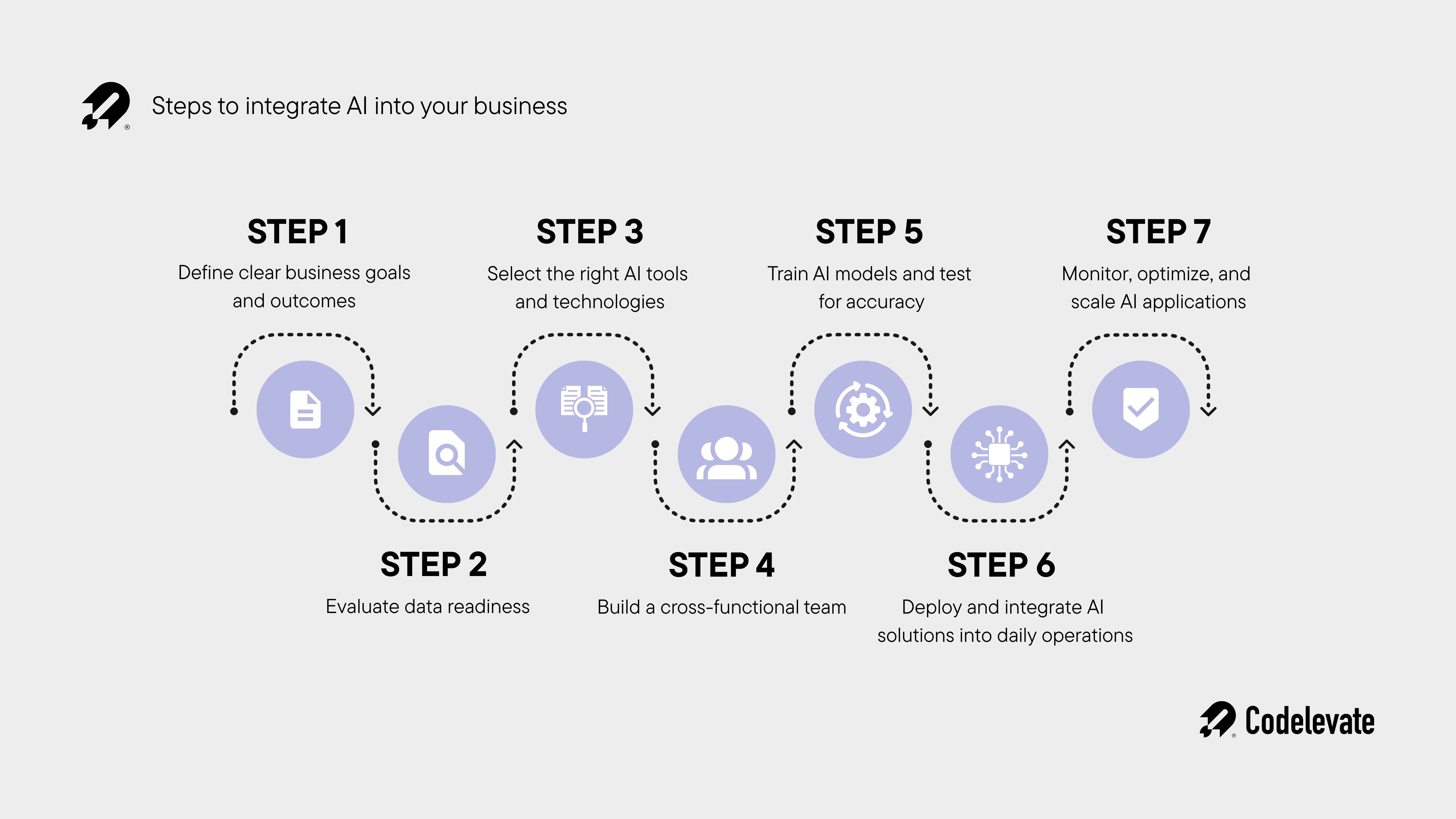
Steps to integrate AI into your business
Now that we’ve covered why AI is essential and the latest trends, let’s look at how you can start integrating AI into your business in 2026.
Step 1: Define clear business goals and outcomes
The first step in successfully integrating AI is to establish clear business goals. Without clear objectives, AI can quickly turn into an experiment that doesn’t deliver measurable results. Start by identifying the specific problems or opportunities that AI can help with, such as:
- Reducing operational costs
- Improving customer acquisition and retention
- Enhancing decision-making with data-driven insights
- Automating repetitive tasks to free up employee time
For instance, a retail business might use AI to analyze customer behavior and personalize product recommendations, while a logistics company could leverage AI to optimize its delivery routes and improve efficiency.
Step 2: Evaluate data readiness
AI relies on data to generate insights, so data readiness is a critical component of AI integration. Many businesses overlook this step, but it’s essential to ensure that your data is clean, structured, and accessible. Assess your current data infrastructure and make sure that data can flow seamlessly between systems. You may need to invest in data management tools or integrate AI into your existing data pipeline to ensure accuracy and reliability.
Step 3: Select the right AI tools and technologies
Once you’ve established your goals and evaluated your data readiness, it’s time to choose the right AI tools. Depending on your business needs, you might opt for tools that offer:
- Machine learning for predictive analytics
- Natural language processing for customer support chatbots
- Computer vision for inventory management
- Generative AI tools for content creation
When selecting AI tools, look for solutions that align with your business objectives and integrate well with your existing systems. Cloud platforms like AWS AI or Google Cloud AI offer scalable AI solutions that can be tailored to your needs.
Step 4: Build a cross-functional team
AI integration requires a cross-functional team with diverse expertise. In addition to data scientists and engineers, you’ll need business leaders who understand the strategic value of AI. Building a team that includes both technical and operational expertise will ensure smoother collaboration and faster implementation.
Step 5: Train AI models and test for accuracy
Once your team is in place, it’s time to train your AI models. This involves feeding your AI system with historical data and allowing it to learn from patterns. Be sure to test your models to ensure they are producing accurate predictions or insights. AI is an iterative process, so don’t expect perfection right away—continually refine your models to improve their performance over time.
Step 6: Deploy and integrate AI solutions into daily operations
The goal of AI integration is not just to implement a standalone system but to embed AI into your everyday business processes. For example, AI-driven chatbots should be integrated into your customer service workflow, or predictive analytics tools should become part of your supply chain management process.
Seamless integration into existing workflows is critical to achieving the maximum value from your AI investments. Work closely with your IT and operational teams to ensure smooth deployment.
Step 7: Monitor, optimize, and scale AI applications
AI doesn’t stop evolving after deployment. It’s important to continually monitor AI performance to ensure it’s meeting your business goals. Use analytics tools to track how well AI is performing and identify areas for improvement. Over time, you’ll find opportunities to scale your AI solutions to other areas of your business.
Overcoming challenges in AI integration
While integrating AI into your business offers incredible opportunities, there are challenges you’ll need to overcome. Here are some common obstacles and how to address them:
1. Data quality and accessibility
AI can only perform as well as the data it’s trained on. If your information is incomplete, inconsistent, or siloed across teams, AI models will return poor or misleading insights. Establish strong data governance, ensure datasets are clean and structured, and make key information easily accessible to AI systems.
2. Change management & team adoption
Introducing AI often triggers concern or resistance among employees who may fear job displacement. The solution is transparent communication and ongoing education – show your teams how AI removes repetitive tasks, supports decision-making, and frees them to focus on higher-value, strategic work.
3. Security, compliance & risk management
AI tools can introduce new security gaps if not properly managed. Protect your organization by implementing strict access controls, encryption, and continuous monitoring. Ensure all AI systems comply with industry standards and privacy regulations to safeguard customer and business data.
4. Integration complexity & operational alignment
AI isn’t plug-and-play – systems often struggle to integrate smoothly with existing workflows, tools, or legacy technologies. Plan for scalable infrastructure, align AI use cases with operational processes, and work cross-functionally so the technology enhances (not disrupts) daily work.
Conclusion
Integrating AI into your business in 2026 is no longer an option – it’s a necessity for staying competitive. By following a structured approach, from defining clear business goals to selecting the right AI tools and continuously optimizing your solutions, you can unlock the true potential of AI to drive growth, improve efficiency, and enhance customer satisfaction. Remember that successful AI integration requires both the right technology and a strategic mindset. By focusing on clear outcomes, building a cross-functional team, and embracing industry-specific AI solutions, businesses of all sizes can use AI to create real, measurable value. In 2026, AI is the future – make sure you’re ready to lead the way.





.svg)
.svg)


